Steel Whisper
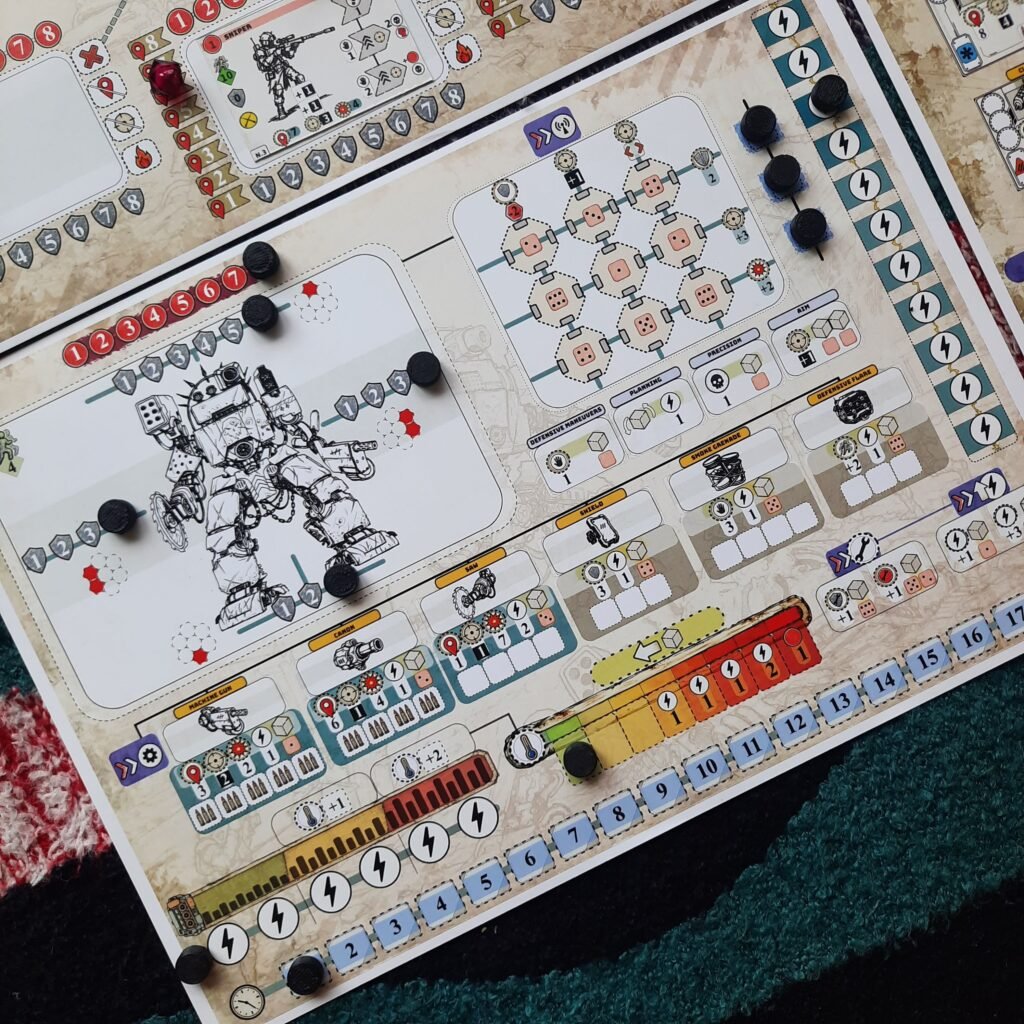
The Great War is over.
And one of the last cities standing is now ruled by what remains of the old military, and the resistance has exactly ONE machine left to throw at them.
Steel Whisper. A legendary combat mech dragged out of the ruins. But it’s nowhere near its prime form.
Its systems are worn out and damaged. Its power is limited, and you can’t keep everything running at full strength at once. Push one system harder and something else has to give.
And while you’re trying to hold this machine together, the enemy is moving, aiming, firing, and increasing in numbers…
Can Steel Whisper take them on?
Entry: before playing the game
First impression
This is the 6th print-and-play of Radek that I’m getting to play, and if you’ve read my blogs before, then you probably know his style by now. Building a system where one thing feeds into another, then pairing it with an interesting theme. Building civilizations, surviving the wilderness, conducting operations in an OT, you name it.
The whole premise of Radek letting us pilot a mech in Steel Whisper is quite exciting. Pacific Rim and Ready Player One immediately come to mind. The fact that this game is gonna throw us straight into battle is the other wow-factor, at least from what I understood after talking to Radek:
“In Steel Whisper, I decided to focus primarily on the battle itself. No unnecessary interruptions and no additional systems that distract from the core of the game.”
So no buildups. Straight to the action it is!
You can read Radek’s full journey behind creating Steel Whisper if you’re interested.
So, what’s gonna happen in the battle?
A bit on the game
Steel Whisper starts with a Mission Card that tells you what you’re up against, where the enemies emerge, and when more of them are gonna show up.
From there, you roll six action dice and draw a Control Card. Those dice are basically what you have to work with for the turn, letting you move, rotate, set up sensors, use weapons, repair the mech, cool the reactor, and bring more equipment online.
Movement changes your distance from enemies, facing determines what you can shoot at and which side of your armor is exposed, and almost everything costs energy. Push the mech too hard and the reactor starts heating up, which is not a good thing at all.
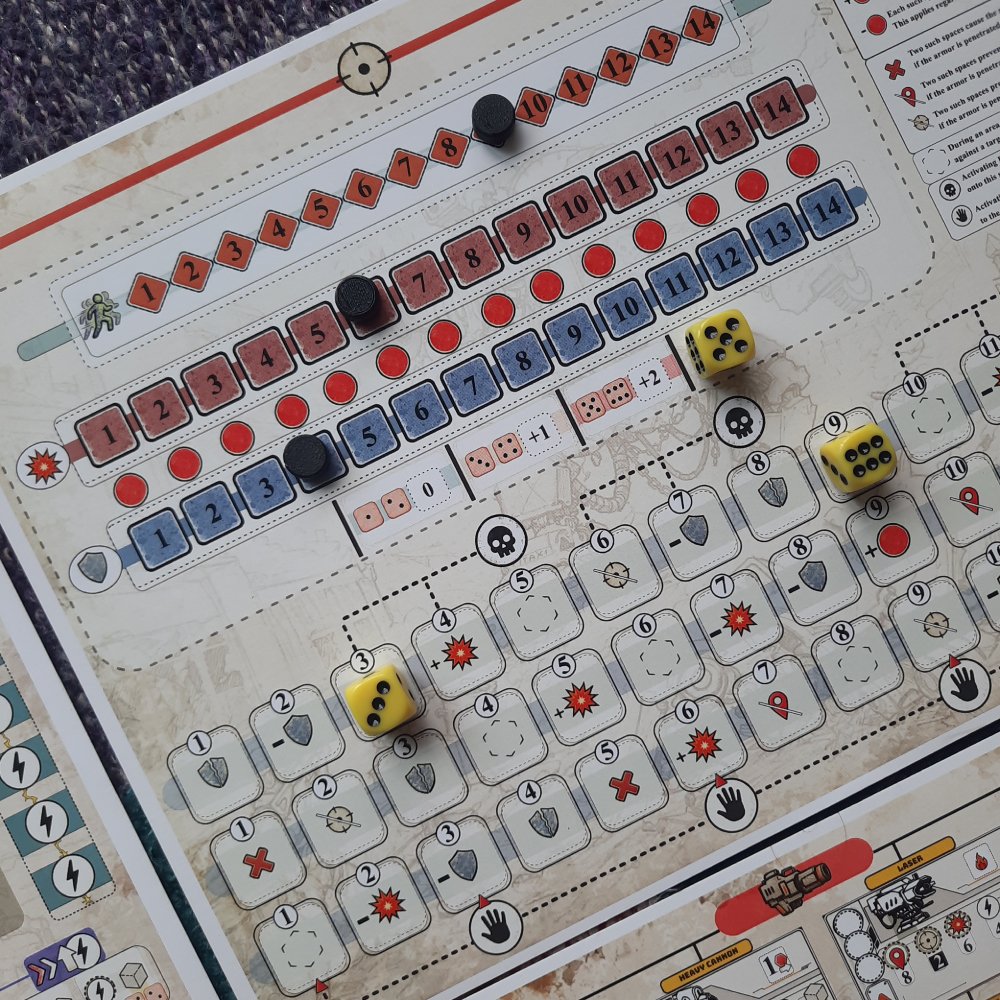
Combat has a few more layers: range affects how difficult a shot is, accuracy determines how many dice you roll, and then armor, attack power, precision, and different effects can change what actually happens once you hit.
Once you’re done, enemies take their turn too, moving, aiming, attacking, or carrying out whatever action is next for them. Then the mission clock moves forward, and you do it all again.
That’s the basic loop. There’s more going on with advanced equipment, ammunition, sensors and different enemy effects, but we’ll get into the relevant bits as they come up.
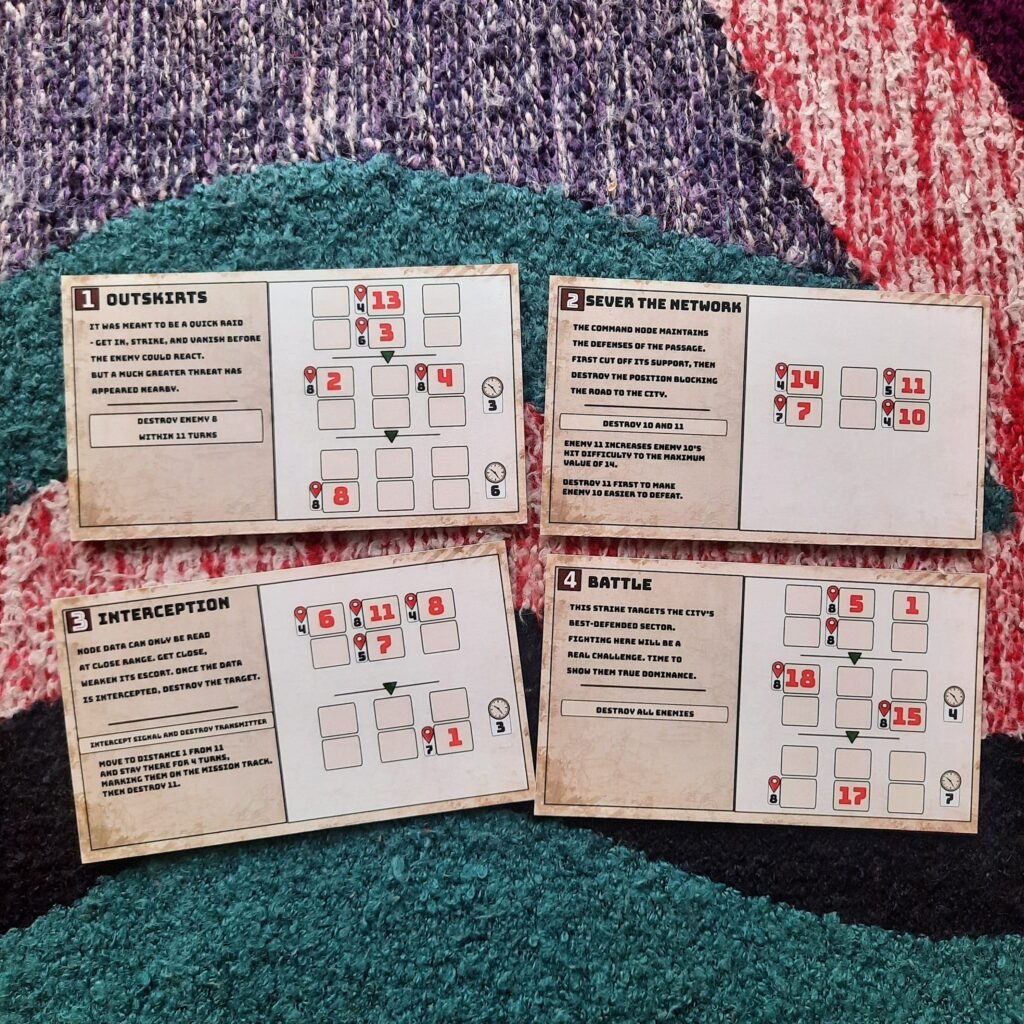
All you need
You need to print out 9 pages in total, including the Battlefield, Combat, Mech, Mission, Enemy, Control, and Equipment Cards. Cut out the Mission Cards, Enemy Cards, and Control Cards, and you’re all set. So assembly is super easy. I printed mine on cardstock.
Next, you need something to represent Steel Whisper itself. A meeple works, or anything that isn’t flat, since the direction your mech is facing is crucial throughout the game. I used a 3D-printed cyborg that was giving off mech vibes!
That sorted, you need 14 D6 dice and 52 small markers. That’s a handful, but if you’ve played Radek’s games before, then you know it’s kind of his trademark. His games have this board-game-like scale to them.
Alright, time for battle!
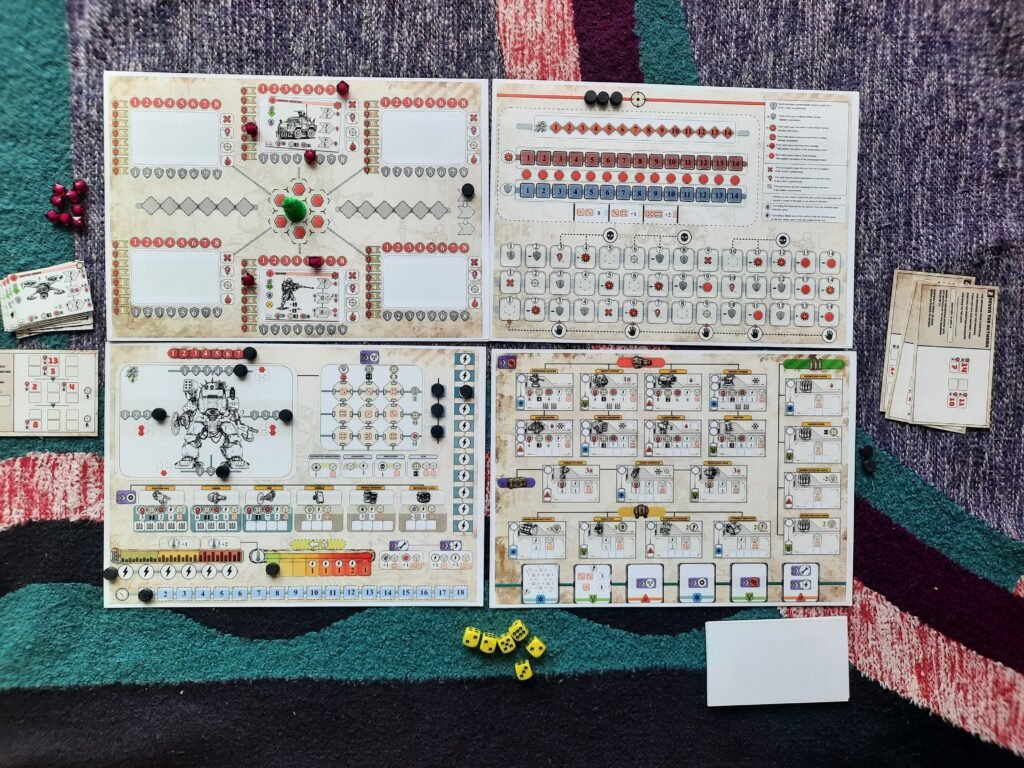
Entry: after playing the game
Findings
The mech and the push-pull
Just how Bravery had me managing my vitals, you play a similar role in Steel Whisper as you constantly juggle the mech’s systems to make sure it keeps doing its bit. Bear in mind, you’re dealing with an old (albeit legendary) machine that’s nowhere near its prime.
Energy is a big part of that. The more you spend, the harder you push the reactor. Push it too far and the temperature starts climbing, which can make the mech even more expensive to operate and eventually start eating into its endurance. So you can’t just go absolutely nuts with everything you have.
The Control Card and six action dice capture the limitations of the mech pretty well. You get one Control Card every turn and can place it in one of four positions, activating three of the six action areas. Those three can then use any of your dice, while the remaining three still need their specific die values. So you do have some control over what you want the mech to be better at that turn, but you’re still working around whatever six dice you rolled. And when the symbols on the Control Card line up with the ones underneath, you can unlock advanced equipment or trigger extra effects too.
Then there are the sensors. Setting them up can eventually give you things like extra attack dice, better targeting, reduced enemy armor, more attack power, or even permanently wreck some of that armor. But again, getting those sensors into place means spending dice you could’ve used elsewhere.
The same goes for your equipment. Steel Whisper already comes with a machine gun, cannon, saw, shield, smoke grenades, and defensive flares. Knowing what offensive or defensive tool you need at that particular moment is also crucial.
And all the while you’re managing the mech, you’re under constant attack from the military. Your armor is getting wrecked, and eventually so is your endurance. So as the game tightens its grip on you, how well you handle that constant push-pull ultimately decides how well you play.
Opportunity cost at its finest!
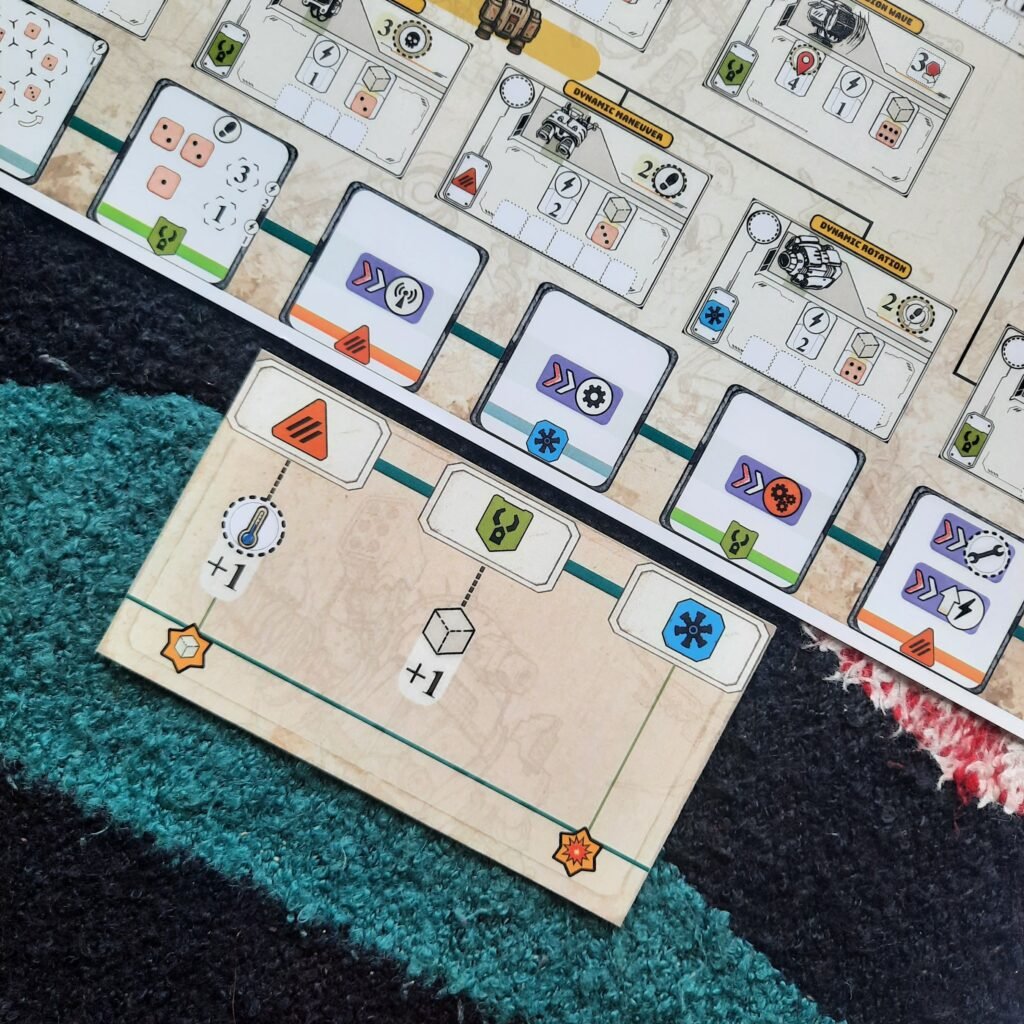
All the actions in the Battlefield
This has to be my favorite part of the game!
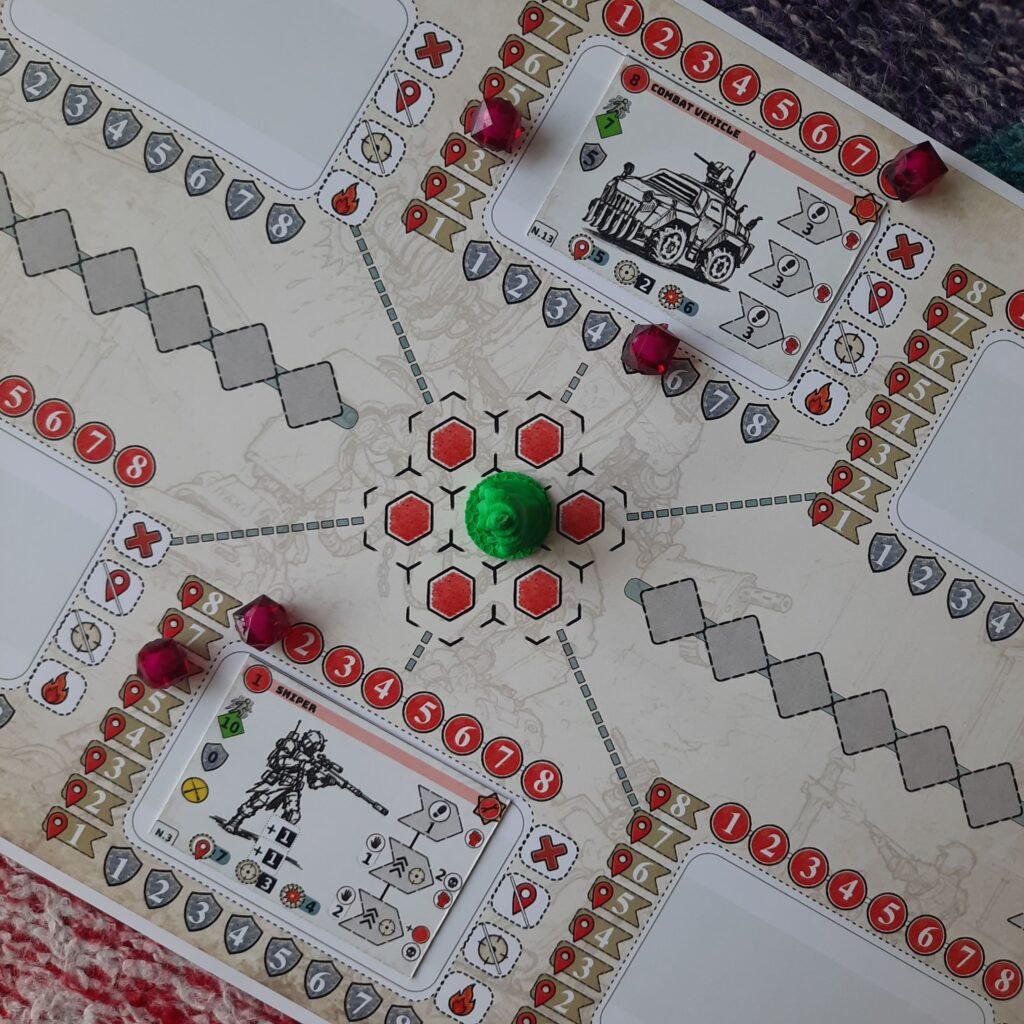
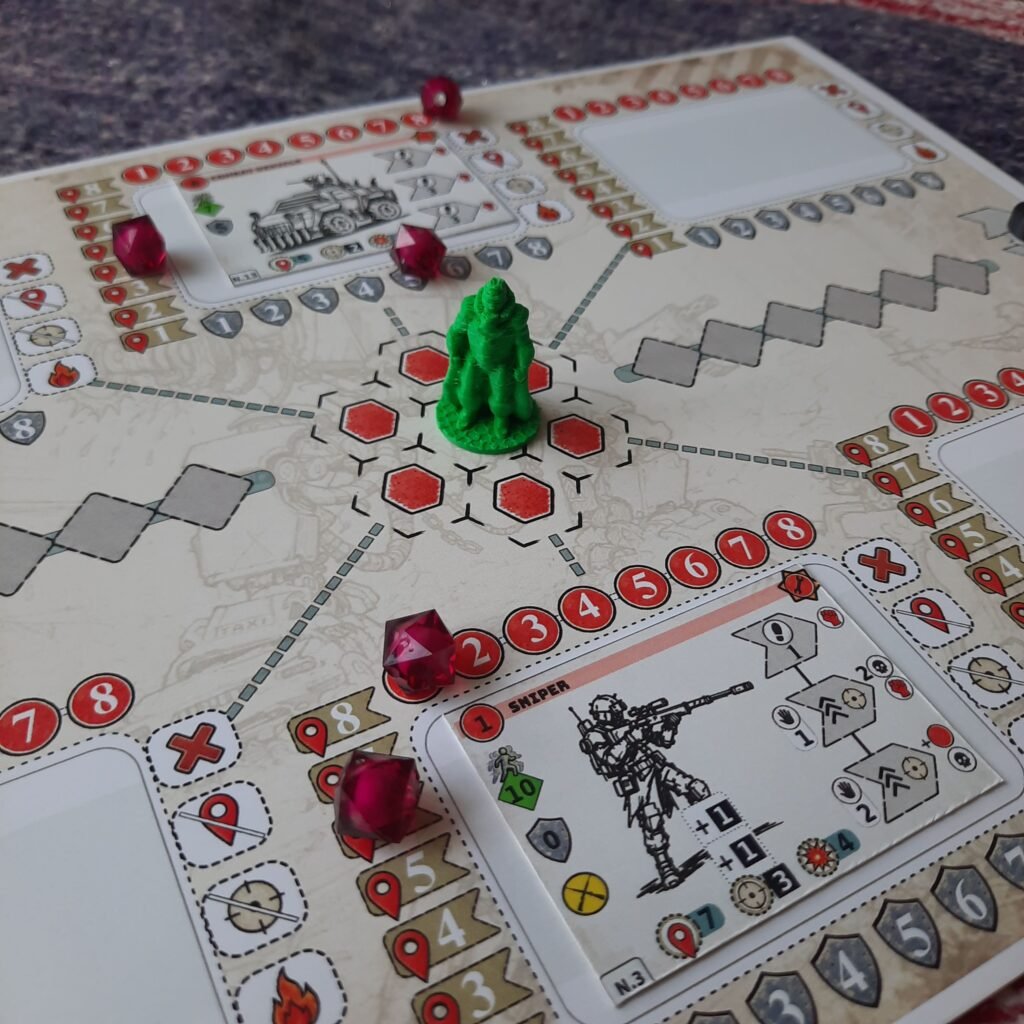
Everything about the Battlefield Card is a big hit for me. The Mission Card tells you where exactly the enemies will arrive across the six possible locations surrounding the battlefield, while right at the heart of it stands Steel Whisper.
And where that mech is facing, where its back is exposed, and how far away every enemy is from it can all be manipulated through your action dice.
Using dice to both move and rotate the mech is a really fun bit, and something I haven’t experienced in a game before. Movement here doesn’t mean physically pushing Steel Whisper around the Battlefield Card either. Move forward, and the enemies in the three spaces ahead of you get closer, while the three behind you move farther away. To rotate, you spend a die pointing toward the direction you want to turn, moving Steel Whisper one facing step that way. Rotate the mech and you’re basically changing who sits in front of your guns.
That matters a LOT because most of Steel Whisper’s weapons fire toward the front, with only certain equipment capable of attacking in other directions. Your armor isn’t equally strong on every side either, and the back is definitely where you don’t want an enemy lining up a shot. So moving into a better range is one thing. Making sure you don’t end the turn presenting your ass to the military is another! Haha.
And the enemies aren’t just standing there either. Nor are they one fixed type that you can learn one strategy for and repeat. There are 18 different enemy units in the game, with different combinations of endurance, armor, hit difficulty, range, accuracy, attack power, and their own sequence of actions. Depending on the Mission Card, only a handful will enter that particular fight at different points during the mission.
With enemies approaching Steel Whisper from different sides and distances, you’re constantly having to rethink where the mech should face, who to deal with first, and which side you can afford to leave exposed.
To make things even crunchier, some enemies can boost their attacks depending on which other units are currently on the Battlefield Card, so letting the wrong combination pile up can make things nastier pretty quickly.
Once a few of them are moving, attacking, and coordinating around you, it almost feels like there’s another player on the other side of the table moving pieces against you.
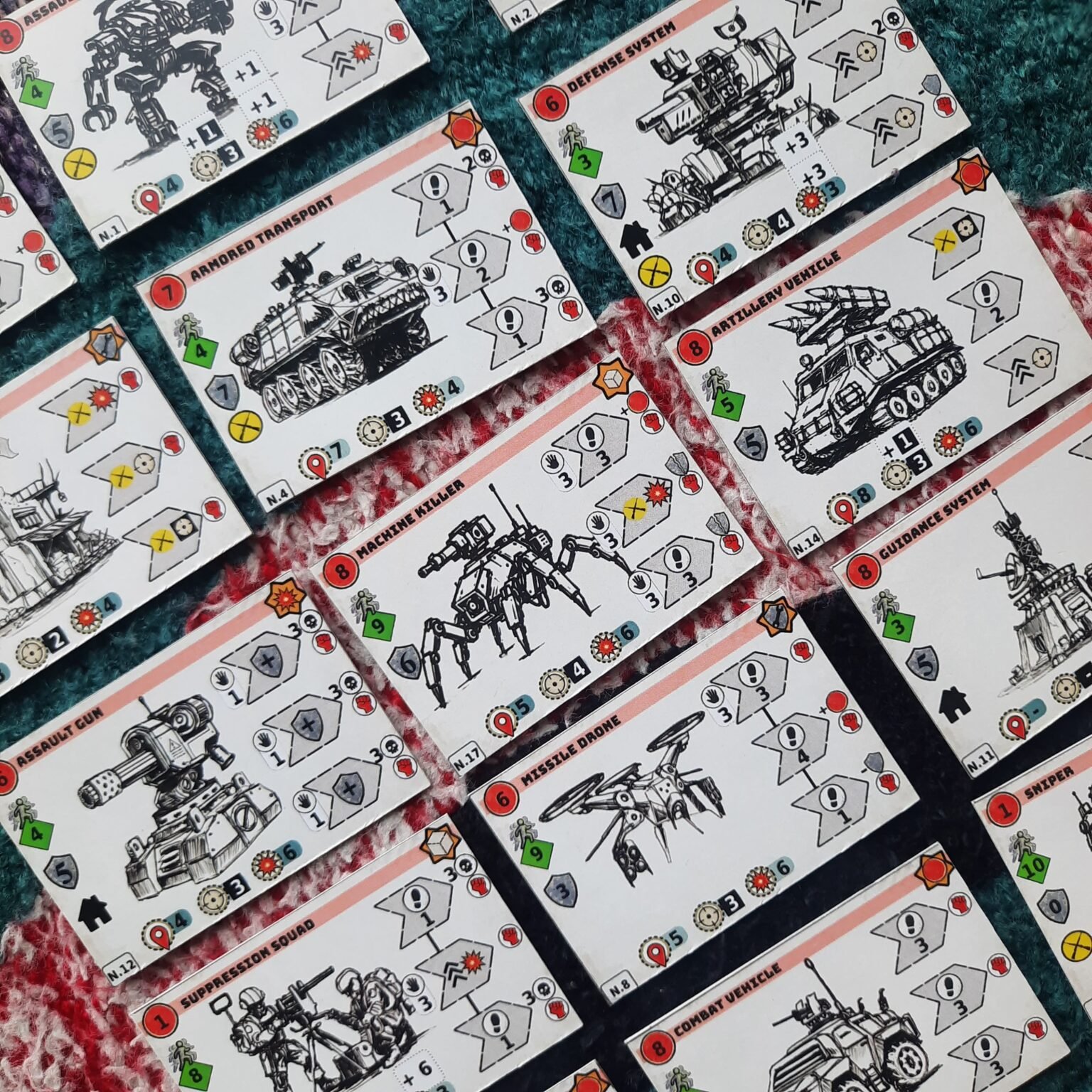
Which track do I choose?!
Combat has to be my second-favorite part of the game, kudos to its tracks which really branch out what otherwise could have been a simple linear attack.
First, you figure out how difficult the shot is based on the enemy and your distance from it. Your weapon’s accuracy then tells you how many dice you get to roll, and this is where the three combat tracks come in. You choose where to place those rolls, building up your hit while trying to land on spaces that can alter attack power, armor, damage, or trigger other effects.
And not everything you do to an enemy works the same way. Some effects only weaken its armor for that particular attack, while others can permanently destroy armor, making the thing easier to crack for the rest of the battle. You can also leave enemies disabled, unable to move, blind, or dealing with other problems depending on what you trigger.
The fun bit is that this Combat Card isn’t yours alone. When the military fires back, their attacks run through the same tracks, except now it’s your armor and endurance sitting at the other end of it.
Your choice of weapon adds another layer to all this. Steel Whisper starts with the machine gun, cannon, and saw, each with its own range, accuracy, power, energy cost, and limited uses. Then there’s the advanced equipment you can unlock through the Control Cards, bringing in nastier toys like heavier cannons, lasers, flamethrowers, and special ammunition.
Is it for you?
I’m honored to have roughly 1300-1500 readers reading my blogs every month, and this perhaps is the question everyone asks themselves, or even asks me!
Steel Whisper, like Radek’s games, is a machine. It’s not something you can take out on a whim and complete in 15 minutes. It heavily relies on your brain, and I can guarantee you’re not winning this game by chance.
You have to keep the mech’s systems in check, constantly reposition yourself, attack the enemy, get attacked, tactfully use your basic and advanced weapons, make the most out of the Control Card every round, and watch the game tighten its grip on you as more enemies emerge.
This is a strategy-heavy game that’ll take around 45–60 minutes to play. I won’t call it easy to learn, but frankly, you start getting the hang of it once you’ve played through a few rounds.
Is it for me? Absolutely.
Not that I always play strategy-heavy games, but I’ve grown a knack for them, kudos to Radek himself. His games have this next-level immersion through both mechanics and themes that I really dig.
The enemy is closing in!
Steel Whisper’s reactor is heating up. The military has surrounded you. You brace yourself for one final shot. It’s now or never…
Are you ready to unleash hell on the old military and save the day?
Recommended items
Game Overview
Designer: Radek Ignatów
Number of players: 1-4
Difficulty level: Medium-Hard
Rounds of gameplay needed to learn: At least 3/4 rounds
Game duration: 45-60 minutes per scenario
Available on: Kickstarter
Theme: Tactical mech combat | Piloting a damaged war machine
Number of pages and color: 9 pages (color print)
Assembling difficulty level: Super easy. Print and cut out cards.
Lamination: Not needed
Additional elements required: 14 dice, 1 meeple and 52 tokens
Time to learn: Within 30 minutes
Travel-friendly: 10/10
Shelving friendly: 9.5/10
Rating from PnP Time: 9.5/10


Tas is a game designer and blogger based in Bangladesh, with the dream of exploring the world of games and introducing it to anyone new to it.