Bravery
The forest is eerily silent. The kind of silence that gives no peace to a living soul.
Anything that breaks the silence startles you. You breathe heavily as you take one more sinking step into the snow, hoping the trail leads somewhere good. Just a fool’s hope…
Frost is already under your skin. You’re low on food and water. You’re praying for a decent spot to camp for the night, because there is more than the cold out to get you.
It’s been a while since you realized that you’re being followed. Only a matter of time before you figure out what caught your scent… a bear, or a pack of wolves.
Will you be able to survive the day?
Entry: before playing the game
First impression
Radek’s games have a pattern of dwelling between lines.
In the space where one thing ends and another begins.
Be it the line between a print-and-play and a full-blown board game (Chronicles of Civilization), or the line between a game and reality (Call the Doctor).
So when Bravery came my way, I was confident this game would follow the same pattern.
I also had a conversation with Radek about Bravery, which became one of my Behind The Scenes issues, where he shared the journey of the game itself. It began in 2022, after The Revenant planted the idea of a survival game in his head. From there, Bravery went through convention testing, drew interest from a publisher, and developed further with the introduction of crafting, scenarios, and mini-games. Eventually, after reaching an agreement with the publisher, Radek chose to release it himself, transformed it into a print-and-play, and brought it to life as what turned out to be his favorite project to date.
That changed the way I looked at Bravery. It was no longer just Radek’s new survival game. It was a project he had carried for years, a project he came back to, and finally released in a form he loves.
A bit on the game
Bravery is a solo scenario-based survival game where each scenario gives you a different reason to enter the wilderness. Sometimes you are simply trying to survive. Sometimes you are following the trail of those who left you behind. Sometimes you are searching for something that may save someone else’s life.
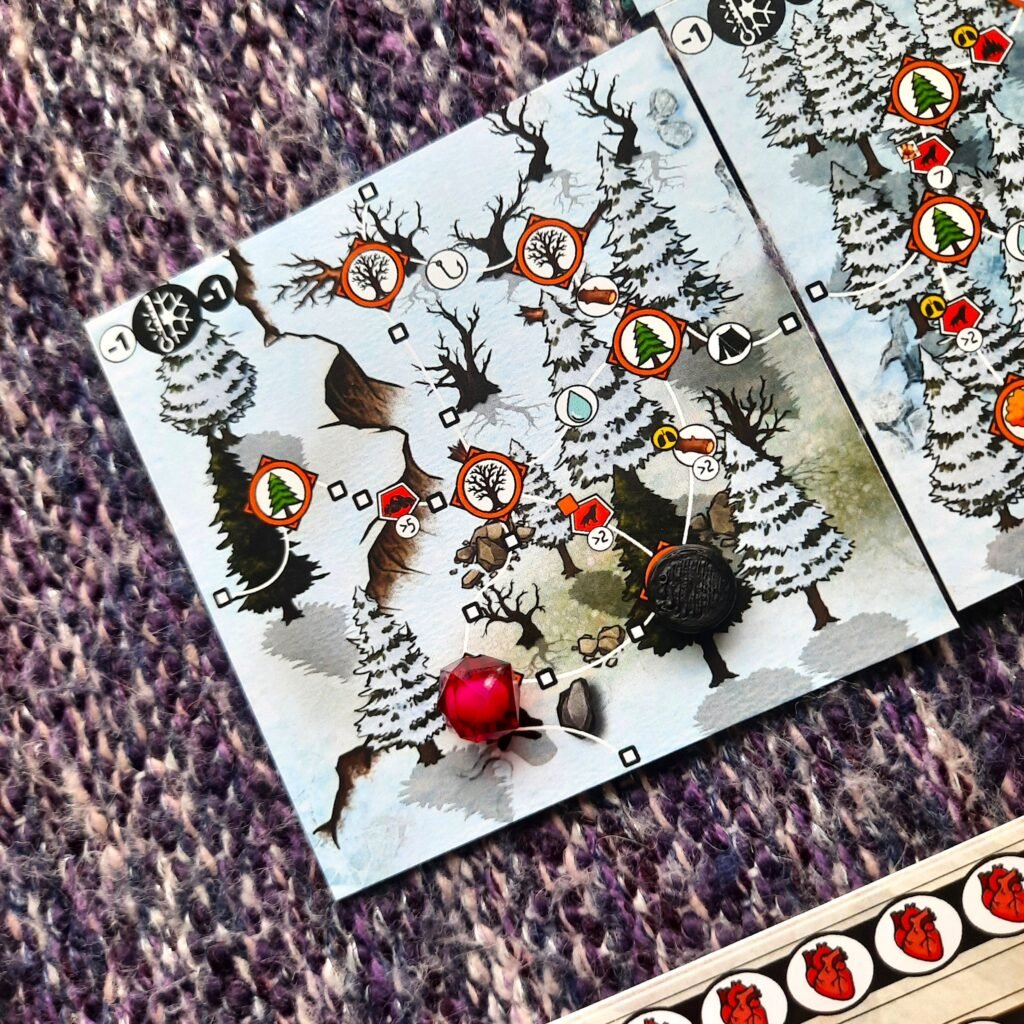
Each scenario sets up the journey with its own starting condition and goal. From there, you move through Map Cards, choosing where to travel next and dealing with whatever stands between you and that destination.
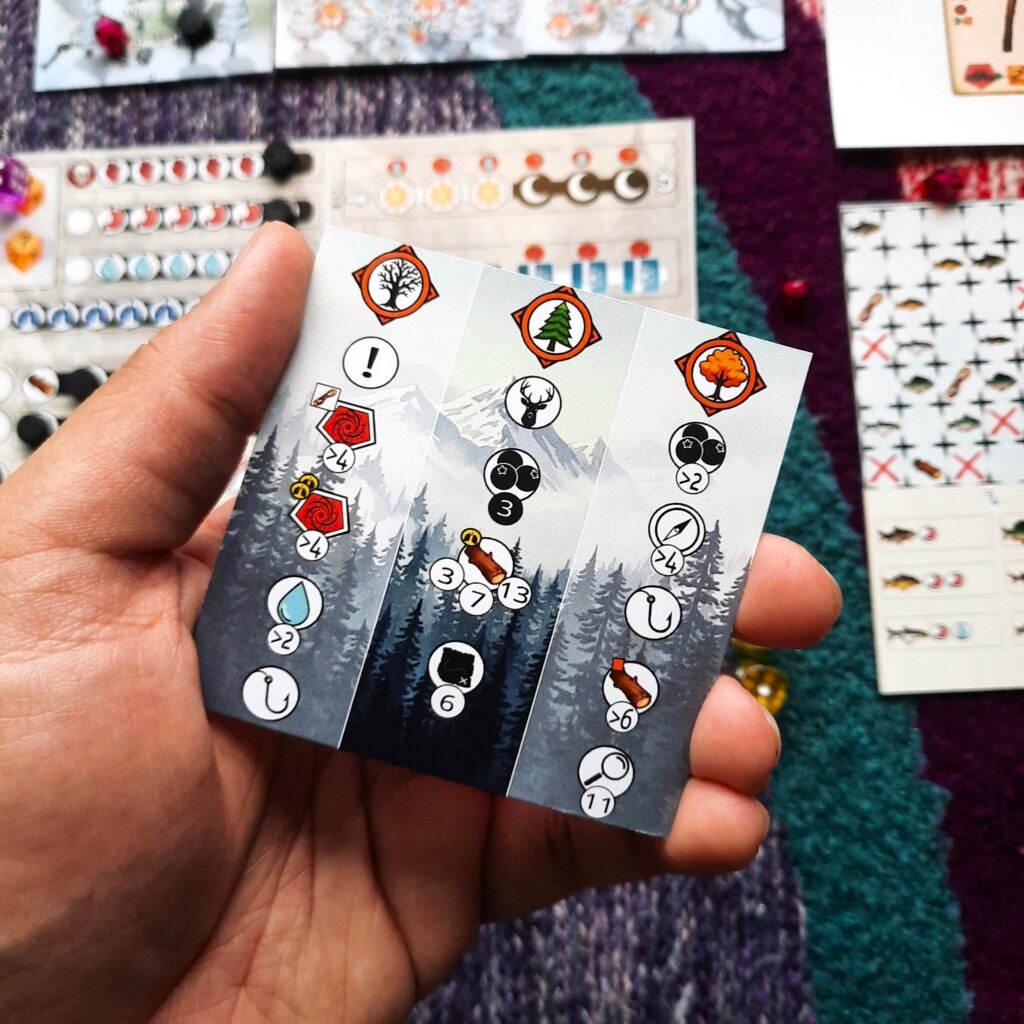
A turn begins by drawing an Action Card. This shows what the wilderness has waiting for you, and from there, you choose where to go on the map. Once the route is chosen, you test the trail, resolve what the trail itself brings, and then deal with the actions available at the location you reach.
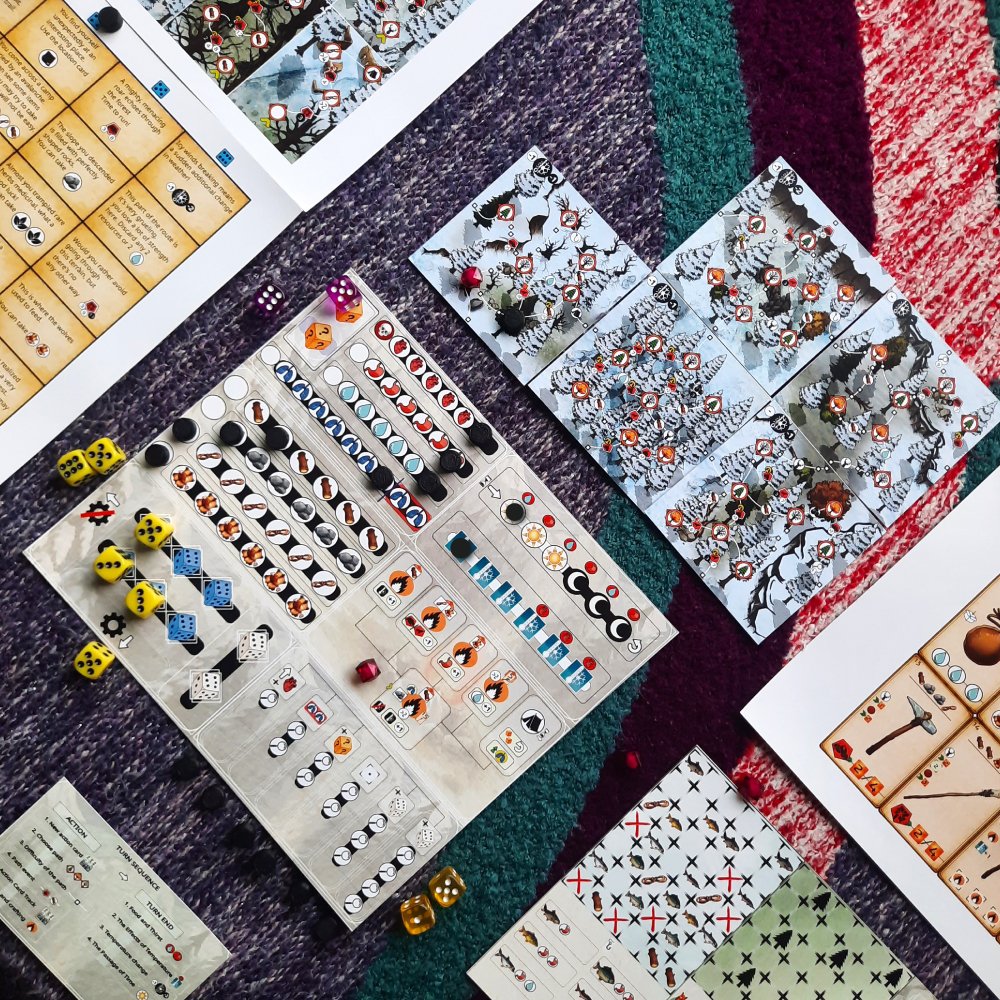
At the heart of all this is your dice pool. These dice are spent on tests and actions throughout the turn, so every decision matters. You may need them to cross a dangerous trail, survive hazards, secure food or water, hunt, fish, make camp, light a fire, or deal with whatever happens to find you.
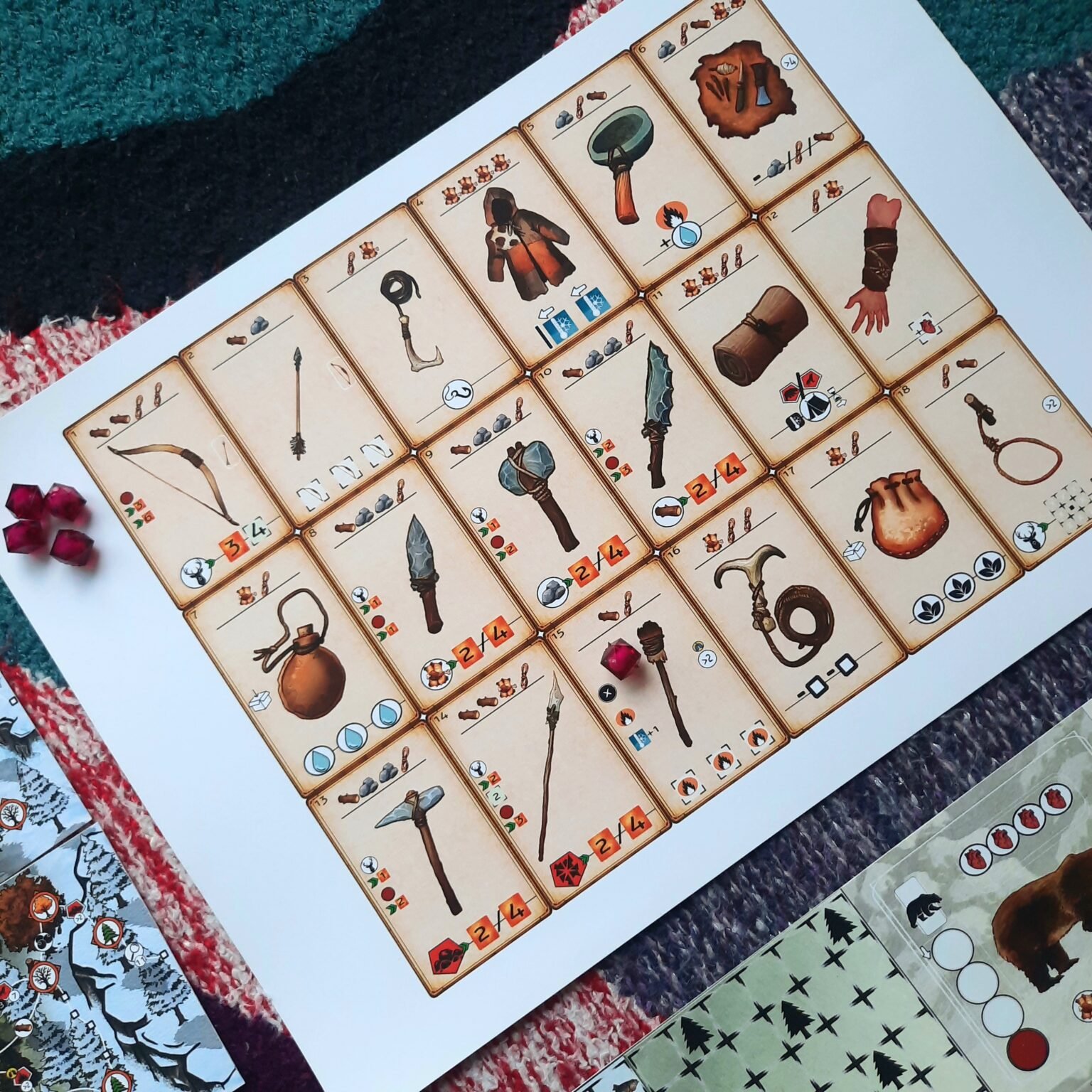
Materials can also be gathered and used to craft items from the Equipment Card. These include things that help you travel, survive the cold, store resources, hunt, or make certain actions easier. The further you go, the more these crafted items can shape what options are actually available to you.
At the end of each turn, time moves forward. You lose food and water, and you suffer the temperature effect if you haven’t taken proper measures. Night will eventually fall, and resting will help you recover, but camping without fire has consequences, as predators are always lurking nearby.
As the scenario progresses, you keep moving from one location to the next, resolving trails, actions, events, and survival needs along the way.
All you need
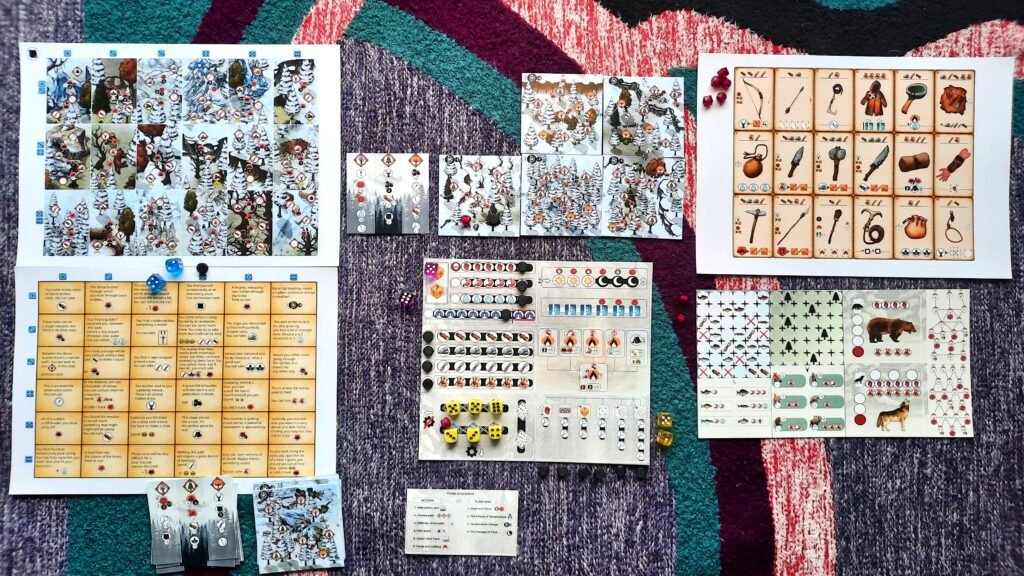
You need to print a minimum of 11 pages to get started with Bravery. You can print them on offset paper, but I preferred cardstock so the cards feel sturdier. More durable that way.
The Scenario Book is 6 pages, but printing that is optional. I kept it on my phone while playing, and that worked just fine.
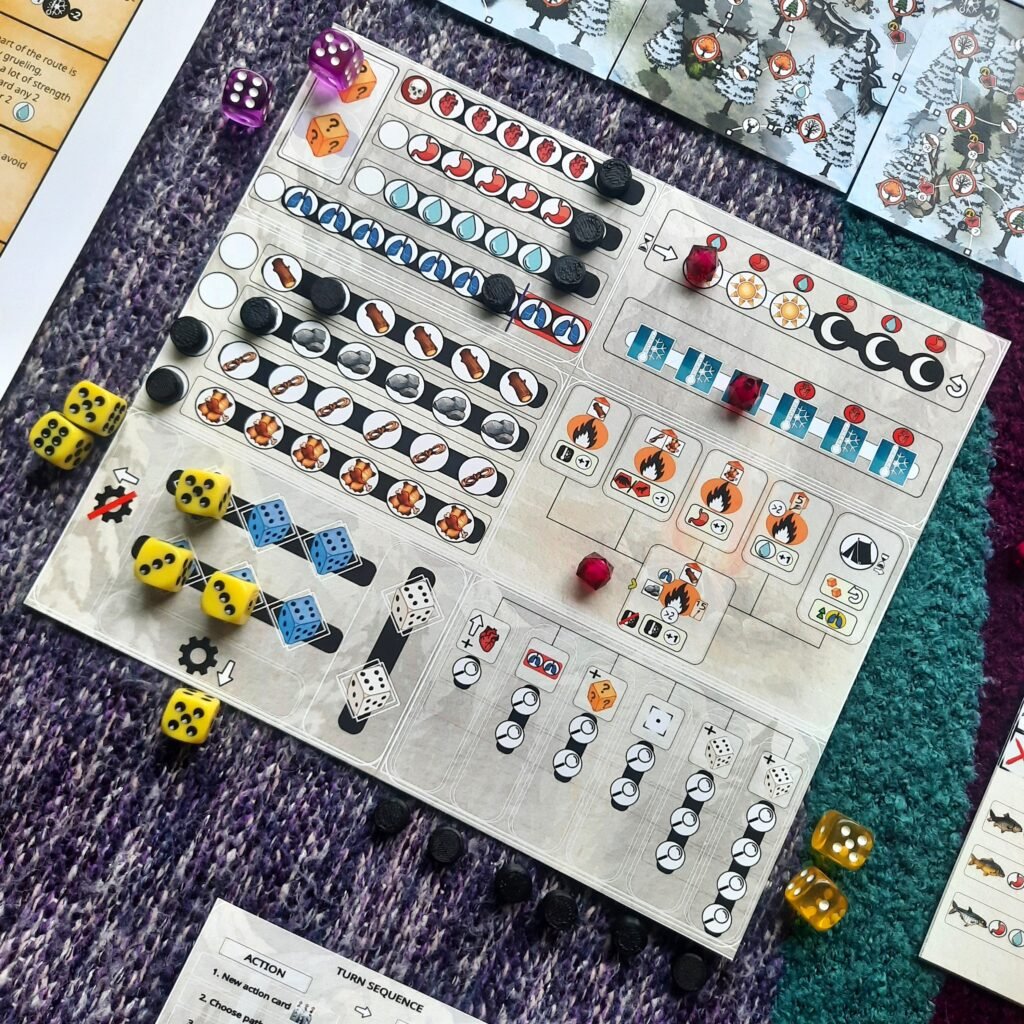
With the printing sorted, you’ll need 11 dice and 32 tokens/markers. The dice are used across different actions and tests, while the markers help track your attributes, resources, time, temperature, skills, equipment, travel, hunting, and player position.
Time to step into the wilderness!
Entry: after playing the game
Findings
Deliberate stress provocation
Putting it simply, Bravery engineers stress.
Not by throwing everything at you at once, but by letting the pressure develop turn by turn. At first, losing a little food, water, or stamina feels manageable. You can recover. You can adjust. You can probably find something useful at the next location.
But then the next turn comes…
Food drops again. Water drops again. Stamina starts running low. The temperature starts becoming a problem if you have not prepared for it. And while all of this is happening, the game still asks you to move, hunt, rest, scout for materials, craft, take risks, and deal with whatever the wilderness throws at you next.
That gradual decline is where Bravery gets pretty real. Nothing unrealistic is happening here. You are simply losing the things you need to stay alive, one turn at a time. Hunger, thirst, stamina, temperature, predators lurking around, and the constant need to keep moving all begin to press against each other.
And when you start running low on the things keeping you alive, the game becomes suffocating.
Not to sound narcissistic, but that tightening of screws feels really intense, in a good way. And this tightening is not unfair or anything. It’s nature in its rawest form. And the state you’re in is ALL your doing. All the little decisions you didn’t think through start biting back at you.
So you start feeling like one of those survival movies where the protagonist is barely holding himself together, dragging his body through the cold, and paying for every mistake he made along the way.
Except you are not watching it happen on TV. You are in it.
Radek’s signature
If you’re new to Radek’s games, they are all about sheer depth. I call them expansive, not because they are necessarily huge in size, but because of how far they can go into the thing they are trying to simulate.
And Bravery carries that signature in full force. Radek seems to have looked at survival in the wilderness and decided to leave no stone unturned!
Bravery does not feel real because it tells you the wilderness is dangerous. It feels real because the game keeps accounting for the little things you would actually be worried about if you were out there.
Crafting is a good example. It is not just there because survival games usually have crafting. The things you make genuinely increase your odds of survival. Fur can help you deal with the cold. A torch can help you push through the night, tackle the harsh cold, and make lighting a campfire easier. A waterskin lets you store water. A bag lets you carry more resources. A climbing hook can make trails less punishing. A frying pan can help you turn snow into water. These are not decorative upgrades. They feel like things you would desperately want before pushing deeper into the wilderness.
Hunting and fishing work in the same spirit. They are not side activities you do because the game offers them. They become part of the survival equation because food, materials, and safety are all connected. Hunting, in particular, can give you animal remains, and those remains are not just food. They can also come in handy when trying to scare off predators. So one action does not just solve one problem. It feeds back into the survival loop.
With everything so intricately placed in the game, you start acting like a survivor. You start thinking about what you can afford to risk, what you need before night falls, whether resting is worth it, whether you have enough protection from the cold, and whether you are prepared enough for the next stretch.
The games that make the game
Other than the base part of Bravery, where you are moving through trails and trying to keep your vitals in check, the game has all these mini-games tucked inside it.
And I think that is one of the reasons the harsh journey stays highly engaging.
Take special locations for instance. When you reach one, the game pulls you away from the main map and sends you into a separate location of its own. You enter from a starting point, move through connected spots, deal with what you find there, mostly good stuff, and then decide when to leave and return to the main journey. It almost feels like a subplot inside the bigger survival arc.
Fishing is another small game of its own. If you have what you need and reach the right spot, you choose where to fish, then use your dice to lower the hook into the water and pull a fish back up. It is simple, but it feels different from the rest of the turn because suddenly you are trying to work with this little fishing grid and hoping the dice let you reach the catch, and pull it back up!
Hunting works differently again. The animal you come across is determined through the Choice Die, after which you place yourself on the edge of the hunting area and roll to see where the animal appears. From there, you use your dice to move through the space, get within range, and land the attack. Positioning and a little bit of luck with the dice do the trick.
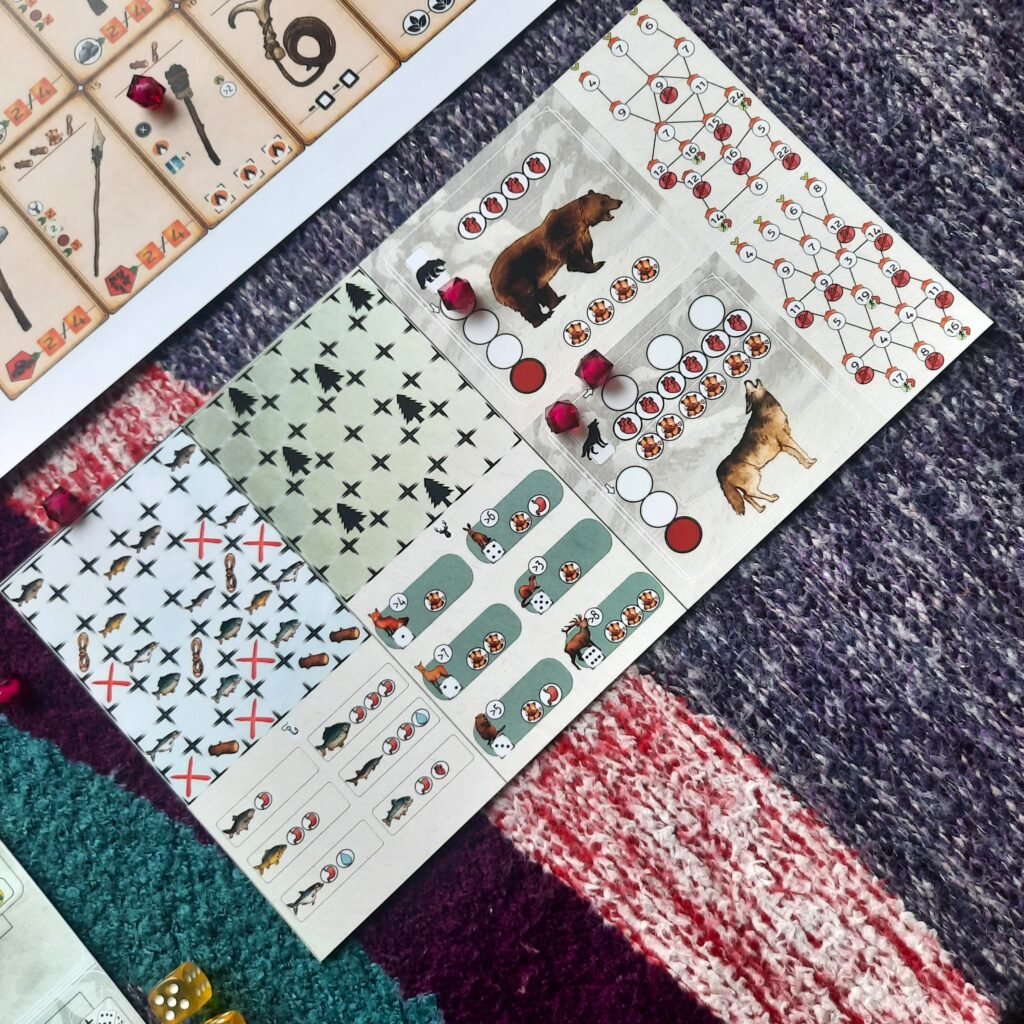
Then come the predators themselves. Bears and wolves are not just names on a hazard icon. They have their own tracks, and when things go wrong long enough, you are pulled into a confrontation. That becomes another mini-game, where you are trying to survive the encounter by moving through the test path, using what you have, and hoping you prepared well enough before the wilderness finally caught up with you. But defeating these predators can be quite rewarding, so the confrontation may not be a very bad idea.
Crafting ties all of this together. You gather resources, spend them on equipment, and those items genuinely change what you can do. They can help you deal with the cold, store water, make fire easier, travel better, hunt, fish, or survive situations that would otherwise punish you hard.
So Bravery never feels like one repeated loop. It feels like a collection of survival moments that keep branching out from the main journey.
The game is brutal. But never flat.
Controlled escalation
Something I appreciated in Call the Doctor was how Radek did not throw the whole system at you in one go. The game had its compartments. You dealt with one focused part, learned what mattered there, and slowly understood how the bigger machine worked.
Bravery does a similar thing, and for a game this vast, that is crucial.
This is not a game where you can just wander in, do random things, and expect to last long. You are learning almost every step of the way. So it is brilliant to see the game segmented into scenarios.
You begin with something a little less fatal, where the game gives you room to understand how survival works. As the scenarios move forward, the pressure starts building. And the wilderness asks more from you.
For a game with this many moving parts, that structure helps a lot. It gives Bravery a sense of progression without making the player feel completely lost from the start.
Replayable?
With scenarios in the equation, one might think replayability gets compromised. It doesn’t.
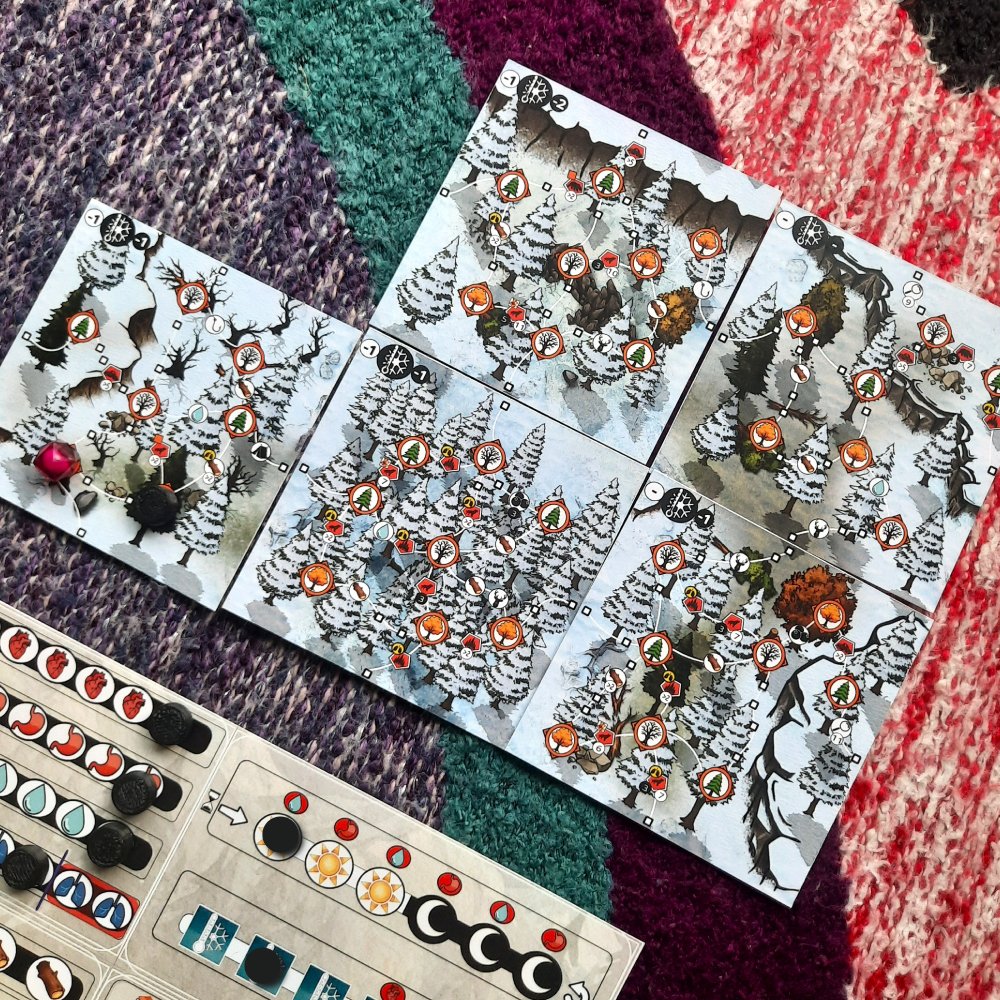
Bravery has enough variables moving around to keep the same scenario from feeling too fixed. The Action Card alone gives you room to explore, because you are always choosing one of three possible lines of action. So even when the scenario remains the same, what you lean into during a turn can change quite a bit.
Then you have the Trail Cards, where branched pathways can make each route feel different depending on how you move through them.
Crafting also plays a big part here. Since you can only have up to 5 items at a time, you are not just crafting everything and becoming prepared for all situations. You are choosing what kind of survivor you want to be for that run.
Add the dice, events, hunting, fishing, predators, and the constant pressure of your vitals, and Bravery feels far from something you can get used to after one play.
In the coming days, I’ll be sharing my gameplay experience in one of my newsletter issues through a Visual Playthrough.
It’s a special format where I show how a game unfolds round by round. So if you want to see how, or if, I can survive the wilderness, make sure to subscribe!
Before the trail goes cold...
Bravery is eerily realistic, harsh, layered, and wonderfully immersive. Just when I think I’ve played Radek’s most in-depth game, he strikes yet again. No wonder this is his favorite project to date!
The short Kickstarter campaign for Bravery is already on absolute fire, and it is closing soon. So if you feel the wilderness calling, now is the time to step in before the trail disappears under the snow.
Will I meet you in the wilderness?
This is the wolf speaking 😉
Recommended items
Game Overview
Designer: Radek Ignatow
Artist: Michał Teliga
Number of players: 1
Difficulty level: Hard
Rounds of gameplay needed to learn: At least 2 rounds
Game duration: 45-60 minutes per scenario
Available on: Kickstarter
Theme: Scenario-based survival game | Surviving the wilderness
Number of pages and color: 11 pages (color print)
Assembling difficulty level: Relatively easy. Print and cut out cards.
Lamination: Not needed
Additional elements required: 11 dice and 32 tokens
Time to learn: Within 30 minutes
Travel-friendly: 10/10
Shelving friendly: 9.5/10
Rating from PnP Time: 9.5/10
Tas is a game designer and blogger based in Bangladesh, with the dream of exploring the world of games and introducing it to anyone new to it.