Space Commander
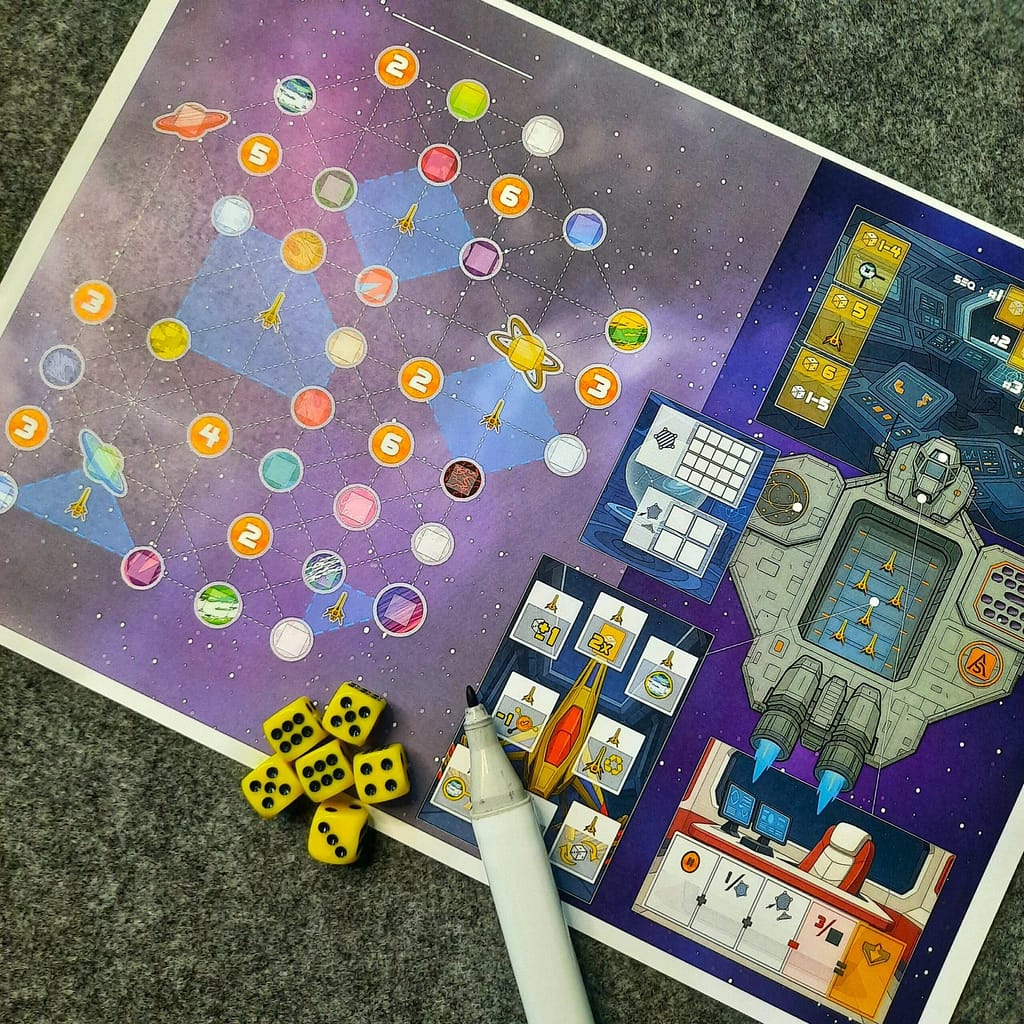
You stand at the edge of an uncharted galaxy.
Scattered planets. Glaring suns. Empty space waiting to be studied, connected, understood.
“Greetings, Commander.” A voice cuts in.
“I am X-038, your tactical assistant. I am here to ensure your decisions are… statistically less regrettable.”
A faint flicker crosses the console as coordinates begin to stream in. Six sequences. That’s all the time you have before resources run dry. No second chances. No room for wasted orders.
You grip the edge of the command deck. Somewhere out there is a perfect network. The only question is…
Will you build it in time?
Entry: before playing the game
First impression
It’s been a while since I last drifted through space. To be precise, my last voyage was back in December 2025 with VoidRoll. So stepping into Space Commander felt like a happy return to space. Of course, on paper.
As much as I enjoy building PnP from the ground up, there’s something refreshing about the ones that ask almost nothing from you. No preparation beyond printing a single page. Just, taking things literally, print and play. Space Commander leans right into it.
Interestingly, this is the third PnP I’ve tried this week that fits that exact mold. One page. Roll-and-write. Some coincidence!
A bit on the game
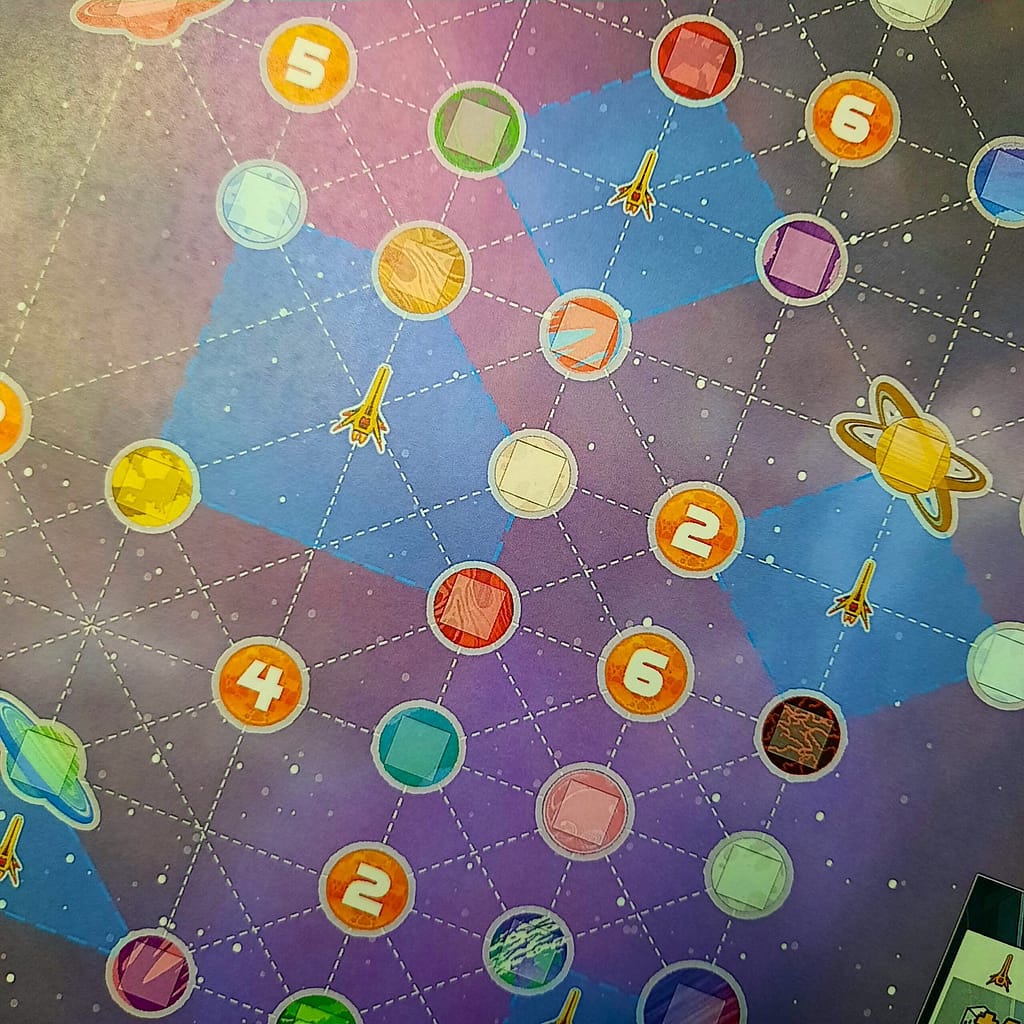
Space Commander is a roll-and-write where you take on the role of a Commander tasked with building an interstellar network across a galaxy map. Over the course of six sequences, you use dice values to secure planets, draw connections, and gradually build your network.
Each round begins with a dice roll. Values from 1 to 4 are used to secure planets by writing the number on them, with the condition that the total number of connections linked to that planet must match the value. Every placement immediately extends your web through the available paths on the map.
Along the way, you work toward connecting suns, which can be locked once they reach their required number of connections. Locked suns contribute points at the end of the game. Another key element is the creation of zones, which are enclosed areas formed by continuous loops of connections. If all planets forming a zone are secured, the zone becomes active and counts toward scoring.
Some zones, marked in blue, have special objectives. Completing them not only contributes to the final score but also unlocks bonus ships, which provide one-time special abilities such as modifying dice values, re-rolling, or gaining additional actions.
The game gradually tightens as the number of dice decreases each sequence, limiting options and increasing the importance of efficient placements. At the end of the sixth sequence, you’ll tally points based on locked suns, active zones, and the size of the largest zone, while also taking penalties for any unplaced values or connected planets that were never secured.
All you need
Like I mentioned earlier, there’s only one page to print. That’s your entire galaxy right there. If you choose to laminate it, you can keep coming back to the same sheet again and again.
Other than that, all you need are six dice and something to write with. A pencil works just fine, or a marker if you’ve laminated the sheet.
That’s it. You’re ready to go!

Entry: after playing the game
Findings
Flow that tightens with every roll
You begin with six dice in hand.
Plenty of options. Plenty of room to experiment. You connect planets, extend your network, start setting things up for something bigger. There’s a certain comfort in those early rounds. A feeling that you have time.
And then the game quietly takes that away from you…
Five dice in the next sequence. Then four. Then three. All the way down to a single roll in the final round. Nothing else changes. The galaxy remains the same. But your options shrink.
That gradual reduction is where the flow of Space Commander really stands out. It tightens the space you operate in, step by step.
The wide-open puzzle slowly turns into something restrictive. Every roll and placement starts to carry weight. Using your bonus ships at the right moment becomes crucial. And by the time you reach that final die, you’re making do with what you have, trying to squeeze the most out of a single outcome.

Brain teasing puzzle
Every placement in this game carries conditions. The number you write must match the total connections to that planet. Not more, not less. That alone starts to limit your options. But then you also have to think about how those connections affect everything around it.
A planet that is connected but not secured becomes a penalty. A loop that is not fully completed fails to activate as a zone. Suns sit there, waiting to be locked at the exact moment their conditions are met.
So it’s not about placing higher numbers to earn more points, but rather the right number in the right place. It becomes a brain teasing puzzle where every decision echoes across your entire network.

A confined galaxy to master
Space Commander plays out over exactly six sequences.
The map itself is fixed. The planets and suns are all laid out in front of you from the very beginning. The special zones are clearly defined, and so are the bonus ships tied to them. Nothing is hidden. Nothing changes between plays.
Because of that, you can start forming a plan right from the start. You can aim for specific zones, position yourself around certain suns, and think about how to make the most of the eight available bonus ships. When to unlock them is one thing. When to use them is just as important, if not more.
Everything about the experience feels contained. It doesn’t sprawl endlessly or introduce new layers midway through. Instead, it presents a defined space and asks you to make the most of it.
So the more you play, the more familiar the map becomes. You begin to see patterns. You start to recognize what fits where, and what doesn’t. It’s a confined system, but one that slowly opens up as your understanding of it grows.

Replayable?
Looking at the arrangement of planets and suns, it was hard not to think about replayability right away. The structure of the game makes it clear that even small changes to the map could lead to very different experiences.
After a few plays on the same map, I started to see how much room there already is to approach things differently. The paths you prioritize, the zones you aim for, and the timing of your bonus ships, all of it shifts from one game to the next.
Having spoken with David Lindet, the mind behind Space Commander, I’m glad to know that multiple maps are in the works. And that makes a lot of sense for a system like this. A new layout of celestial bodies can easily refresh the entire puzzle.
That said, even the current map holds up well on its own. After multiple plays, it still manages to offer enough variation in how things unfold.
Worth your command?
I’ve always tried to support indie designers who put in the work to bring their ideas to life. And Space Commander comes from one such effort.
Designed by a solo creator at Aviinde Studio, this is a roll-and-write that keeps things simple on the surface while offering plenty to think about once you get into it.
If this sounds like your kind of game, it might be worth checking out and backing the project.
Recommended items
Game Overview
Designer: David Lindet
Number of players: 1 to 6
Difficulty level: Easy to medium
Rounds of gameplay needed to learn: 1 to 2 rounds
Game duration: 20-30 minutes
Available on: Kickstarter
Theme: Roll-and-write | Building your Galaxy Network
Number of pages and color: 1 page (color print)
Assembling difficulty level: Super easy, nothing to assemble!
Lamination: Recommended for durability
Additional elements required: Six D6 dice and a marker/pencil.
Time to learn: Within 20 minutes
Travel-friendly: 10/10
Shelving friendly: 10/10
Rating from PnP Time: 8.5/10

Tas is a game designer and blogger based in Bangladesh, with the dream of exploring the world of games and introducing it to anyone new to it.