Shinobi Spy and Supply

Two shops sit side by side, both selling tools for ninja spies.
Kunai for the quick jobs. Cloth for camouflage. Kikatsugan for the long nights when the mission refuses to end…
Yep, it’s one shady business.
Things move subtly here. A customer walks in, asks for supplies, pays in silence, and disappears back into the alleyways. Then another follows. Then another.
But when your customers are spies, running a shop becomes a dangerous little game of observation. Not just on your customers, but also on the rival shop.
You keep an eye on the shelves next door. Watch what is selling. Watch which supplies their customers keep coming back for.
And every now and then, you quietly slip one of your own people into the shop beside yours. Just to see what they are up to.
But some part of you knows that you might get a taste of your own medicine, and get spied on too!
Can you serve customers who are spies, sell them spying tools, while also spying on the rival shop selling the same spying tools, while they might be spying on you too?
Entry: before playing the game
First impression
What’s a Shinobi?
It’s a Japanese word that roughly means someone who conceals themselves or moves in secret. AKA, a ninja spy!
Historically, they were not just shadowy assassins running around with blades. They were agents of stealth, infiltration, and intelligence gathering. Spies, in the truest sense.
Now, add to that the two rival shops selling tools to spies… and then sending spies to spy on each other? Hilariously amazing!
It genuinely felt like the script of a movie, haha. Refreshing.
Not too long ago, I almost started a tiny war in one of my newsletter issues over what takes slight precedence in games: themes or mechanisms. Even by a bit.
I backed themes 51 to 49. Most folks leaned the other way.
But games like Shinobi Spy and Supply make my point beautifully. I hadn’t even played the game yet, and simply reading the premise already had me hooked.
Folks, the power of stories.
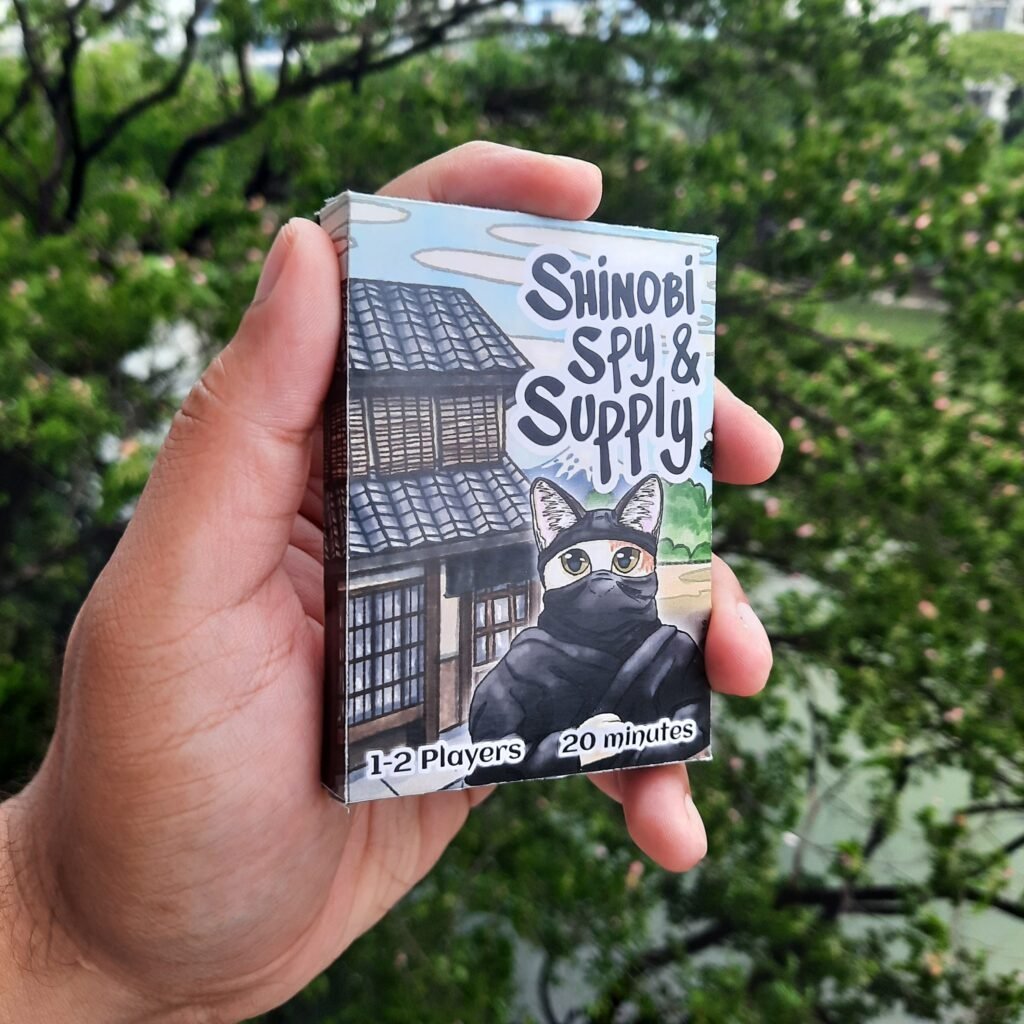
And then there’s one more thing that instantly wins me over: a tuck box.
Just look at this little gem! It looks good and stores the game neatly. A nice tuck box always makes a print-and-play feel extra complete to me.
A bit on the game
Shinobi Spy and Supply is a competitive tableau-building card game for two players, where each player runs a shop supplying tools to ninja spies.
The game revolves around three types of resources: Kunai, Cloth, and Kikatsugan. Customers are served by paying different combinations of these resources, earning points along with bonus actions that give players an edge in the game.
On each turn, a player will either draw a card, serve a customer, or spy.
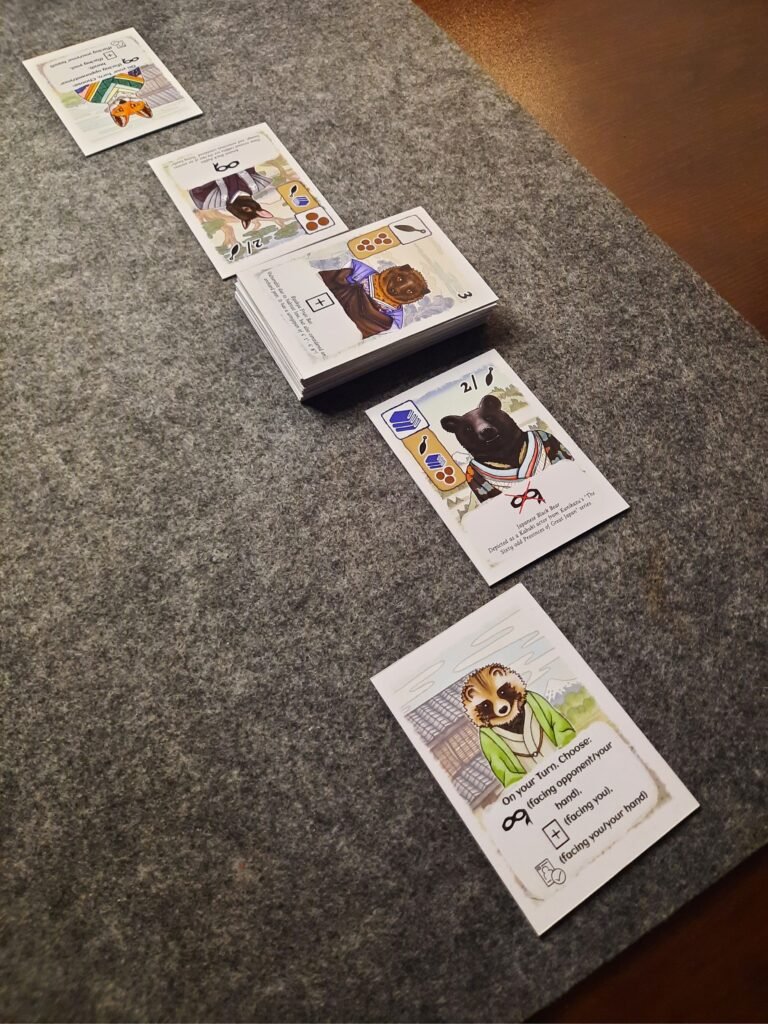
Drawing cards is tied heavily to positioning. Cards in the market face different players, and only the cards facing the active player can normally be taken into hand. The center pile also rotates throughout the game, subtly shifting what each player has access to.
Serving customers requires discarding matching resources from hand. Once played into a tableau, these customers begin contributing towards endgame scoring, often rewarding specific combinations and sets of resources.
Then comes the really fun part: spying.
Players can take cards facing the opponent, or cards from their own hand, flip them into spies, and tuck them beneath cards in the opponent’s shop. These spies do two things. They help score additional points at the end of the game, while also acting as permanent resource discounts throughout the match. Bear in mind that both players can spy on each other.
The game ends once the draw pile runs out, after which players score both their own shop and the spies they planted on the opposing side.
All you need
The print-and-play version only requires printing the 27 cards across a maximum of 6 pages. Sleeve them up if you want to.
Add one more page for the tuck box, and the setup is ready to go. No additional components are required to get the spy shops up and running.
Since the game is 1v1, I’m handing the rival shop over to my spouse.
戦いの時 (Tatakai no toki)
Time to fight!
Entry: after playing the game
Findings
Opponent Parasitism
Most tableau-builders ask you to focus entirely on your own setup. Build better combinations. Score more efficiently. Optimize harder than your opponent.
This one constantly pushes you to also look at your opponent’s tableau.
Because the rival shop is more than just that. It’s also an opportunity.
By slipping spies into your opponent’s tableau, you can slowly start benefiting from what the other side is building. Spy cards give you resource discounts. Your opponent’s growing setup can become part of your scoring engine. Their progress starts mattering almost as much as your own.
And the best part is, it fits the theme perfectly.
The spies are not just another mechanism pasted onto the game. They behave exactly like spies should. They infiltrate. They quietly sit inside rival operations. They gather value over time. And before long, someone else’s carefully built shop slowly starts working for you too.
Deliciously shady stuff.
Opponent Parasitism is a design space I have wanted to explore in one of my own games for a while now, and I’m so happy to see Shinobi Spy and Supply implement and execute it to perfection.
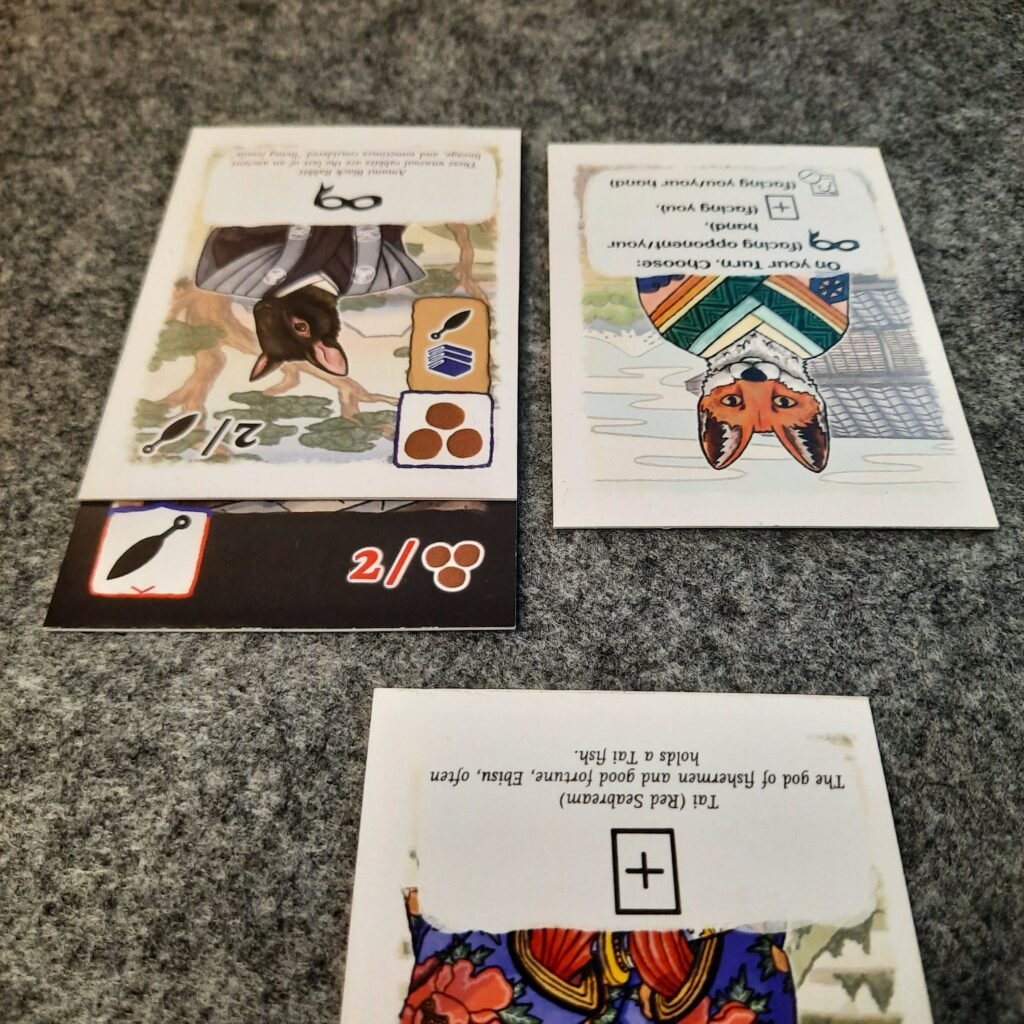
Absorb better, win better
You’ll need less than 10 minutes to understand and get going with Shinobi Spy and Supply, but to really ace this game? You need to absorb as much as you observe.
On the surface, it may feel like the objective is simply to serve more customers and score more points at the end. That, or spy as many cards as possible on your opponent’s shop.
Will these help? Yeah. But not always.
The game has 24 ninja cards, and they don’t all reward you the same way. Each card comes with its own scoring condition, often tied to specific resources or combinations of resources. Some also bring bonus actions into the mix, like drawing cards, spying, serving another customer, or removing spies. So blindly serving any customer whose resources you have in hand is not going to cut it.
And the same goes for spying.
You shouldn’t send spies just for the sake of it. You need to look at what the card scores from, what resource discount it gives, and whether placing it on your opponent’s tableau will actually help you later.
You have to plan ahead. Watch the market. Track what your opponent is building. Figure out which cards are better in your hand, which ones belong in your tableau, and which ones are better quietly spying from the other side.
Do that, and the points start stacking.
Don’t do that, and you might still end up with a beautiful tableau.
Kudos to the artwork. Not you.
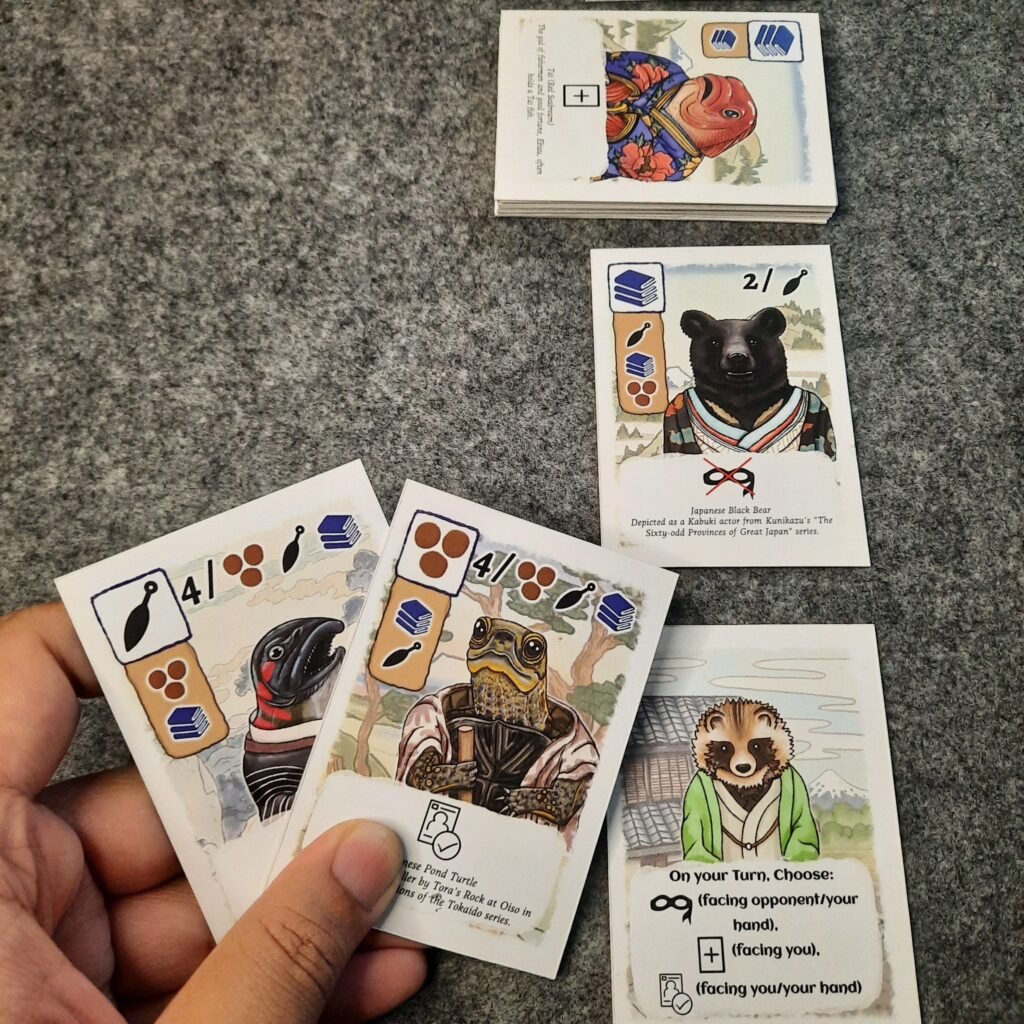
The right size of trouble
This point might come more from the game designer side of me than anything else.
Shinobi Spy and Supply could easily be a game with 50 ninja cards instead of 24. Maybe even more. The game absolutely has room for it. More characters, more scoring patterns, more little tricks hiding in the deck.
But the game is much more compact than I initially thought it would be. Once both players get fluent with it, it can wrap up in less than 15 minutes.
Then it hit me. If I’m not wrong, it’s deliberately kept that way.
Not just for the playtime, but to keep things crunchy.
Every card matters because there simply aren’t that many of them. Every card drawn, served, or turned into a spy has consequences, good or bad. The cost of misplacing a card hits harder when there is no giant deck waiting to bail you out.
From a few rounds of play, 24 characters feels like the sweet spot where the game sits best.
Compact. Replayable.
And honestly, I applaud Jered Byford and Leslie Kolke, the minds behind Shinobi Spy and Supply, for that.
Knowing the right number of cards to keep a game intense, quick, and replayable is one tough cookie to crack.
A little bit of math goes a long way
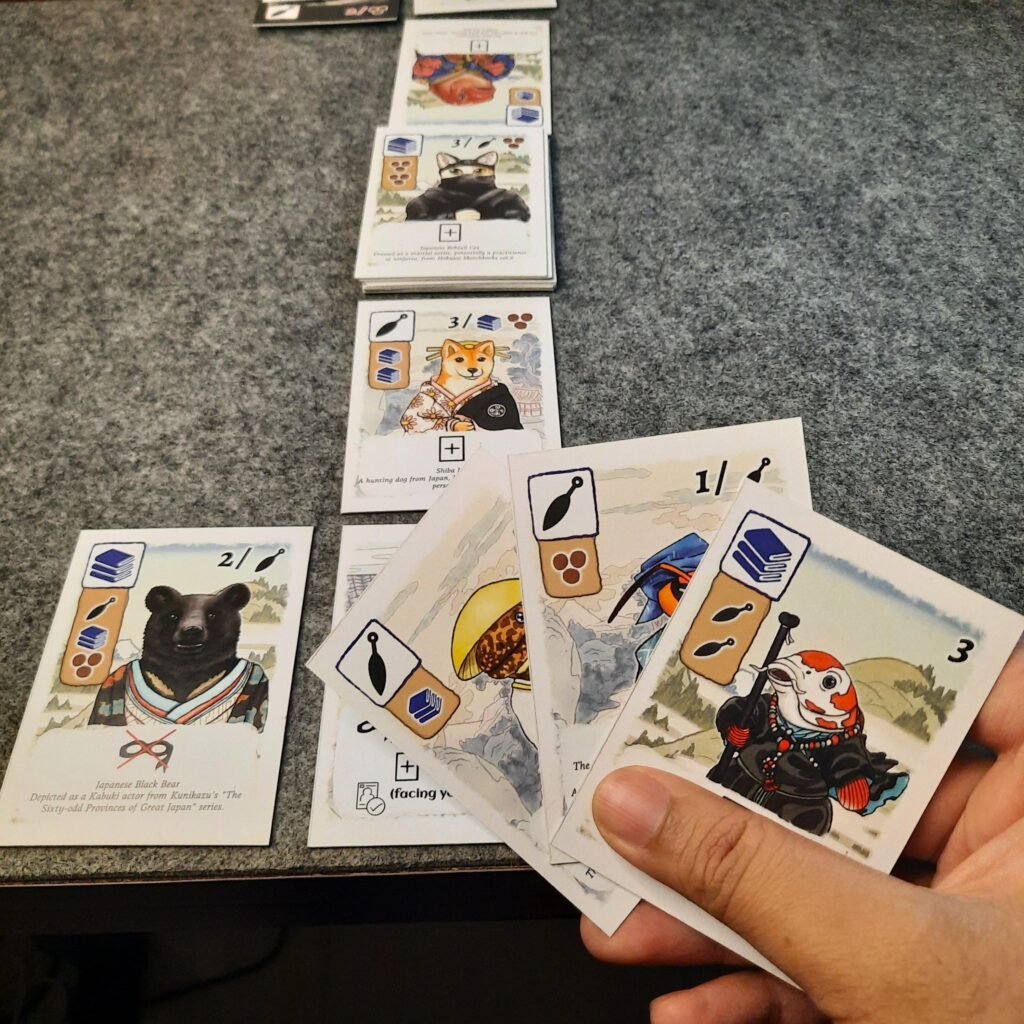
Being good at quick calculations really paid off in this game.
Since you are building your own tableau while also planting spies in your opponent’s, you constantly need to check whether a move is actually worth it.
Is this card better served now? Better saved for later? Better tucked away as a spy? Will it score more from your side, or from theirs?
On my third run of the game, I found myself mentally calculating which cards I wanted to serve, which cards I wanted as spies, and how many matching resources I needed to squeeze out the most points.
You don’t need crazy math skills for that, though. It also gets easier with more rounds of play.
But if you are good at quick multiplication, reading icons, and spotting scoring patterns, you’ll have a lovely little edge here.
The art… *chef’s kiss*
I mentioned earlier how the story of Shinobi Spy and Supply instantly enticed me, but I have to give a huge chunk of credit to the artwork too.
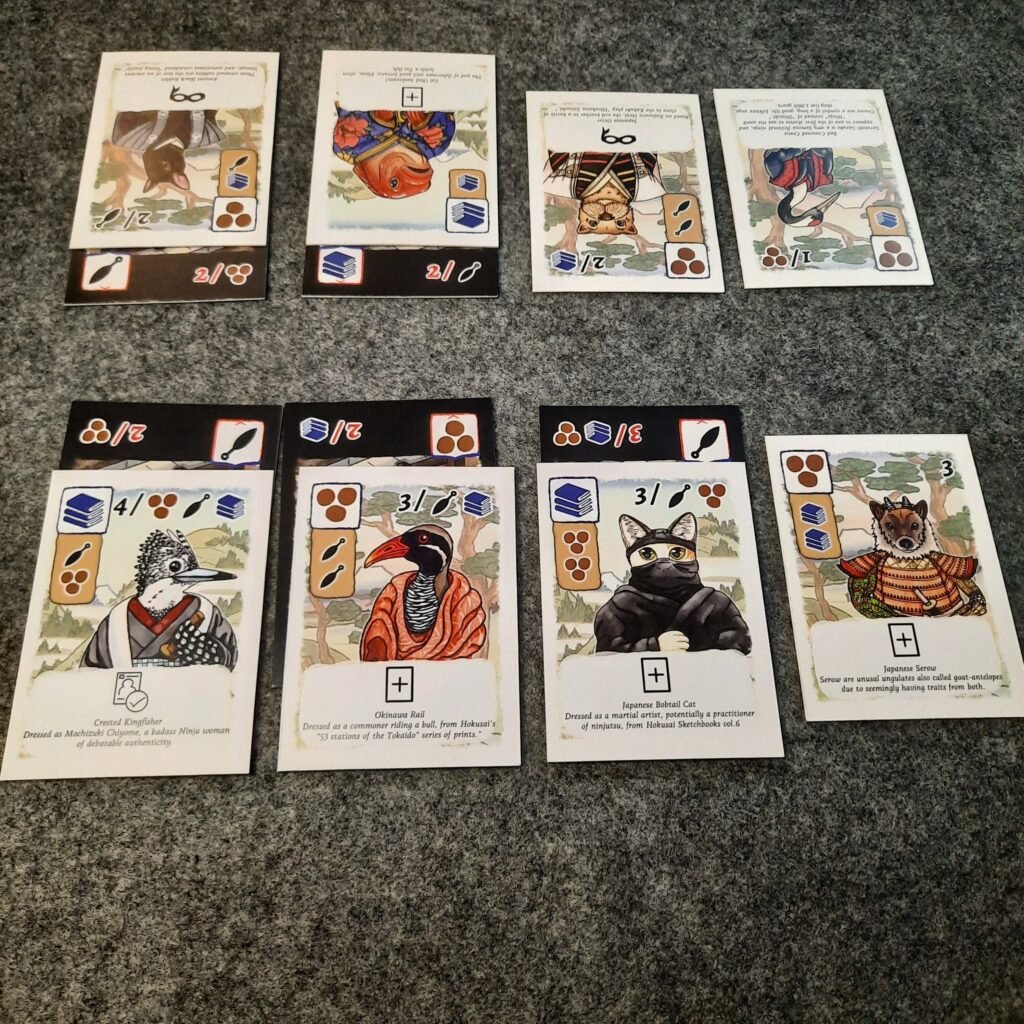
Leslie Kolke’s hand-drawn art is bursting with personality, featuring Japanese animals dressed in historical outfits inspired by Edo-period Ukiyo-e prints.
The names, the little backgrounds, the animal characters, the whole presentation? Absolute icing on the cake.
It also introduced a funny bit of bias into the game for me. I am a big cat person, and I can shamelessly confess I served the cat more often than not just to have it in my tableau. No regrets.
Other than the names and backgrounds of each ninja, the game is mainly governed by symbols, which is another neat touch. Once the iconography clicks, there is little to no language barrier in actually playing the game.
Served. Spied. Sold.
It’s not every day a game grabs me across all three fronts: story, artwork, and mechanisms.
The artwork is bursting with personality. The story is hilariously clever. And then there are the mechanisms, with ideas like Opponent Parasitism at the heart of it.
Safe to say, Shinobi Spy and Supply won me over.
Can you outsell the shop next door, or will you end up working for them without even knowing it?
Recommended items
Game Overview
Publisher: Orca Island Games
Designer: Leslie Kolke and Jered Byford
Artist: Leslie Kolke
Number of players: 2
Difficulty level: Medium
Rounds of gameplay needed to learn: 1 round
Game duration: 15 minutes
Available on: Kickstarter
Theme: Spy-flavored tableau-builder | Run a shop for ninja spies
Number of pages and color: 7 pages, including the tuck box, in color
Assembling difficulty level: Medium, cutting and assembling 27 cards
Lamination: Not recommended
Additional elements required: None
Travel-friendly: 9.5/10
Shelving friendly: 10/10
Rating from PnP Time: 9/10

Tas is a game designer and blogger based in Bangladesh, with the dream of exploring the world of games and introducing it to anyone new to it.