Red Dungeon
Ever felt like being watched all the time?
For generations, the Red Dungeon has swallowed the desperate and the unlucky, forcing them to mine crystals under the iron grip of merciless guards. Gold changes hands. Keys change fates. The Eye of the Dungeon misses nothing.
But repression does not last forever…
Somewhere between the clatter of chains and the scrape of boots on stone, resistance begins to take shape. Scrap turns into machines. Bribes buy moments. A stolen key can change everything.
Down here, every decision is a gamble. Freedom is not given. It is taken.
Entry: before playing the game
First impression
I spend the better part of my game sessions in dungeons. Well enough to call it my second home. So the instant I see a game based on one, I’m in. Add the essence of underdogs striking a rebellion and that’s the perfect icing on the cake.
I’ve had more than pleasant experiences with card-driven games too. Building a garden in Château Gardens or battling it out in 52 Fuels come to mind. Adding one more to that little list excites me.
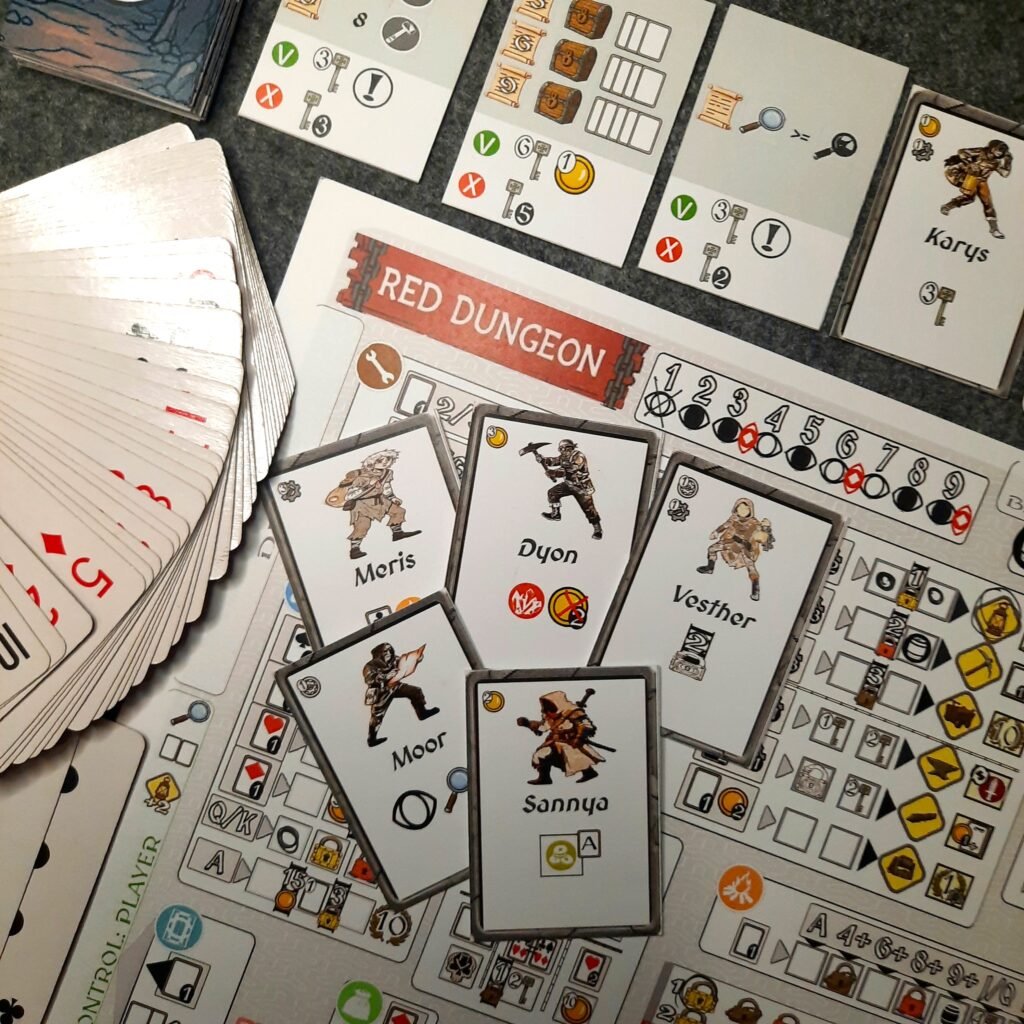
One look at the board sheet and I knew this was going to be quite decision-driven. Consider me enticed!
A bit on the game
In Red Dungeon, you’re a rebellious leader operating inside a prison controlled by ruthless guards and the ever-watchful Eye of the Dungeon. Prisoners are forced to mine crystals and remain under their thumb.
Your objective? Gather gold and crystals, build machines from scrap, bribe guards, and steal keys in order to free as many prisoners as possible.
The game revolves around managing resources and control within the dungeon’s locations. You collect and store resources, convert scrap into machines, use gold for bribes, and use keys to unlock prisoner cells. Storage and deep storage play a role in how efficiently you manage what you gather.
Guards, events, conspiracies, and padlocks influence what actions are available and when. Success is ultimately determined by how many prisoners you manage to free before the dungeon tightens its grip.
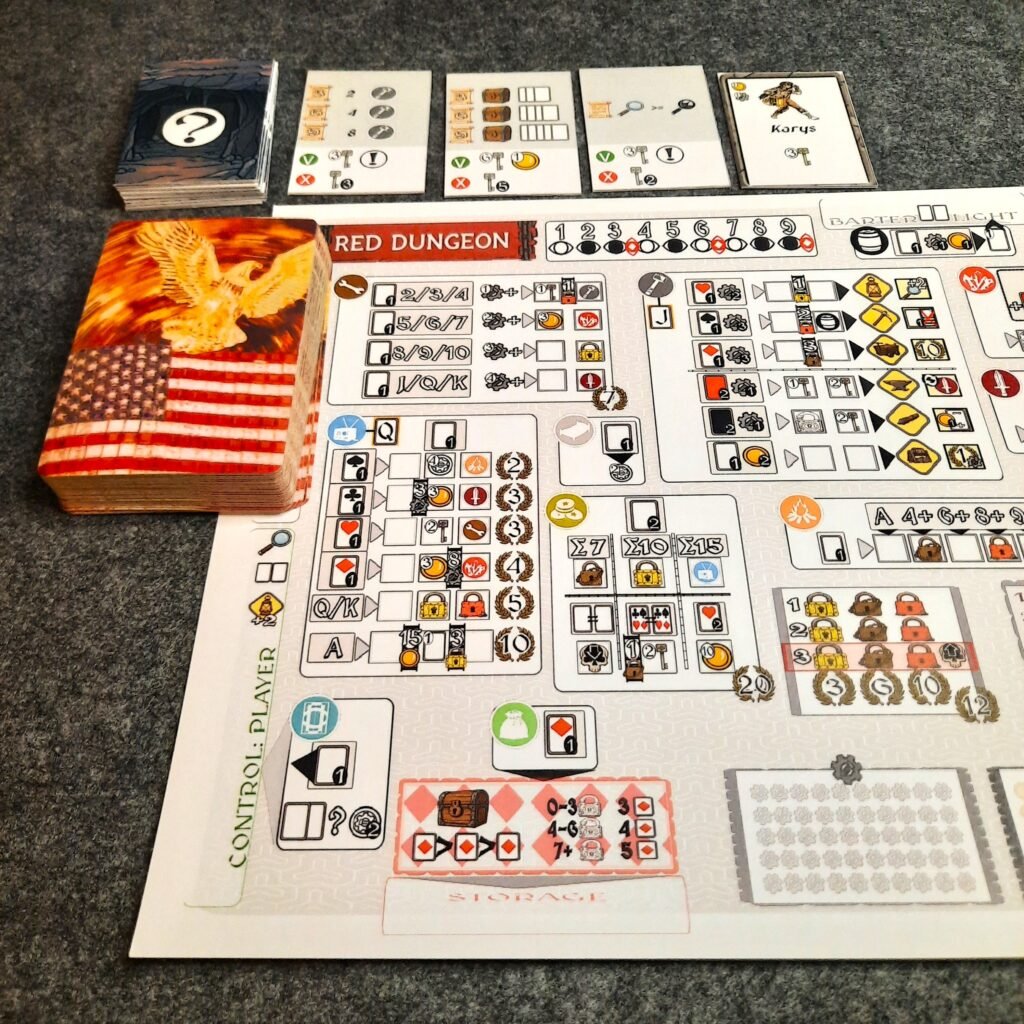
All you need
I printed six pages in total, including the game board sheet and both sides of the Event, Conspiracy, and Hero cards. With that sorted, I grabbed a pen, a small token, and a standard deck of cards.
You can laminate the game board sheet to enable replayability, but I preferred the good old pen-on-cardstock experience and giving my eyes a break from the glare of glossy sheets.
Time to be a badass rebellious leader!
Entry: after playing the game
Findings
Confirming my earlier assumption
I said this game looked decision-driven from a glance. After actually playing a round? Confirmed.
For example, on every round of the game, you draw six cards. Now, where do these go?
+ Do you spend a card on Spark of Revolution, or do you save that high rank for something else that needs it more?
+ Do you push building machines, or do you switch gears and go for Sabotage to stock up on scrap first?
+ Do you invest in Radio for rewards and padlocks, or do you focus on raw resources and keys?
+ Do you risk a Spy play to expand your hand, knowing it can literally add another card to the enemy control zone?
+ Do you prep for the control phase by placing your own cards into your control zone… or do you leave it empty and let luck fill the gaps for you?
Further, do you take what’s visible in light barter, or do you gamble on the face-down unknown in dark barter?
And depending on the round, do you reveal one of the guards’ control cards, or do you sit in the dark and hope you’re not walking into a control-phase slap?
And the thing is, it’s not “do I have a good move?”
It’s “which bucket does this card belong in,” because every card you commit to one track is a card you cannot use somewhere else. With only six in hand at the start of the round, allocating them right is the heart of it.
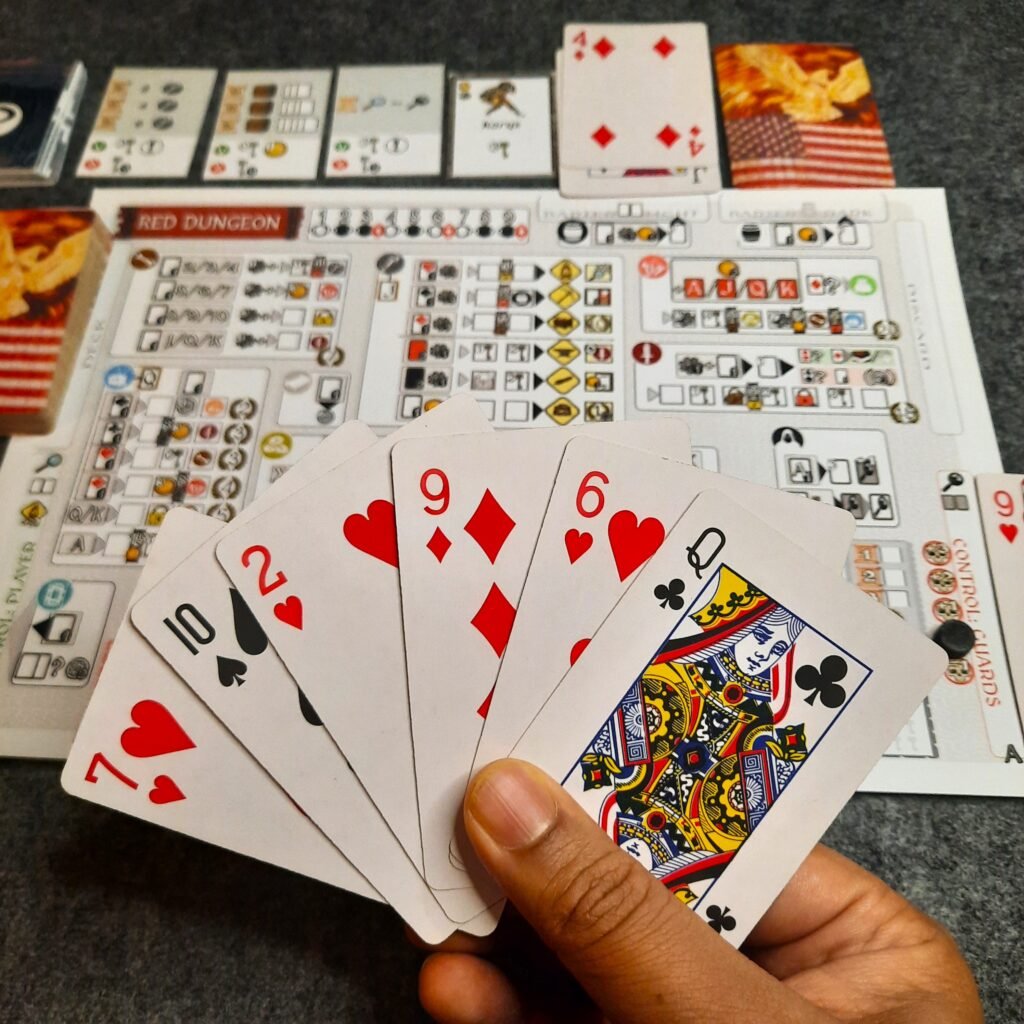
Cool usage of the cards
You are not just playing cards for a single effect and discarding them. The same deck is constantly being stretched across different systems. A card can go into light or dark barter. It can sit in your control zone. It can be stored. It can power Sabotage. It can help build machines. And more!
A high-value card in your hand might look perfect for the Spark of Revolution, but committing it there means it cannot strengthen your control zone. A lower-value card might feel weak at first glance, until you realize it fits Sabotage or Storage just right.
I also liked the Control phase. It feels like a quiet faceoff between you and the guards. You compare the cards in your control zone against the guards’, and suddenly it’s a numbers game with consequences.
Lose that exchange and you’re not just shrugging it off. You can lose keys. You can lose stored cards. Progress you thought was absolute suddenly slips through your fingers.
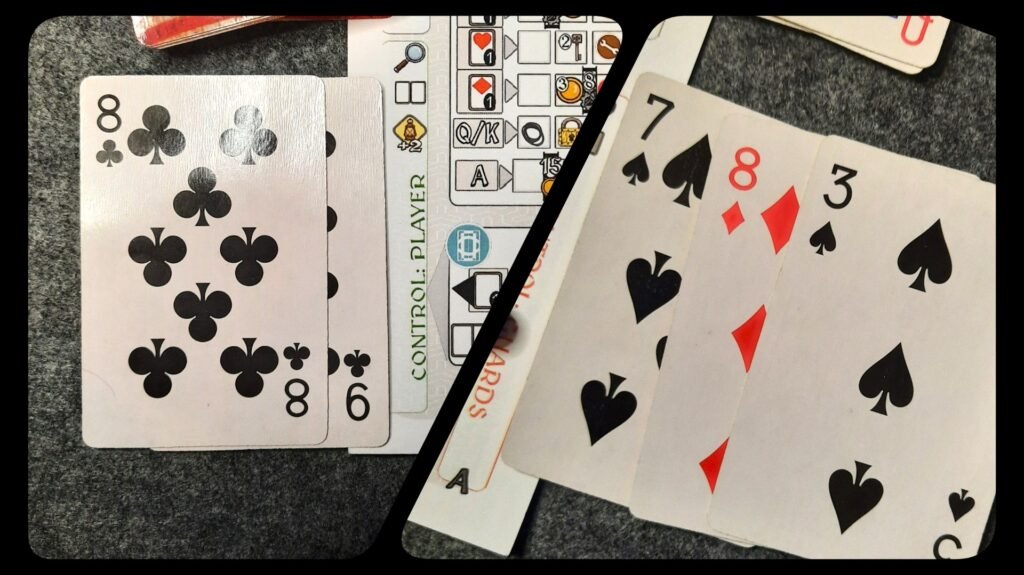
The light, dark, and smelting
I really liked how the round structure in Red Dungeon quietly shapes your decisions.
The game alternates between light and dark rounds. In the Guard phase, two cards are placed into the enemy control zone every round. During light rounds, one of those cards may be revealed, giving you a glimpse of what you’re up against. During dark rounds, everything stays hidden, and an Event is revealed and resolved instead. One round gives you partial information. The other pulls the rug slightly from under you. That alternating rhythm matters.
Then there’s smelting. Once every three rounds, crystals are converted into gold. It sounds simple, but it forces a pause. Were you planning to hold onto those crystals? Do you convert now and strengthen your gold supply? Smelting acts as a checkpoint that can shift your priorities mid-flow.
Across the nine phases of a round, from guard placement to actions, control resolution, events, and smelting, the game keeps rotating your focus. You are not stuck doing the same type of decision repeatedly. Each phase nudges you in a slightly different direction, creating a steady cadence that keeps the round moving without feeling repetitive.
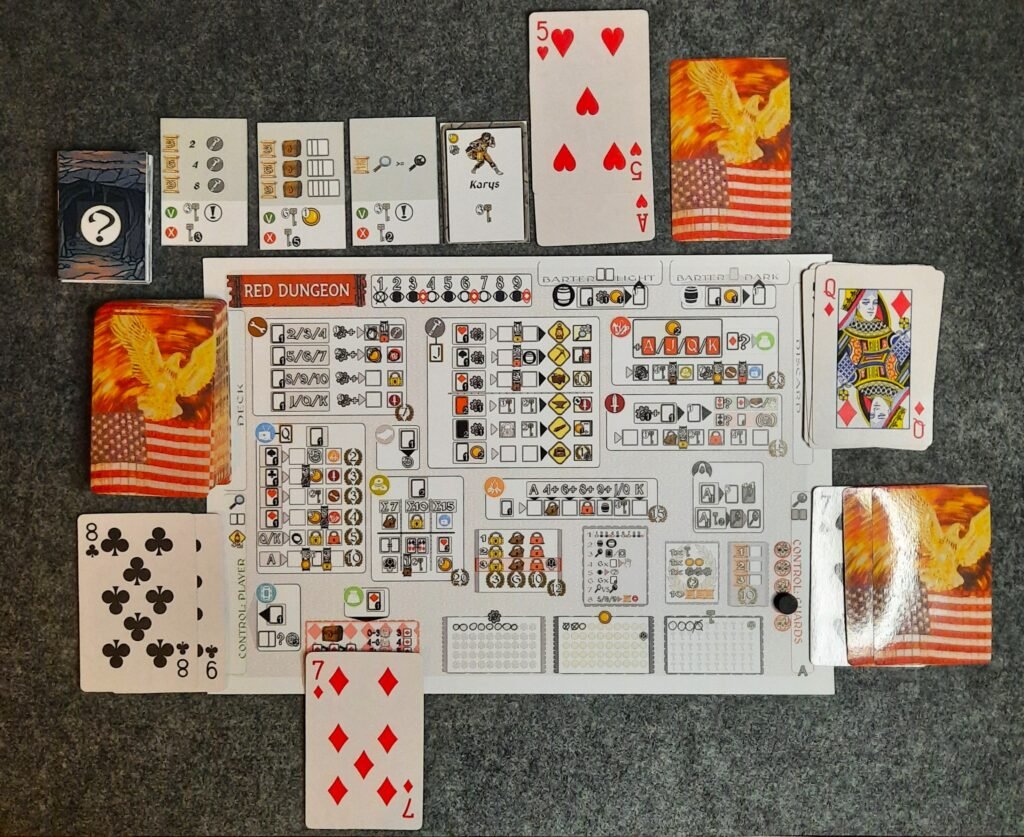
Replayable?
Time to do the math.
You have 6 different leaders, each with different starting resources. On top of that, every game starts with three conspiracy cards drawn from the deck, and those can steer your priorities in completely different directions.
Then comes the round-to-round swing. Each round you draw six cards and decide how to allocate them across action lanes like Sabotage, Building machines, Radio, Spark of Revolution, Bribery, Spy, Transfer, and more. On dark rounds, an event card is revealed and resolved, usually offering two possible outcomes, which can twist your plans in ways you did not fully anticipate.
So yeah. Between leaders, conspiracies, events, machines, and the constant where do my six cards go this round puzzle, this one has more than enough ways to play out differently. Replayable? Yes.
I took my time playing this game solo, and really enjoyed it. If you’re playing for the first time, you can bench the Event and Conspiracy cards. The first time I played it, the session went for over 1.5 hours. Time flew by! Loved it.
The campaign is live!
This is Sparker’s first Kickstarter campaign, and it’s already funded. Playing a game created by a designer who’s been at it for over a decade makes me appreciate Red Dungeon even more.
Give the project some love!
Recommended Items
Game Overview
Publisher: Time To Dice
Designer: Krzysztof “Sparker” Pietrzak
Number of players: 1 to 4
Difficulty level: Easy to Medium
Rounds of gameplay needed to learn: 1 round
Game duration: 45 to 90 minutes
Available on: Kickstarter
Theme: Flip-and-Write | Escaping a Dungeon
Number of pages and color: 6 (color)
Assembling difficulty level: Quite easy. Print and assemble cards.
Lamination: Recommended for replayability
Additional elements required: A pen, a token and a standard deck of cards
Time to learn: Within 30 minutes
Travel-friendly: 9.5/10
Shelving friendly: 9.5/10
Rating from PnP Time: 8.5/10

Tas is a game designer and blogger based in Bangladesh, with the dream of exploring the world of games and introducing it to anyone new to it.