One Page Quest
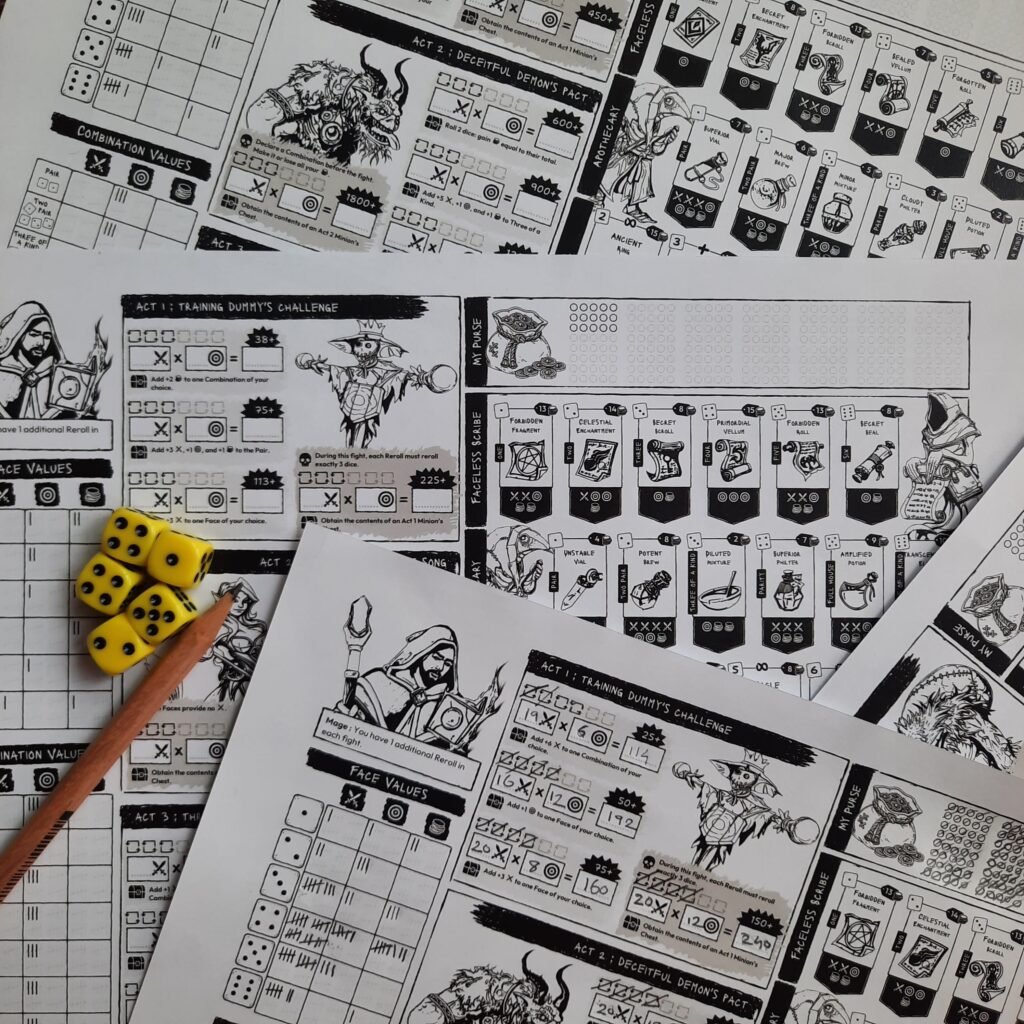
Five dice. One sheet of paper. Three acts standing between me and the victory line.
And in front of me stood a training dummy. Hardly a terrifying opponent, right? But as my eyes travelled further down the line, past the minions and the bosses awaiting me, I realized this one was gonna take some planning!
So I grabbed the five dice and braced myself. I gotta roll these foul creatures out of my way!
And so, my quest began.
Entry: before playing the game
First impression
I got wind of One Page Quest’s Kickstarter campaign about two weeks ago, when I came across Léandre’s post about the game. And at first glance, I could tell that a LOT was happening, in a good way!
I was looking at a one-page PnP that appeared to blend dice manipulation, poker hands, character upgrades, and increasingly challenging monster battles. Alexz’s Roll Breakers immediately came to mind, a roll-and-write inspired by Balatro that I’d recently played. And I really liked Roll Breakers, so One Page Quest certainly intrigued me.
But what grabbed my attention the most was the website that Léandre and Clément built for the game. You could choose your difficulty, gradually unlock heroes and other content, track your wins and losses, and generate your own adventure sheet before printing it out. Now THAT’S something interesting!
I’ve been blessed with playing three Dynamic Print-and-Plays earlier this year. Kudos to Robin and Jack of Pagepunk, who opened up this whole other world of print-and-play for me. And generating adventure sheets through One Page Quest’s website seemed to have a similar flavor!
Consider me double intrigued.
A bit on the game
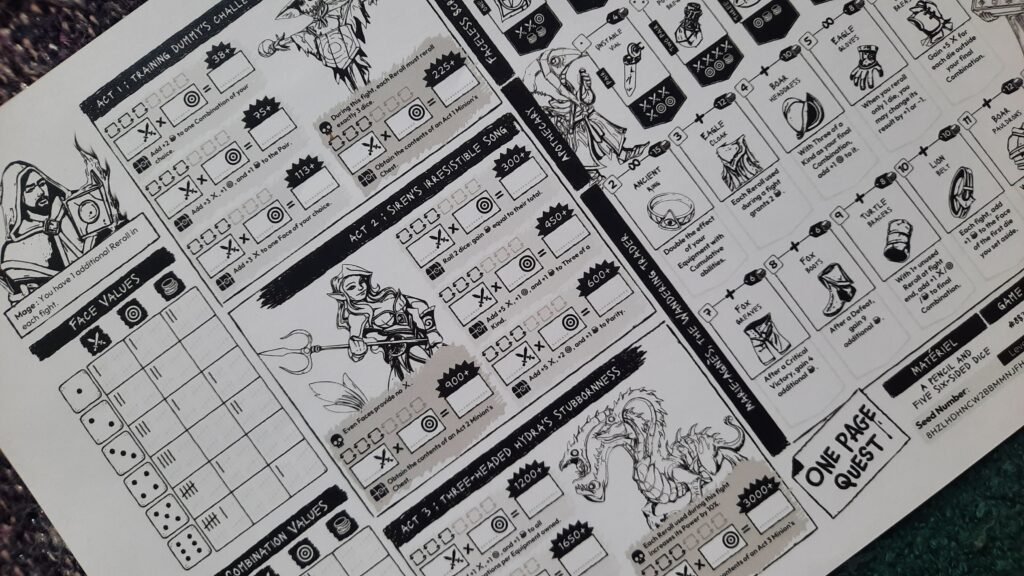
One Page Quest is a solo fantasy roguelike roll-and-write by Léandre Proust of Grammes Édition and, as you’ve guessed by now, a one-page PnP.
Your goal? Fight your way through three acts, each featuring three minions and a boss, and ultimately defeat the final boss to complete your adventure.
You start by choosing a hero and difficulty level on the game’s website, which generates a unique adventure sheet for you to print.
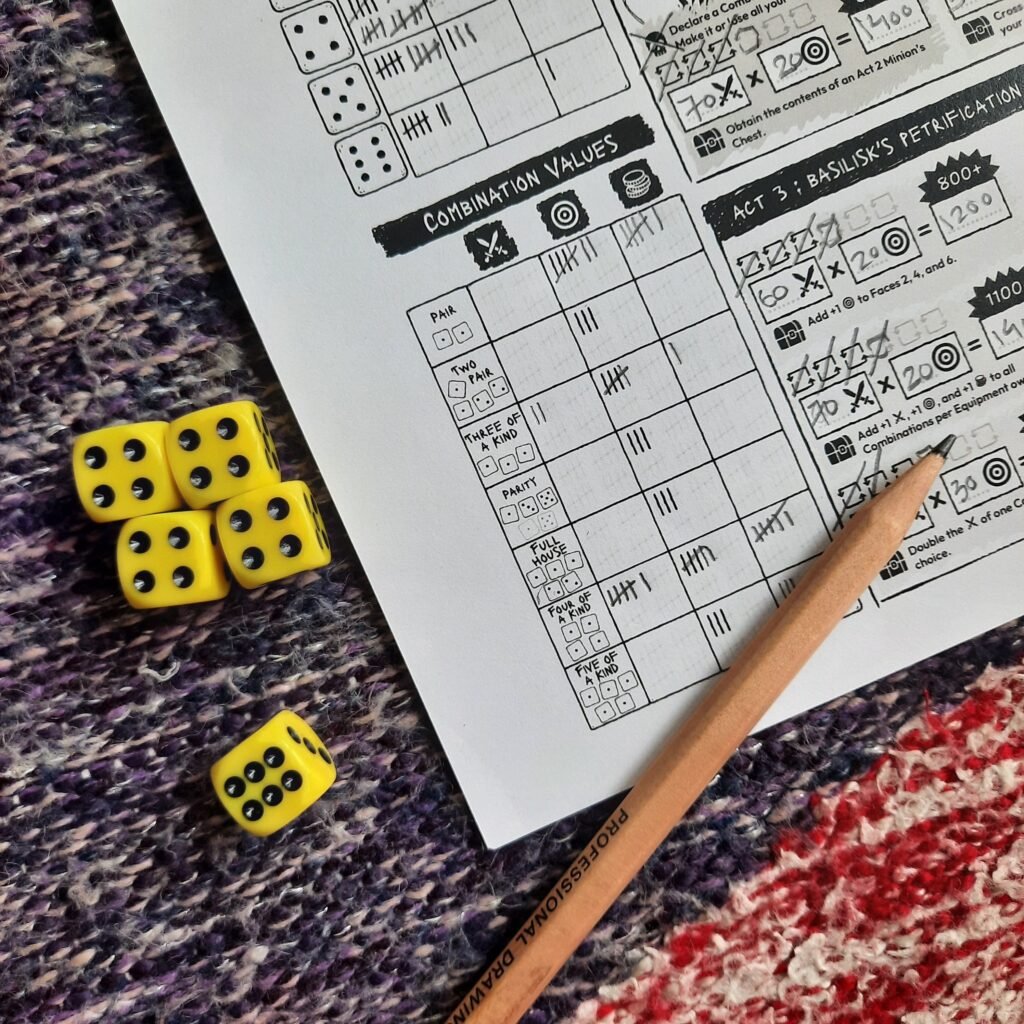
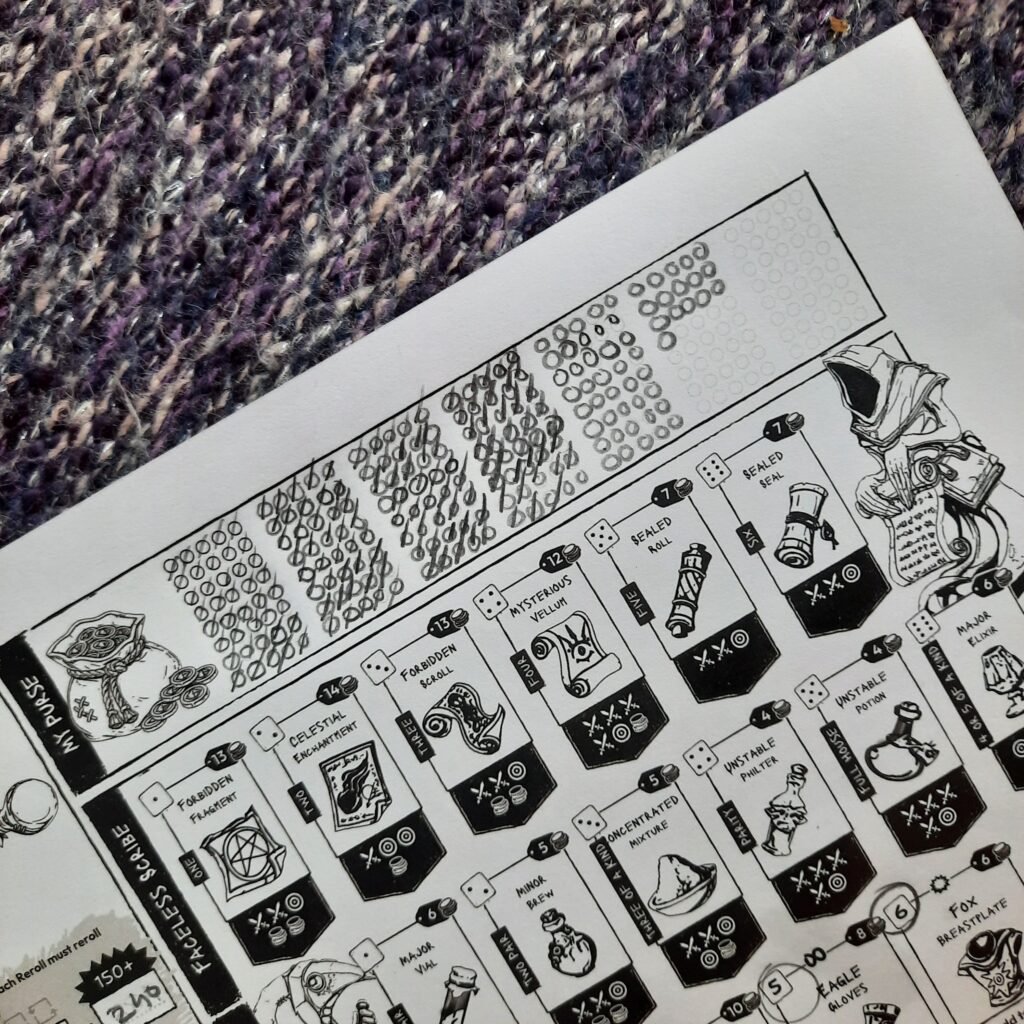
Armed with five dice, you’ll roll and form poker-style combinations such as pairs, full houses, and four of a kind. Each die face and combination has Strength, Accuracy, and Gold values. Multiply your total Strength (rounded down to the nearest multiple of 10 if it reaches 20) by your total Accuracy, and you’ll get your attack Power, which determines whether you’ve defeated your opponent.
Between encounters, you’ll visit merchants to spend your Gold on upgrading dice faces, improving combinations, and purchasing equipment with special abilities. As you progress, your hero gradually grows stronger to face the increasingly difficult enemies ahead.
But beware! Losing to a boss means losing the entire adventure. So make those dice rolls count!
All you need
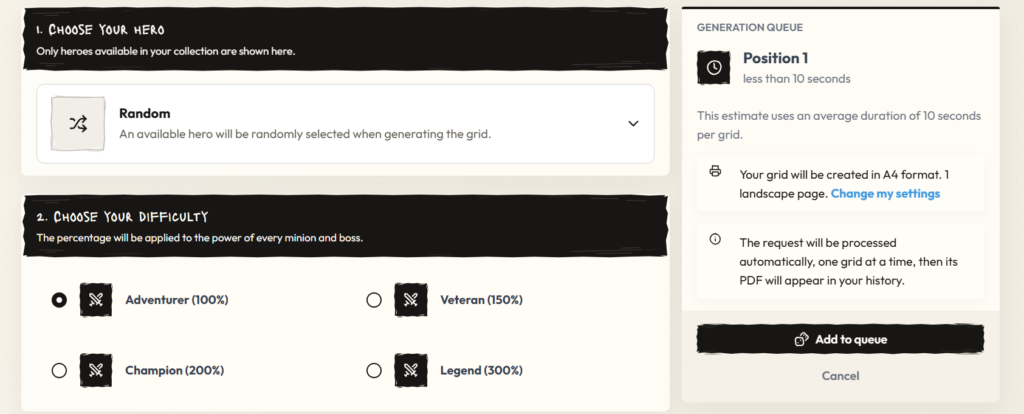
Head to One Page Quest’s website and opt to generate a new sheet. You start by choosing your hero, then pick your preferred difficulty. There are 4 difficulty levels to choose from: Adventurer, Veteran, Champion, and Legend.
Once you’re happy with your choices, you add your adventure to the generation queue, and voila! A pdf of your adventure is generated, ready for you to download and print.
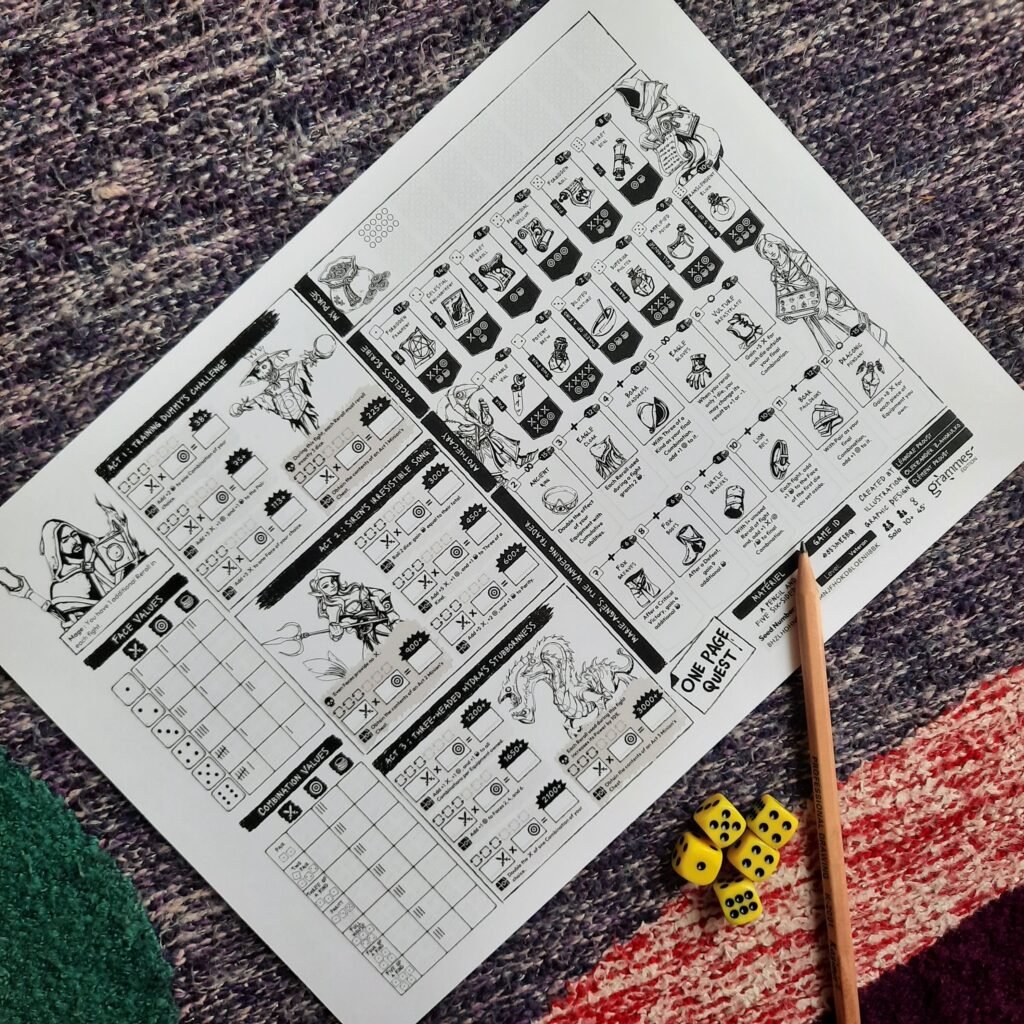
After all that generating, we’re back to good old-fashioned print-and-play. You print the adventure sheet (low-ink, black and white), grab 5 D6 dice and a pencil. That’s it. No assembly whatsoever.
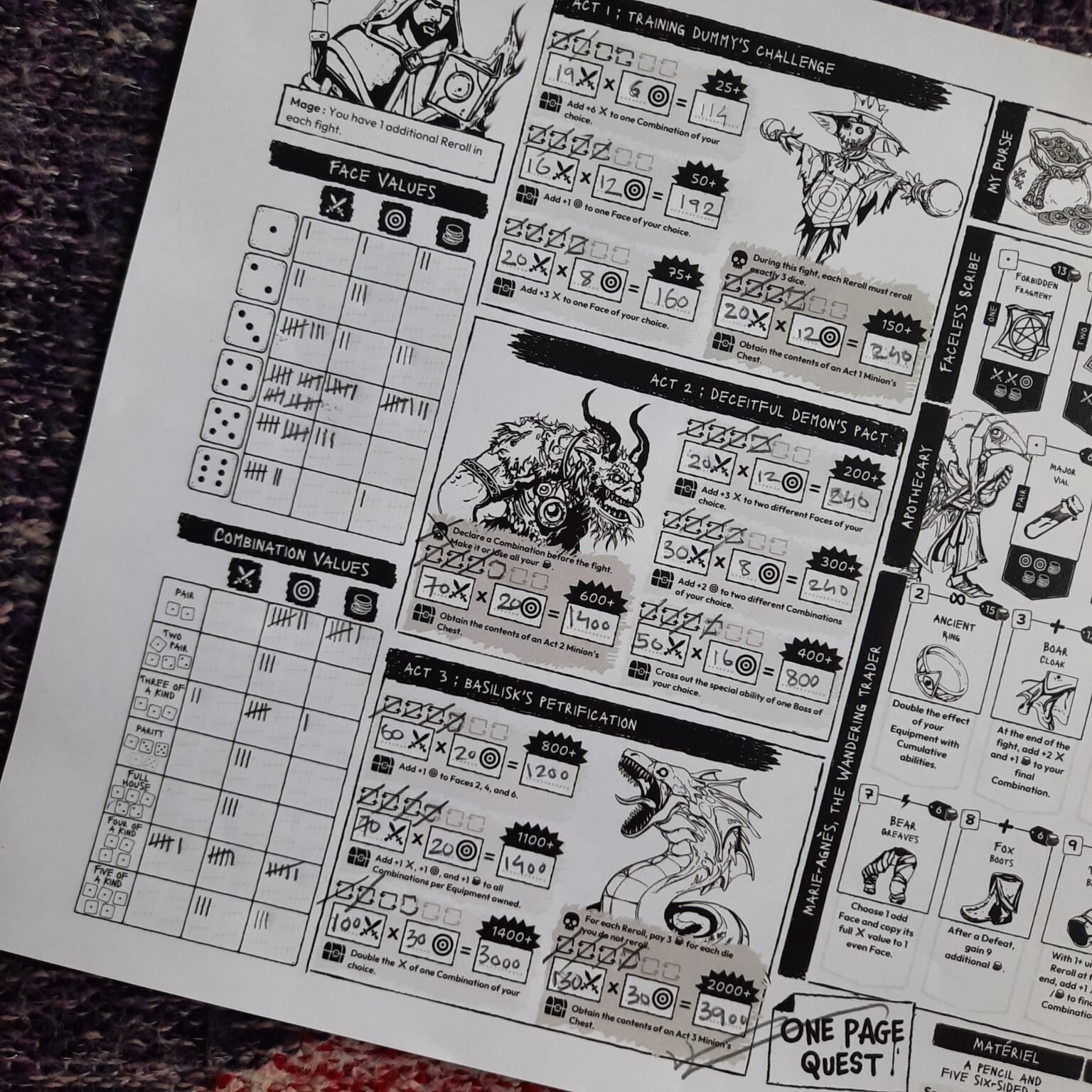
The sheet itself is absolutely PACKED with stuff, from enemy encounters and character upgrades to merchants, equipment, etc. Quite fun just looking at it! And I really dig the old-school fantasy artwork.
Okay, time to roll into battle! Let’s see how this whole roguelike adventure plays out.
Entry: after playing the game
Findings
My debut
My first go at One Page Quest was with the Mage as my hero, on Adventurer difficulty. That’s level 1 out of 4. So things started pretty chill as I took out the first minion comprehensively, bagging a nice chest reward along with a handful of Gold. That’s encouraging stuff!
I went straight to them merchants to get some Strength and Accuracy upgrades, though I admit I didn’t strategize my moves as much. I bought whatever my humble Gold could afford, hehe.
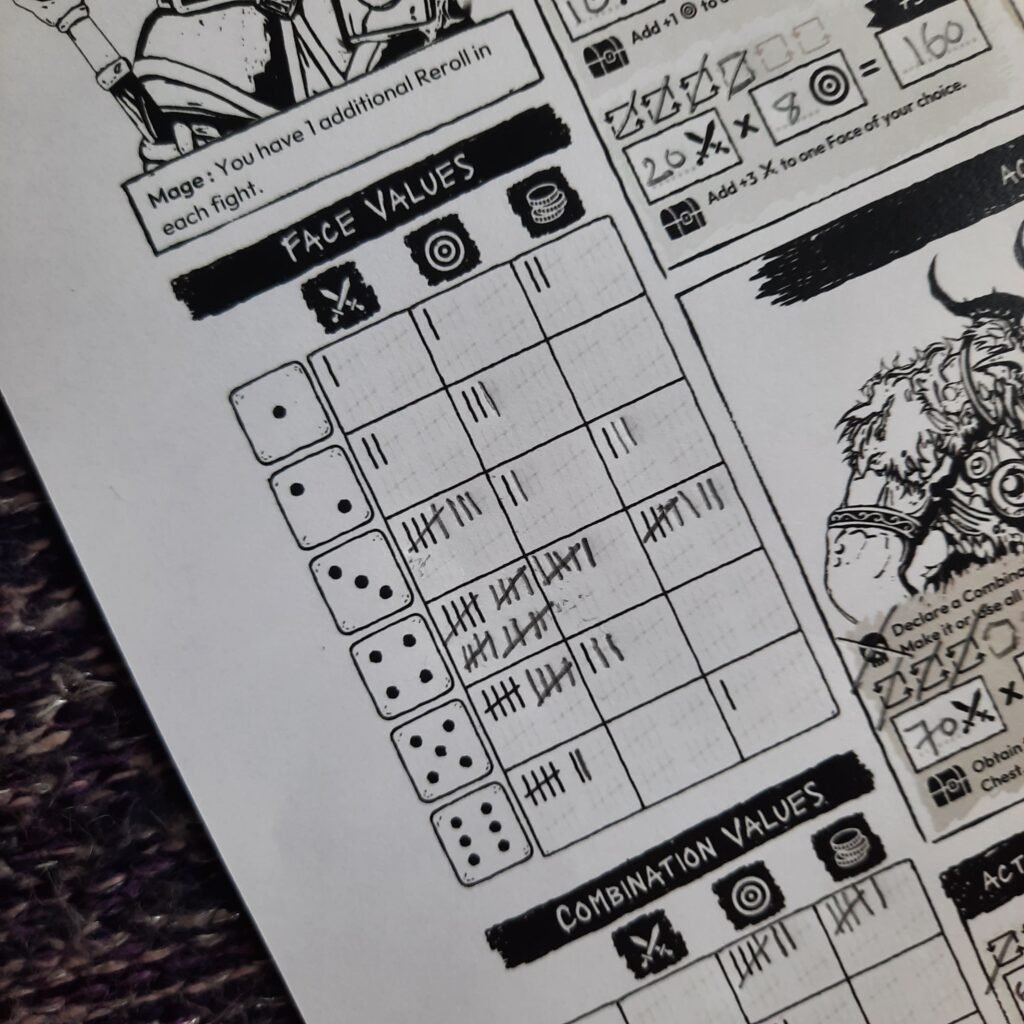
The second minion was also easy to handle, but with the third, I could sense the game gradually tightening its screws, ever so slightly. So I slowed down on the dice rolls a bit and started thinking about making my 3s and 4s more powerful. Why? Cause the dice roll gods were showering them on me, haha. Also, I sort of wanted the middle of the dice range to pack more punch. The 1s and 2s didn’t make for particularly powerful attacks, while 5s and 6s weren’t appearing as much.
Another layer of strategy came into the equation when I started upgrading the poker combinations themselves. I felt I could capitalize a lot on Three and Four of a Kind, particularly the latter. So investing more Gold in those combinations felt like the right move. Focusing my upgrades on just a few dice faces and combinations felt like a gamble, but it paid off pretty well. I cleared Act 1 quite comfortably. Two more Acts to go!
Act 2 tightened its screws even more. The Power required to defeat the minions and bosses kept increasing. And right around the halfway stage of my adventure, I suffered my first defeat at the hands of a minion.
But it wasn’t game over! You can continue your adventure even after losing to a minion. You only lose the game if a boss takes you down.
After that bitter defeat, I realized I wasn’t making nearly enough use of Marie-Agnès, the Wandering Merchant. So I started making amends by purchasing three pieces of Equipment, and boy did they pay off! The Wandering Merchant can be a game-changer if used well. My Equipment helped me boost Accuracy based on odd dice in my final combination, alter a die’s value by 1 when rerolling just that die, and even add Strength equal to the amount of Gold left in my Purse!
So, by combining those Equipment abilities with my gamble of upgrading a select few dice faces and poker combinations, I managed some narrow escapes against the minions and bosses and ultimately emerged victorious. And that was the easiest level!
Got to improve my game before I even dare to take on the tougher levels, haha. It was one catchy, catchy first try.
The bosses and their minions
I stumbled upon an interesting concept while playing Echoes of Tomorrow earlier this year, called Failing Forward. Meaning, if you fail to achieve something in the game, the adventure doesn’t stop there. You get the chance to gain something, regroup, and move on. And I’m glad to see the same concept surface in One Page Quest!
Endgame doesn’t trigger when you get defeated by the minions in each act of the game. Of course, you don’t get as many perks as you would by defeating them, but you still get the chance to bag some Gold and purchase items from merchants. So you get this opportunity to learn from your mistakes, reassess, and continue your journey through the acts, as long as you don’t repeat such mistakes with the bosses.
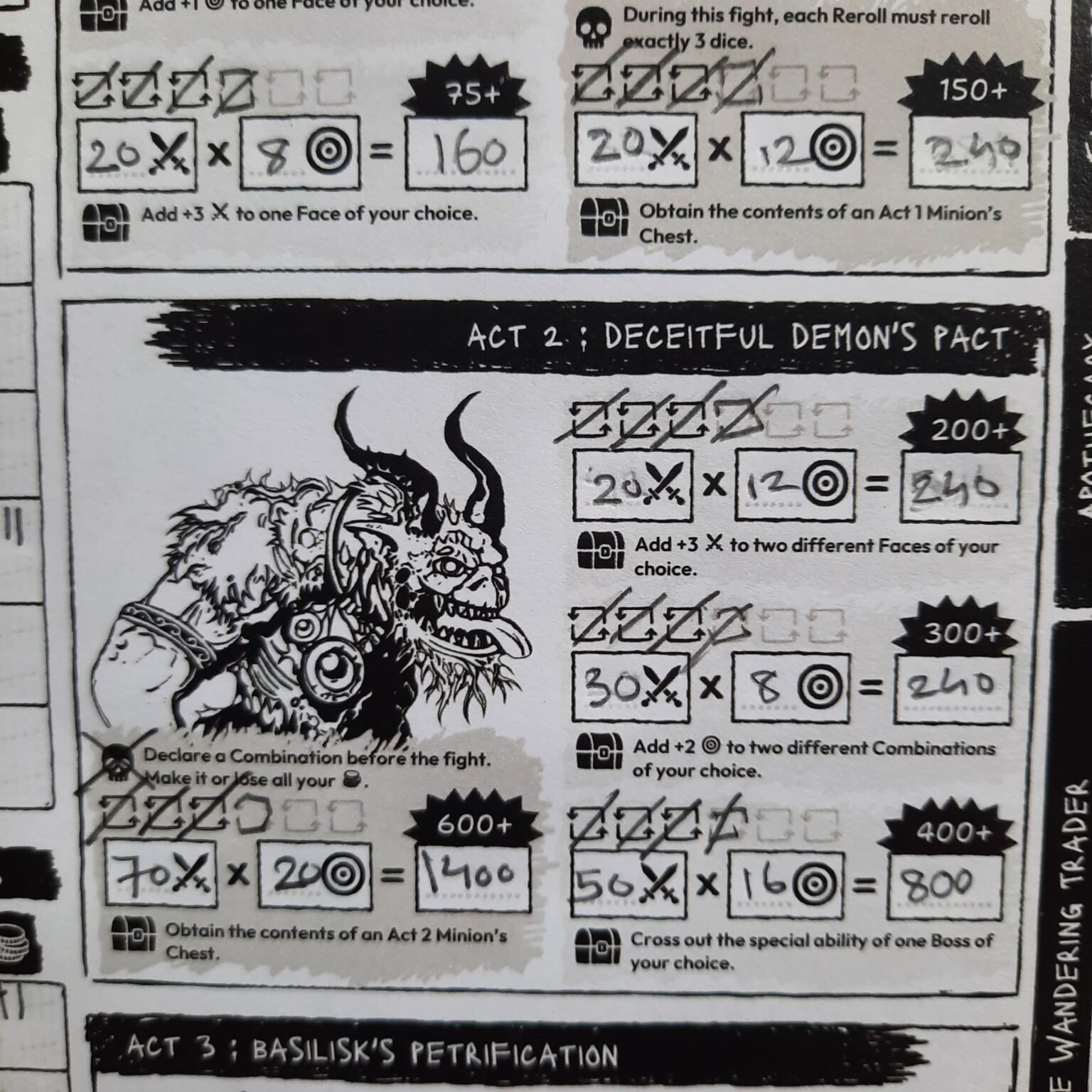
Cause the bosses are ruthless! Losing to a boss means losing the entire adventure. And to make matters more interesting, each boss comes with a special ability, indicated by a little skull icon on the adventure sheet. These abilities introduce additional challenges during boss fights. In my adventure, the first boss forced me to reroll exactly three dice whenever I used a reroll. The second required me to declare a poker combination before the fight, and failing to make it meant losing ALL my Gold! The third made rerolling rather expensive, charging 3 Gold for every die I chose not to reroll. Brutal.
As if the increasing Power requirements weren’t challenging enough, haha.
The website
When I first printed out the game, I was focusing only on generating the adventure sheet. That involved choosing the hero and one of the four difficulty levels. It was on my second visit to One Page Quest’s website that I realized there’s plenty more at play.
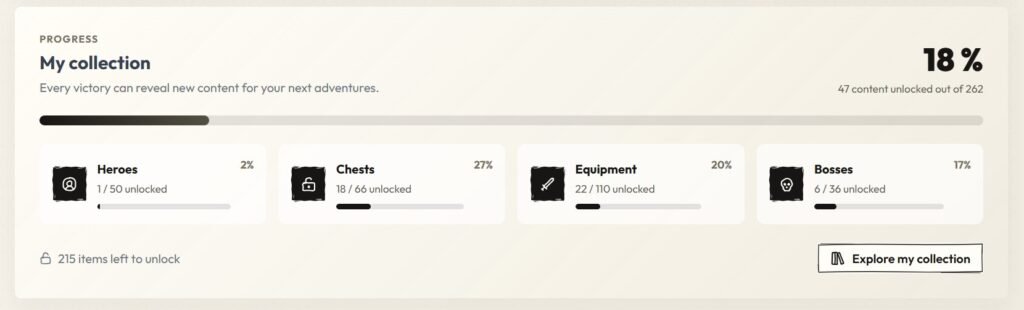
I was surprised to see a history log where you can track your victories and losses, which is actually tied to what you unlock down the line, be it new heroes, equipment, bosses, chests, etc. And we’re talking about a LOT of content here. According to the Kickstarter campaign, the game features 50 Heroes, 36 Bosses, 66 Chests, and 110 pieces of Equipment to unlock progressively.
So the adventure sheet evolves not only based on your hero or difficulty level, but also on how far you’ve progressed by the time you generate it. The more you play, the more One Page Quest’s website opens up to you. That is really cool!
And that’s not all. With the surprises Léandre has been unveiling throughout the Kickstarter campaign, what the website currently offers (which is already pretty solid) seems like just the foundation. There’s plenty more to come.
A lot of heart
The more I got to know about this project, the more I could feel the passion behind it. Léandre has been designing games for almost 15 years, and you can totally feel that experience and passion not just in the game itself, but in everything surrounding it.
I already mentioned how much the website wowed me, not because of fancy bells and whistles, but rather because it doubles as an adventure log for players, complete with rewards and progression.
Beyond that, the game has translations into six additional languages confirmed, bringing the planned total to eight. It just had its full-color version announced, offers flexible printing options for different paper sizes, and even has a printable dice tower to go with all the dice rolling! And there’s plenty more, cause Léandre and his team keep announcing new stuff.
All these little extras are things Léandre and team could easily have opted not to include. But they didn’t stop at just making the game and its adventure sheet generator. And that’s something I really applaud.
A big win for the community!
When two relatively similar games launch their Kickstarter campaigns around the same time, it’s easy to assume they’ll be competing with each other. And having played both Roll Breakers and One Page Quest, I sort of wondered the same thing. Till Léandre and Alexz proved me wrong!
Both designers had independently developed their games, drawing inspiration from Balatro, using almost identical material constraints, and without even knowing each other. And somehow, their Kickstarter campaigns ended up running at nearly the same time.
But rather than treating each other as competitors, Léandre reached out to Alexz with a pretty wholesome idea: why not collaborate and introduce their games to each other’s communities?
The two came up with questions covering their inspirations, design choices, mechanics, progression systems, replayability, and more. They answered the questions independently, without knowing what the other had written, and published the interviews on each other’s Kickstarter campaigns!
So Léandre shared Alexz’s answers on the One Page Quest campaign, and vice versa. Instead of trying to prove which game was better, they gave their communities a chance to learn about the thought processes behind two games born from similar inspirations but developed in different directions. How cool is that?
A big salute to Alexz and Léandre for such a wholesome collaboration. As someone who’s played both games, I can vouch for both. And no, they are not the exact same game, folks! They are awesome in their own ways.
Is it for you?
Not every game will be your thing, and that’s totally okay. So if you’re wondering if One Page Quest is your type, here’s your checklist:
+ Do you like tons of dice rolls?
+ Do you like drawing and crossing lines or marking little circles?
+ Do you like mathing in your games? Not the algebra kind, but basic sums and multiplications?
+ Do you like dice manipulation to form combinations?
+ Do you like games that are a bit loop-y?
Ask yourself these questions to assess if One Page Quest is your cup of tea.
As for me, it certainly is, cause I liked how the entire experience kept me hooked, and how my strategy had to evolve as I faced increasingly powerful bosses. And with tougher difficulty levels still to tackle and so much more to unlock as I keep playing, it’s the kinda game I’d gladly keep coming back to.
Your quest awaits!
As I write this blog, One Page Quest has about 9 days left in its Kickstarter campaign. And I’d nudge you folks to check it out for a couple of reasons, beyond simply finding out if it’s your cup of tea.
First, the campaign has gone WILD! Over 3,000 backers for a print-and-play game is something you don’t see every day, so that’s worth checking out.
Secondly, there’s a free demo that you can print and play right away to see if the game is your thing. Why miss that chance?
So go check out One Page Quest’s Kickstarter campaign and see if it’s your cuppa tea!
Recommended items (affiliate)
Game Overview
Designer: Léandre Proust
Number of players: 1
Difficulty level: Easy to Medium
Rounds of gameplay needed to learn: 2-3 rounds
Game duration: 30-40 minutes
Available on: Kickstarter
Theme: Roll-and-write × Poker hands | Taking out minions and bosses
Number of pages and color: 1 page (black-and-white)
Assembling difficulty level: Super easy, ZERO assembly!
Lamination: Only if the glare doesn’t bug you
Additional elements required: 5 D6 dice + 1 pen/pencil
Time to learn: Within 20 minutes
Travel-friendly: 10/10
Shelving friendly: 10/10
Rating from PnP Time: 9/10


Tas is a game designer and blogger based in Bangladesh, with the dream of exploring the world of games and introducing it to anyone new to it.