King
You have just been crowned king.
Yet somehow you don’t feel the joy you thought you would.
The court smiles. The banners rise. The throne looks steady from a distance. Up close? It’s shaking.
Rumors say your appointment was meant to bring the kingdom’s downfall. And the worst part is this. The rumors sound plausible.
You have no support. Your enemies have momentum. The borders are already bleeding.
Do you still want the crown, now that you know what it costs?
Or will you buckle under the weight of it?
Entry: before playing the game
First impression
Every designer has a specialty. Some design minimalist games. Some build puzzles.
Radek builds systems. Heavy-duty. The kind where you sit down for a quick look and suddenly you’re an hour deep, tracing consequences like you’re reading a map by candlelight.
Two of his games have lived at the top of my list for that exact reason. Chronicles of Civilization and Call the Doctor have competed with each other in my head for being the most in-depth PnP experience I’ve ever played. Whether you’re saving lives in an operating room or building a civilization from scratch, these games take things deep.
Going into King, I had one piece of context. It’s a sequel to one of his previous titles, Knight.
I haven’t played Knight. Which means this sequel, for me, is not a sequel at all. No muscle memory. Just an unspoiled first step into another world of Radek’s. And I’m excited.
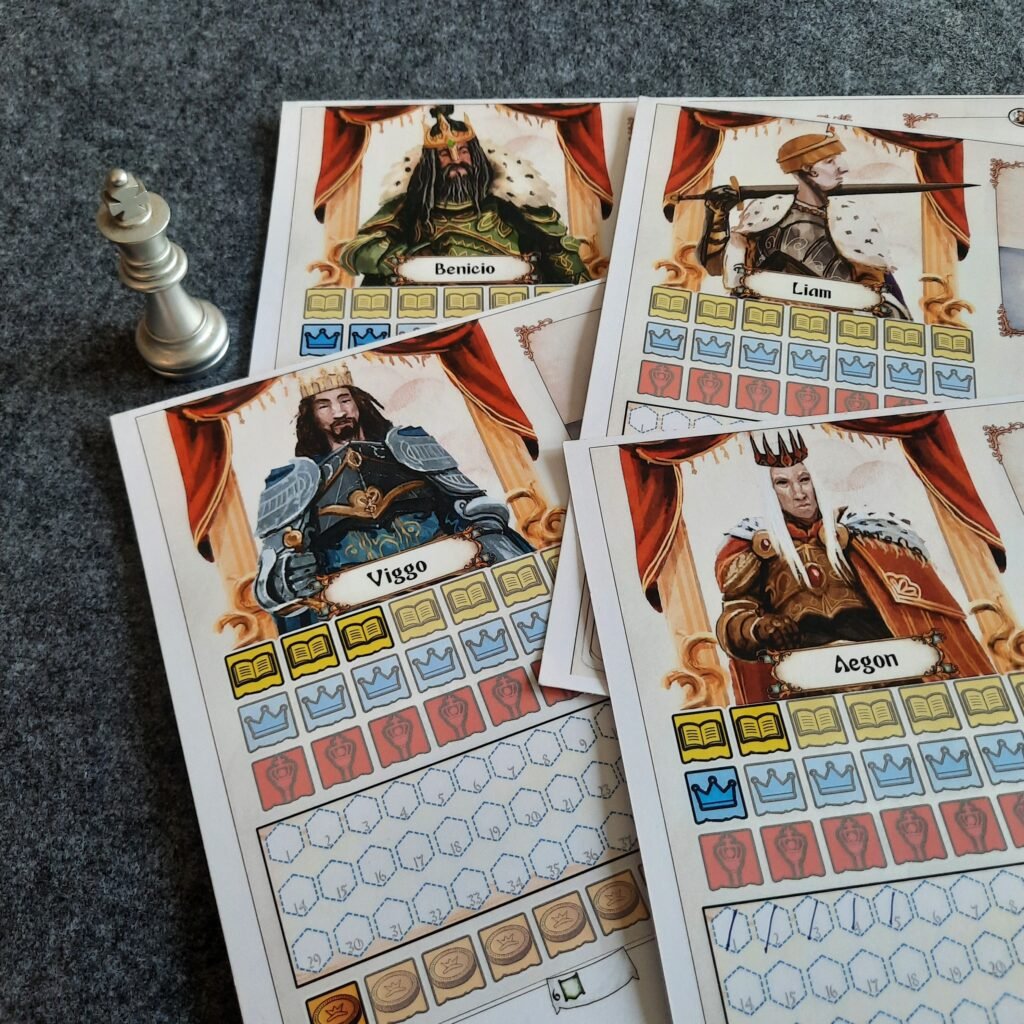
A bit on the game
King is a solo, scenario-driven flip-and-write about keeping a kingdom upright while it actively leans toward collapse. You play through a scenario with its own objectives, but one system sits underneath everything: Diplomacy. It is always shifting, and it can end the reign early if it swings too far in the wrong direction.
Each turn begins with an Event card and a simple decision. Choose left or right. That choice determines what resources you gain, which Advisor is available, which domain you will activate, and what consequences will arise at the end of the turn. While you build your side of the kingdom, the enemy develops too. Units appear on the map. Watchtowers rise. Pressure spreads across routes you can no longer ignore.
You spend what you gathered to develop and act, trigger the domain tied to your choice, then take the consequences. Round by round, the kingdom grows, the situation tightens, and the margin for error shrinks.
All you need
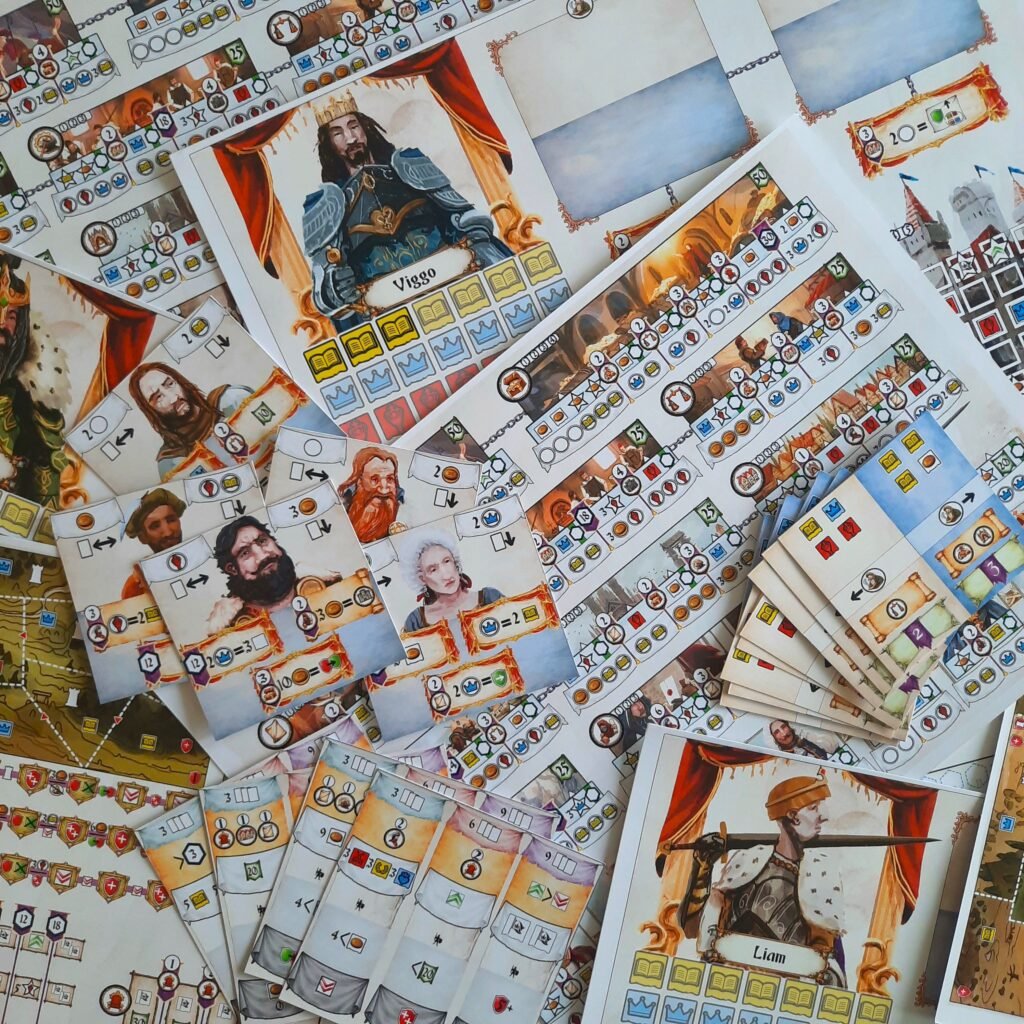
To play King, you will print 3 cards and 3 decks. The cards are the King card, Kingdom card, and Scenario card. The decks are the Event deck, Goal deck, and Advisor deck.
If you print everything, including the multiple Kings and Scenarios, it comes out to 11 pages. Once printing is sorted, you will need the following:
+ 4 value markers
+ 18 unit markers in two colors
+ 12 Watchtower markers in two colors
+ 1 Diplomacy marker
+ 1 Goal marker
+ 1 choice marker
+ a writing utensil
+ and a few extra tokens, just in case a scenario asks for more tracking than the base set
Numerous Kings, Scenarios, and Goal cards are already screaming replayability. But knowing Radek, it’s a preconceived notion I’m always leaning on.
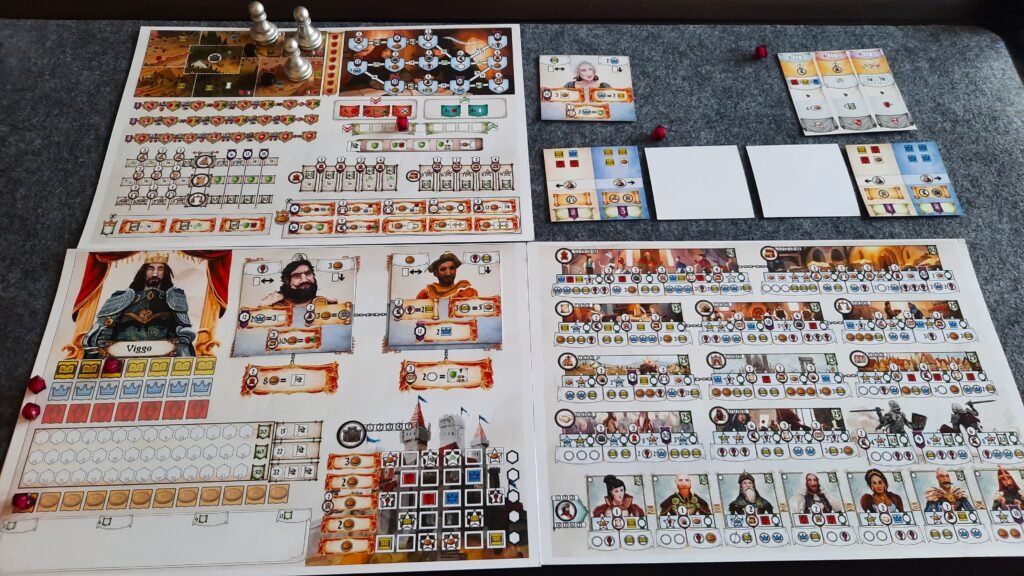
Entry: after playing the game
Findings
Smooth flow with sharp spikes
King, like Radek’s other titles, is packed. But it is also beautifully paced across the 12 turns of a run. The game tightens at turns 3, 6, and 9, when you stop and check your progress against the Goal card. Those moments hit like spikes. You either meet the condition and reap the rewards, or you don’t and suffer the consequences.
The rest of the pressure comes from everywhere at once. You are constantly allocating resources to the right place at the right time, and every turn begins with the same loaded decision. Which side of the Event card are you taking? That choice decides what you gain, which Advisor is active, which domain you will trigger, and what consequences you are inviting in at the end of the turn.
With the responsibility of the entire kingdom on your shoulders, it should feel overwhelming. But the flow does a lot of work. Each turn has clear divisions, and you move through them in order.
Gather. Spend. Activate. Resolve.
If you know what you are doing, that structure makes the weight feel manageable. Not light, just doable.
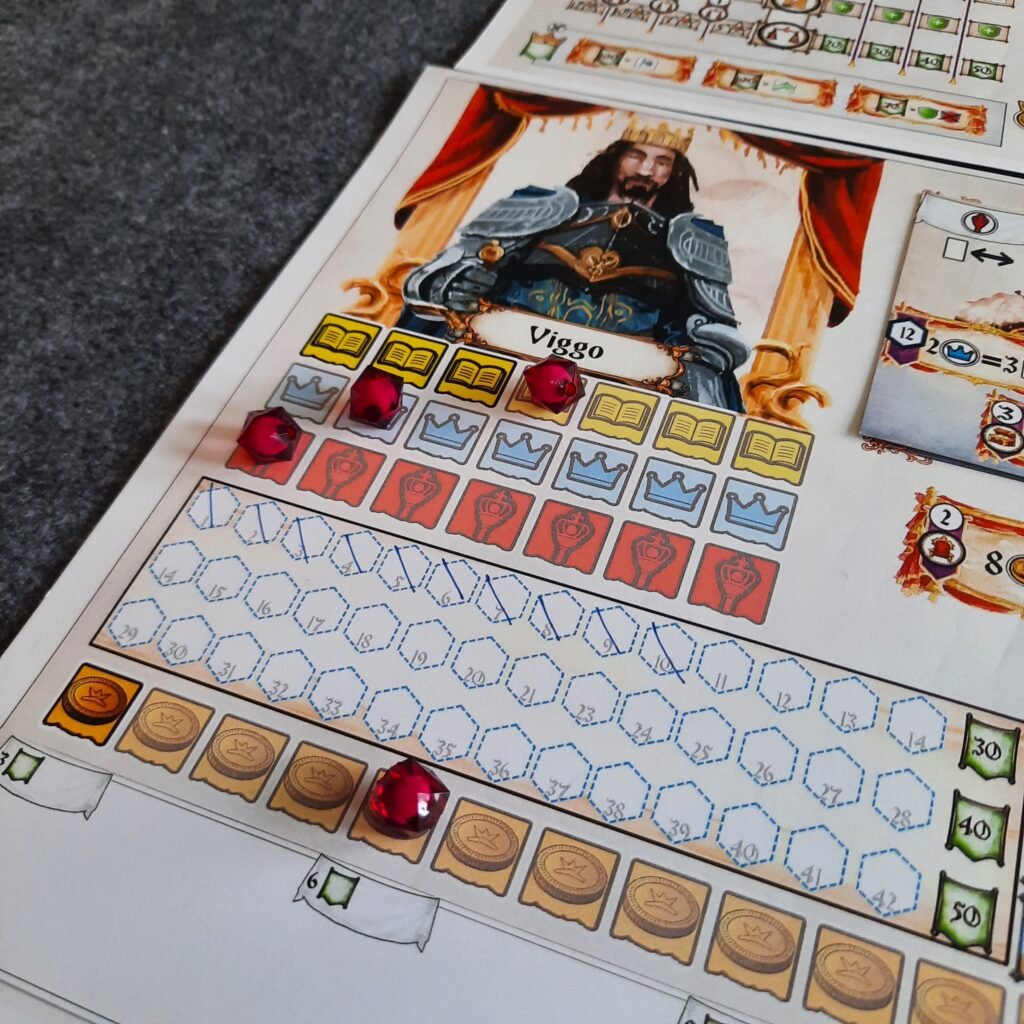
Everything is connected
Shamus (Out of the Box Board Games) explained it beautifully while playing King. Everything on the Kingdom card is connected. You are not developing tracks in isolation. Push one domain and you bump into requirements somewhere else.
Want to climb the Lords track? You’ll need Treasury at level 2. But to reach Treasury level 2, you need Trade at level 2. And Trade level 2 does not happen unless Villages are developed. One decision becomes a chain of obligations, and suddenly your “simple upgrade” has a whole family tree. The tracks on the Kingdom card are literally chained too. Develop one, and it unlocks the next.
And it is not just the Kingdom card. The game keeps that same logic everywhere else. The Advisor you can use is tied to the side of the Event card you picked. The domain you activate is tied to that same choice. And the consequences at the end of the turn are also tied to it. So a turn is never take resources and move on. It is commit first, then live with it. King makes sure your actions always have a shadow.
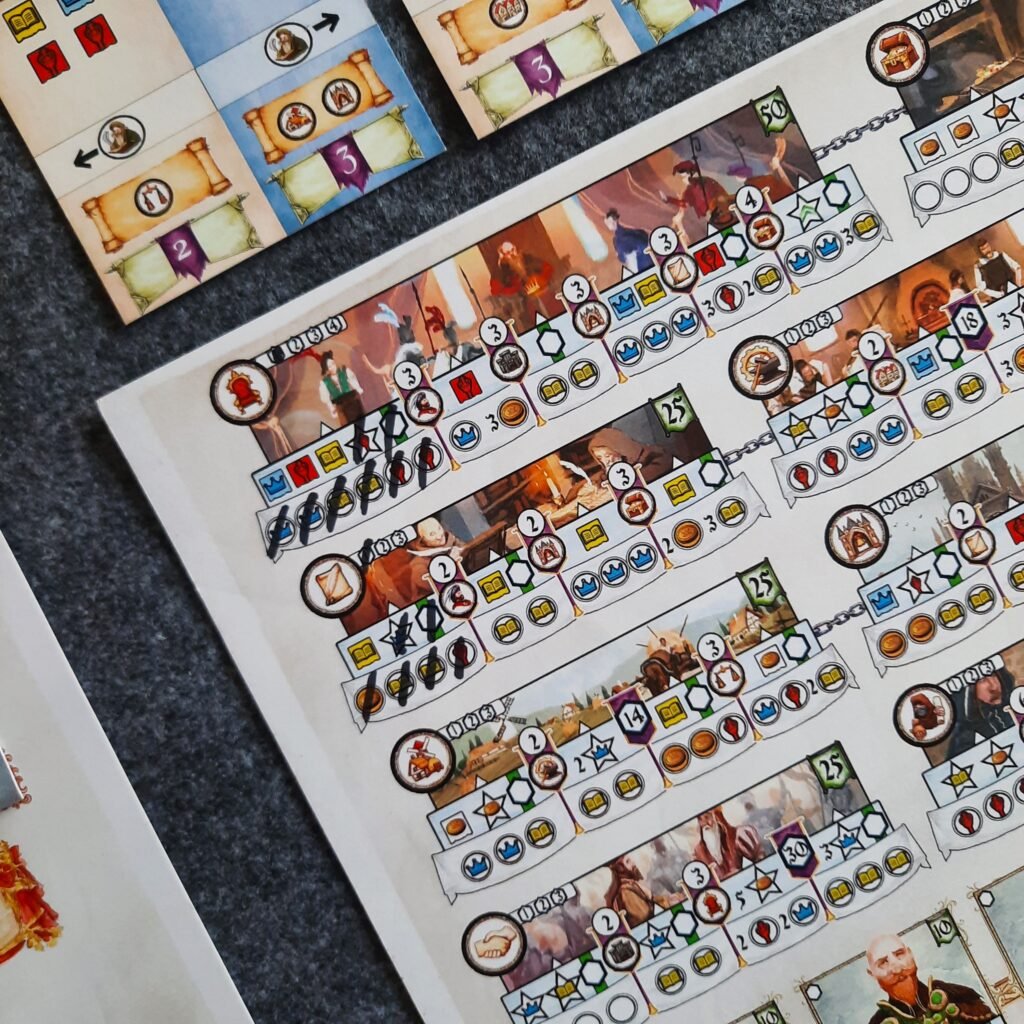
Unforgiving if you don’t plan it right
Whenever I try games for the first time, I usually give round 1 a shot without thinking too much. Just to get a feel for it. With Radek’s games, that is always risky. And with King, I had a feeling that approach would get thrashed.
I picked an Event side that looked decent, grabbed the resources, and started spending before I actually studied the Kingdom and Scenario cards as a whole. It was enough to get the gears turning, but it also meant I was building blind. I felt I had everything under control for just five good minutes. Till things flipped. Fast.
The penalties started stacking, the board state turned against me, and the Diplomacy marker slid into territory it had no business reaching. And once that marker goes too far left, the reign ends. Right there. You do not get to play it out. The game makes you commit early, and the first turn is more than enough to set a mess in motion.
So spare a couple of minutes before you start. Study the Kingdom card. Study the Scenario card. Have some plan in motion if you want to keep your throne. As a King should?
Even the game itself gives you a small courtesy to plan ahead. At the start of each round, you are not staring into a complete mystery. The first and last Event cards are visible, and because the fourth card carries over into the next round, you can see the 4th, 8th, and 12th cards coming. King practically tells you to look ahead. Then it punishes you if you do not.
Also be mindful of your Advisors. They are handy, but can at times be very high maintenance!
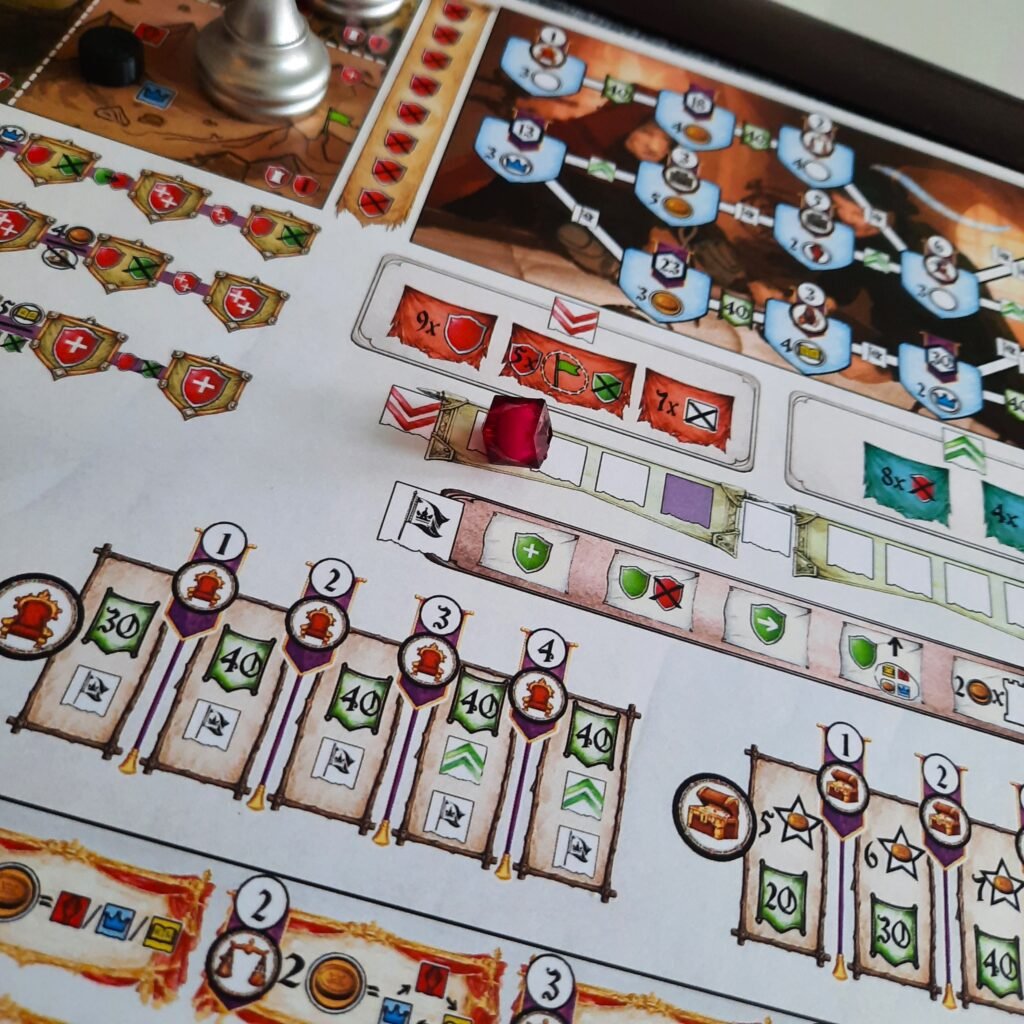
A Kingdom with many fronts
King is not just allocating resources to manage outcomes. It is juggling different parts of the kingdom, each with its own logic, and the game shifts gears with that. The Kingdom card is the best example. You are not filling tracks in isolation. You are unlocking one domain to qualify for the next. One “upgrade” turns into a sequence, and progress becomes something you earn in order, not something you stumble into.
Then the game asks you to manage other fields that behave differently. The Castle is its own kind of build. It is still a pay-and-cross system, but it is structured by vertical levels, and you must finish a level before moving higher. On the Scenario side, the kingdom stops being abstract and becomes physical. Command points drive tactical actions on the map. Recruiting units, moving them, attacking, building Watchtowers. You are not just improving engines, you are exerting pressure.
That variety is a big part of why the game holds up across repeats. The systems already offer different kinds of play inside one run. Then you stack the obvious layer on top. Multiple Kings. Multiple Scenarios. Multiple Goal cards. Endless replayability loops?
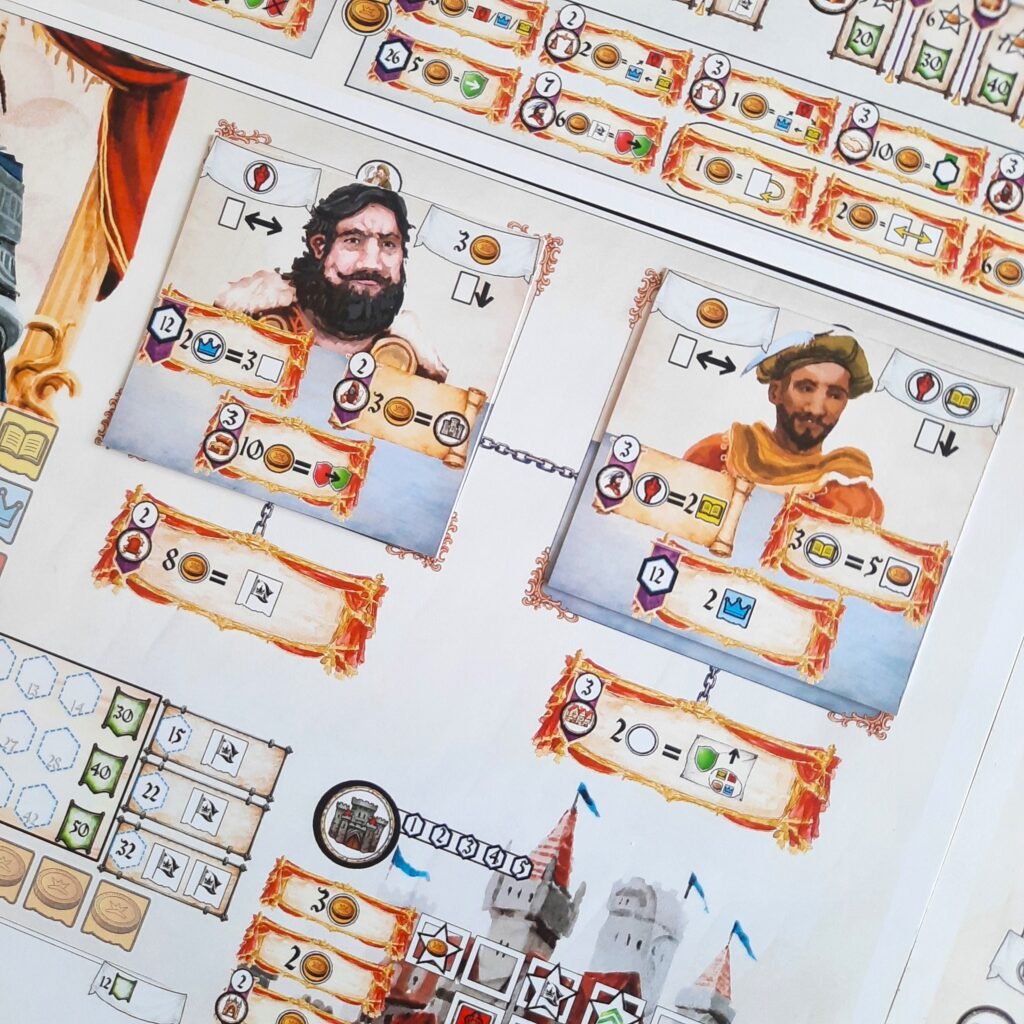
A crown worth carrying
It’s been a couple of days since this Radek classic went live on its short Kickstarter campaign, and it’s already living up to its name.
King is not the kind of game you simply try. You commit to it. You sit down, plan, take the hit, and come back sharper the next time. And that is exactly why it works.
So cheers to Radek for delivering another heavy-duty system I’ll happily indulge in whenever I’m craving a print-and-play that actually goes deep.
Recommended items
Game Overview
Designer: Radek Ignatow
Artist: Michał Teliga
Number of players: 1
Difficulty level: Medium to Hard
Rounds of gameplay needed to learn: 1 to 2 rounds
Game duration: 40-75 minutes
Available on: Kickstarter
Theme: Flip-and-write | Building your kingdom
Number of pages and color: 11 pages (color print)
Assembling difficulty level: Relatively easy. Print and cut out cards.
Lamination: Only for the Scenario Cards
Additional elements required: approx. 40 tokens and a pen/pencil.
Time to learn: Within 30 minutes
Travel-friendly: 10/10
Shelving friendly: 9.5/10
Rating from PnP Time: 9/10

Tas is a game designer and blogger based in Bangladesh, with the dream of exploring the world of games and introducing it to anyone new to it.