Hidden Realms: The Mummy's Tomb
You step into a tomb that has not been touched in ages.
The air is dry. Every step feels louder than it should.
There is no map waiting for you here. You are going to build it yourself.
A path begins to take shape. One tile at a time. Passages stretch out. Rooms start to form.
And then, the tomb begins to reveal its secrets…
A glint of treasure. A locked chest. But that’s not all.
It feels like someone is watching. Waiting for you to come just a little closer.
You do not know how far this path goes.
But you are already too deep to turn back now…
Entry: before playing the game
First impression
I am a big fan of Egypt. Ancient Egypt, to be precise.
I still remember being hooked on documentaries about the secrets of the Great Pyramids when I was a boy. That, and The Mummy movie series. I loved the action sequences Brendan Fraser’s O’Connell had with the mummies, and I even chanted “Imhotep” the way his followers did when he came back from the dead. Frantically.
Fun fact, the real-life Imhotep was nothing like the necromancer the movie turned him into. He was known more as a man of peace. Funny how movies twist history.
Though I’ve never been to Egypt, I did find myself trapped in a tomb last year while playing Hieroglyph Historian, a clever card game where you decipher cryptic hieroglyphs. And now, I am glad to be back in a tomb once again, this time for a very different kind of adventure.
Let’s see if I get to fight some monsters!
A bit on the game
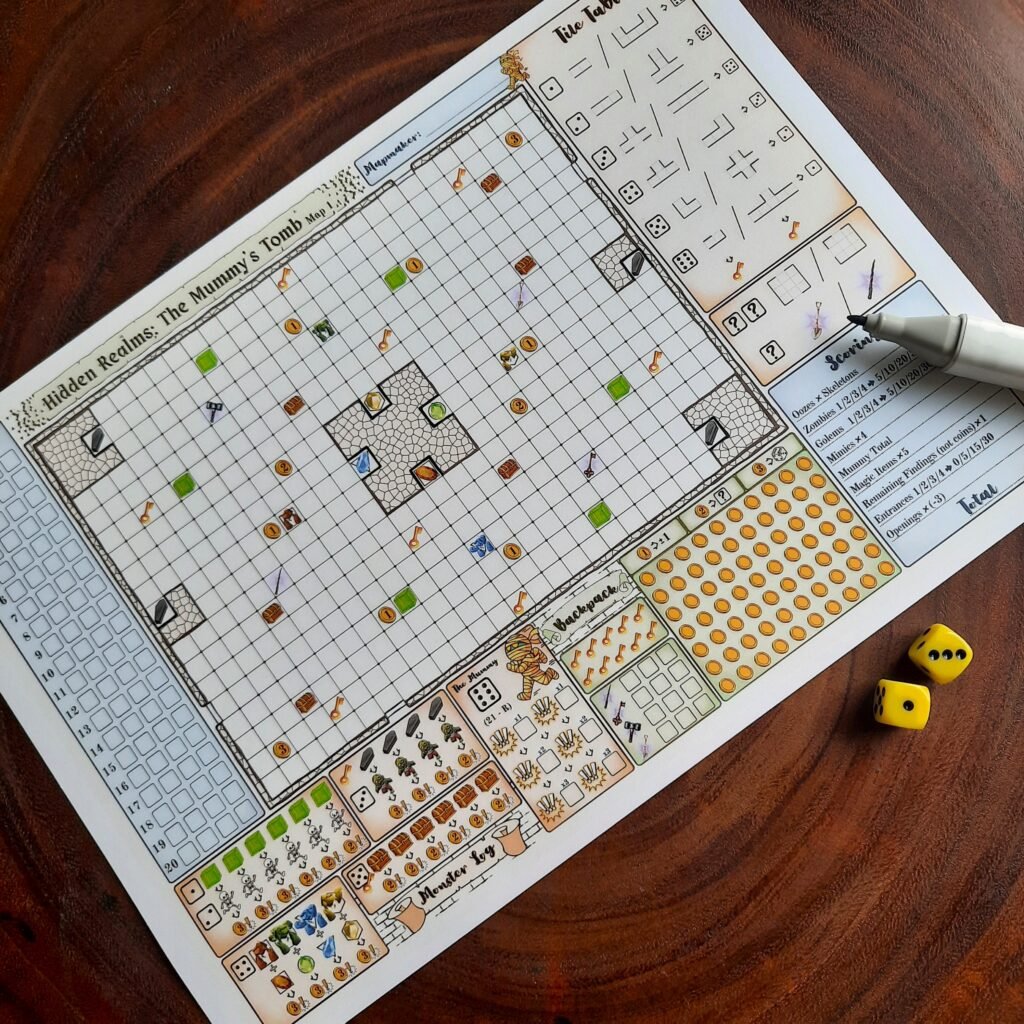
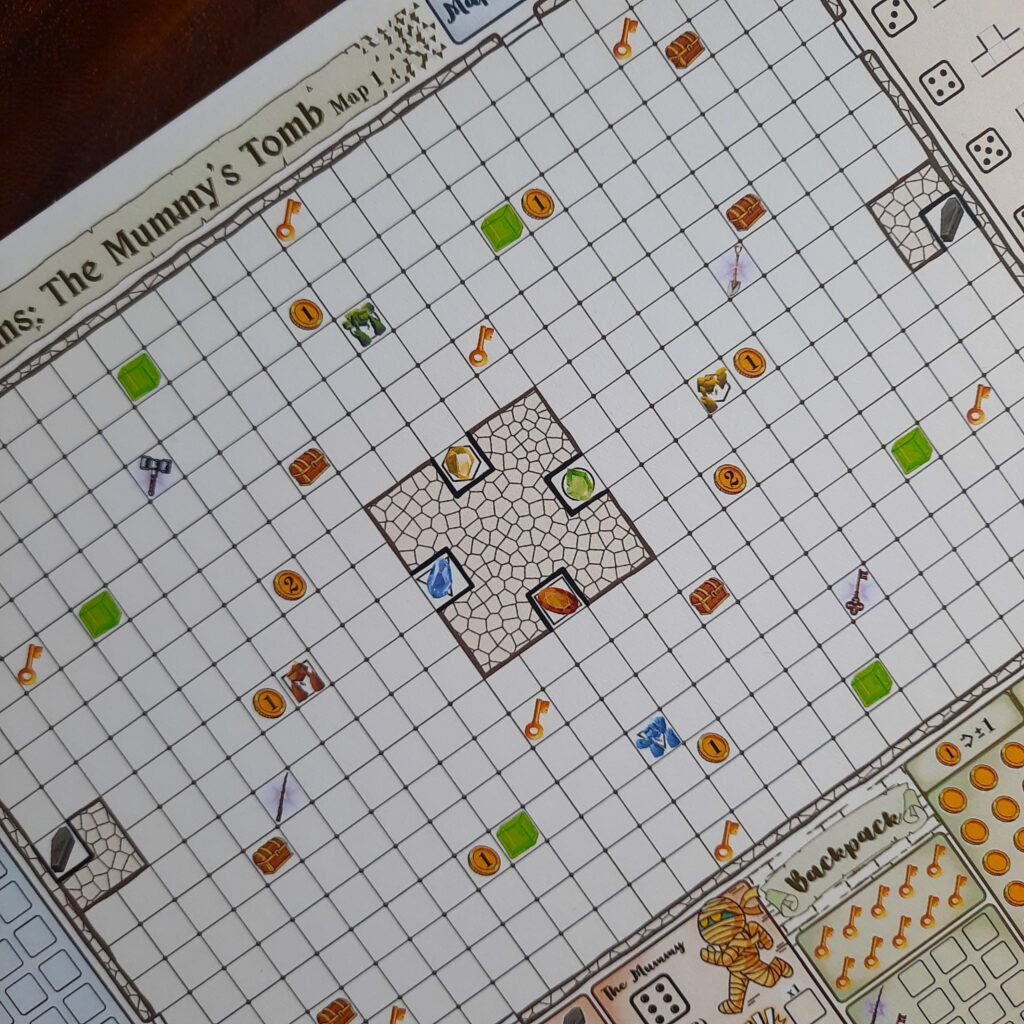
Hidden Realms: The Mummy’s Tomb is a solo roll-and-write dungeon crawler built around exploration, map-building, and careful resource use. Instead of exploring a tomb that is already laid out for you, you gradually create the layout yourself as the game unfolds.
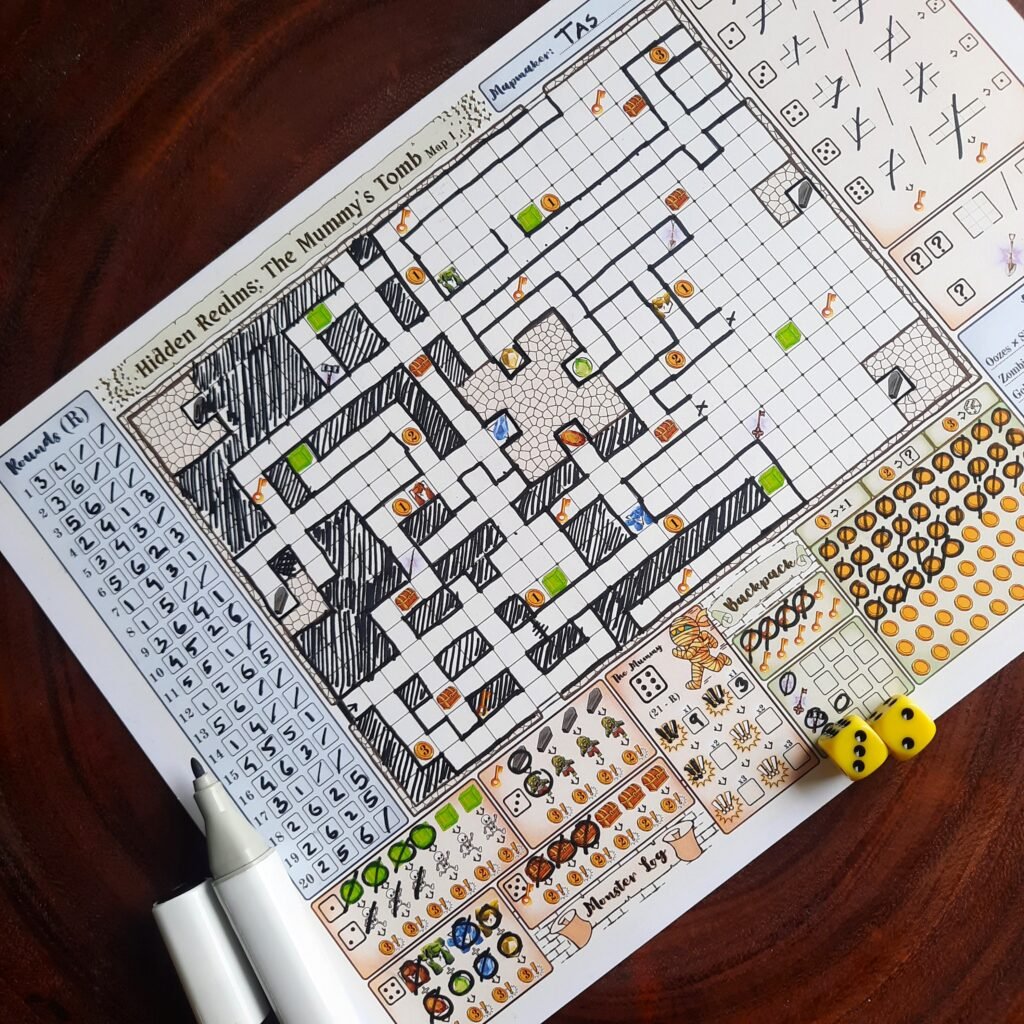
Each turn begins with rolling a couple of dice. Based on the results, you draw polyomino shapes onto your sheet to expand the tomb, forming passages and rooms while trying to keep future expansions open. As the map grows, you begin uncovering different discoveries hidden within it, including treasures, coins, keys, magic items, and monsters.
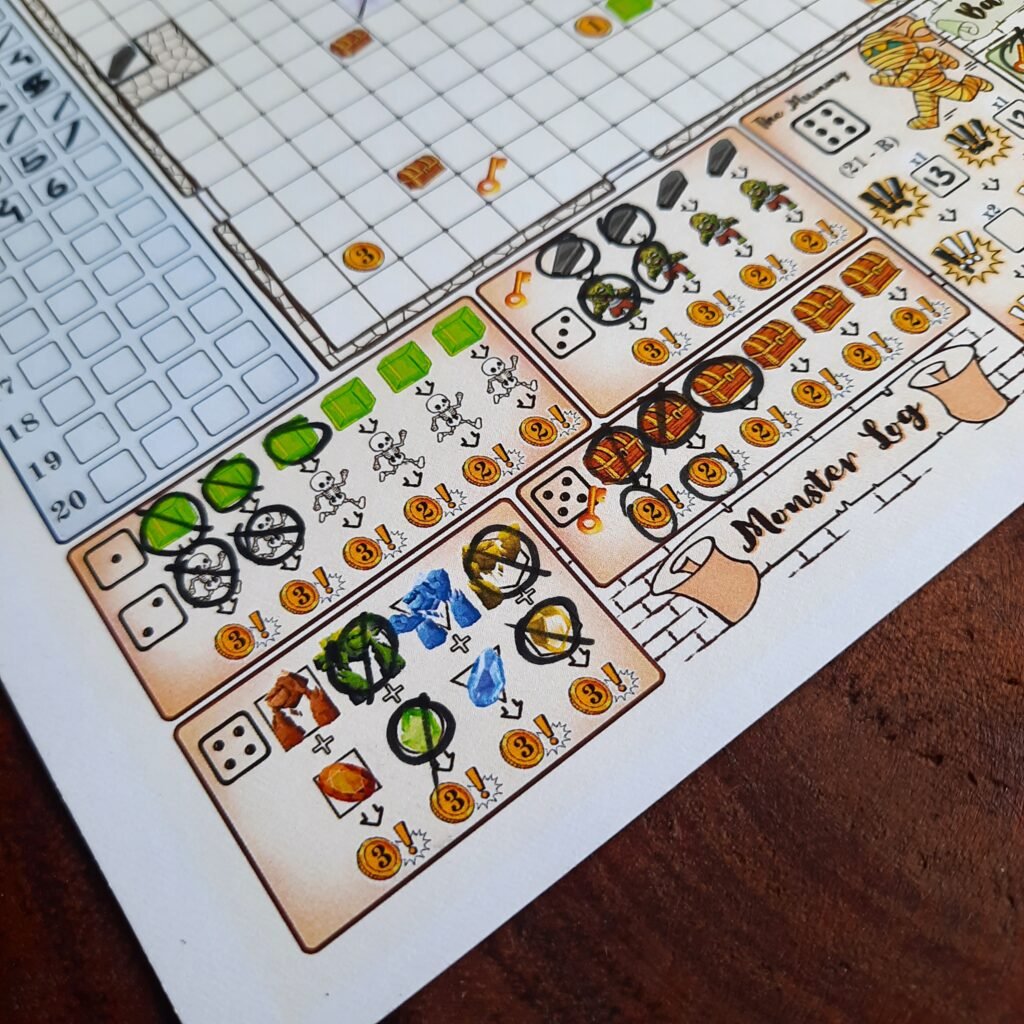
These discoveries do not all work the same way. Coins help you gain more control over your dice, keys are used to open locks, and magic items give you specific advantages. Monsters, on the other hand, need to be dealt with through specific conditions. Some require certain dice values, while others depend on items or resources you have collected along the way.
As you defeat monsters, you also increase the pressure, bringing the Mummy closer. So while exploring the tomb rewards you with more tools, it also steadily builds toward the moment the Mummy enters play, with your progress against the monsters helping to wear it down bit by bit.
By the end, the game is scored based on what you managed to uncover and achieve inside the tomb, and the map you’ve built along the way.
All you need
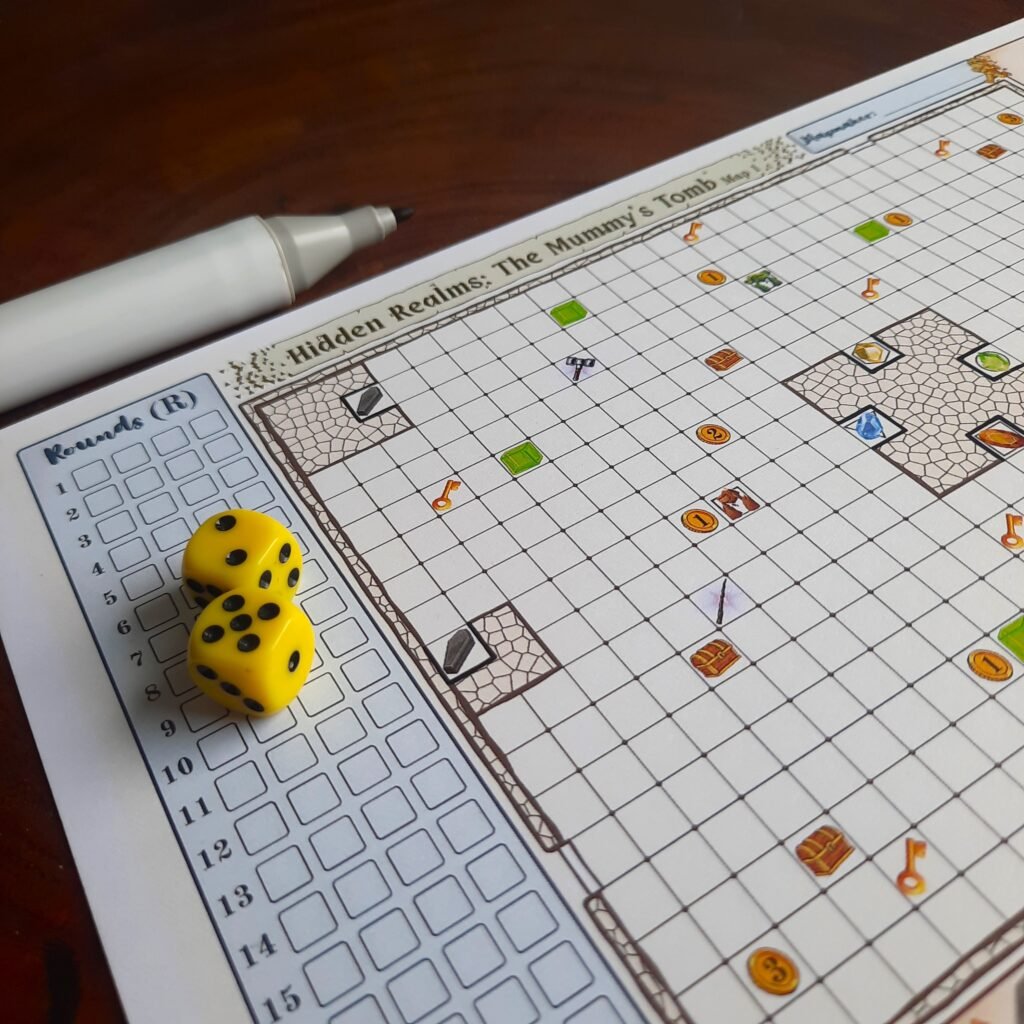
You only need to print a minimum of one page for the game sheet. The second page is for the spells, which I kept open on my phone instead. You do you, but I liked keeping it as a one-page game.
With the print sorted, grab a couple of dice and a marker. You’re ready.
Lamination can be an option too, as long as you do not mind the glare.
Entry: after playing the game
Findings
Be a master of polyomino placement
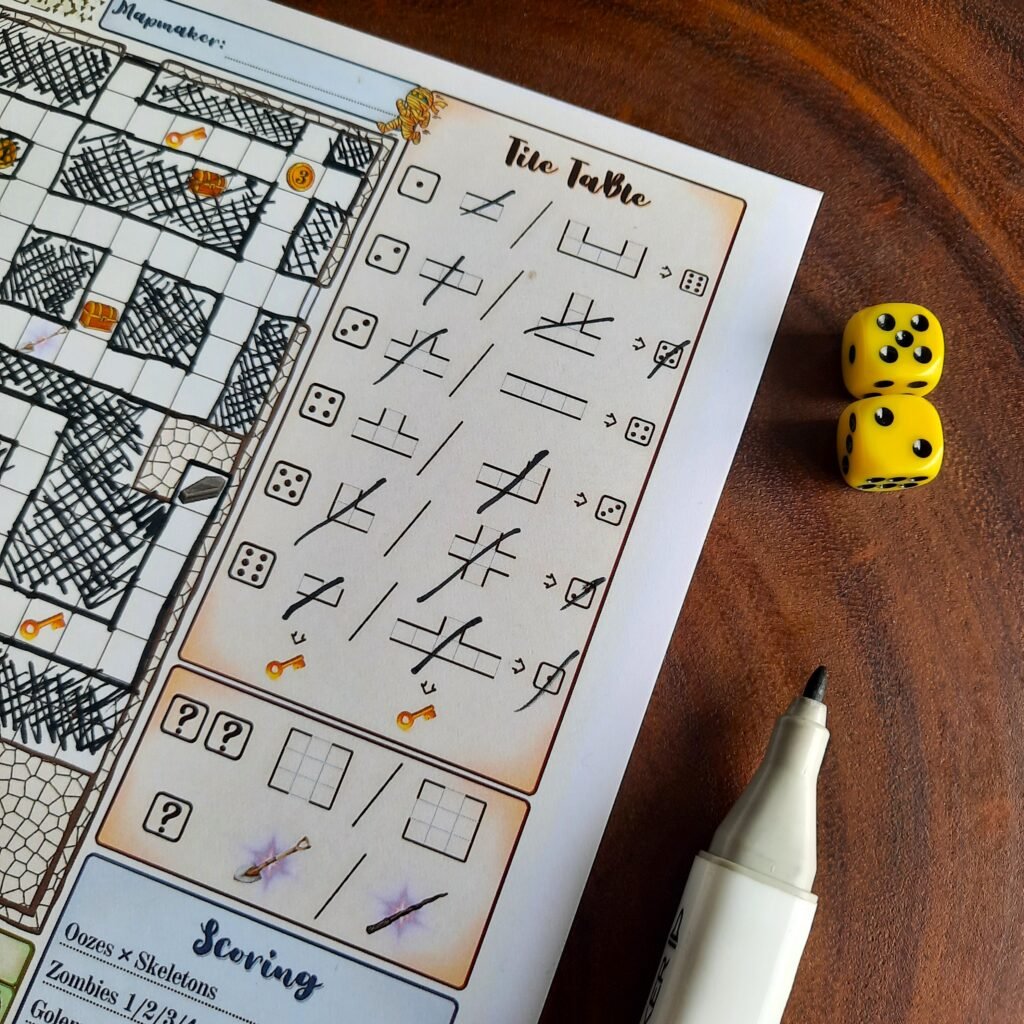
A big part of this game comes down to how well you place your polyomino shapes.
Since the shapes can be rotated and placed in different ways, there is usually more than one way to work them into your map. That flexibility is great, but it also means every placement asks for a bit more thought. You are not just filling up space. You are trying to keep passages connected, leave room for future expansions, and line yourself up for the discoveries you want to reach.
I initially struggled with that. In my first attempt at the game, I had a few placements that looked fine in the moment, only to make later turns much more awkward. By the second run, it started to click a lot more. Figuring out where a shape should go, how it opens up the map, and how it sets up your next few turns is the heart of the game.
Beyond map building
At first, the map-building is what grabs you. There is something therapeutic about mapping out the tomb piece by piece, connecting passages, shaping rooms, and trying to make a neat loop where everything stays connected. But the game does not stop at being a spatial puzzle.
What gives it more variety are the monsters, treasures, keys, coffins, and magic items scattered through the tomb. They keep pulling your attention in different directions. One moment, you are thinking about how to extend a passage without boxing yourself in. The next, you are eyeing a chest you want to open, a monster you need to deal with, or an item that could help later on.
That is where the game started to feel richer to me. You cannot just focus on building a clever map and call it a day. You also have to think about timing, resources, and what to prioritize first. The tomb keeps asking you to juggle all of it at once.
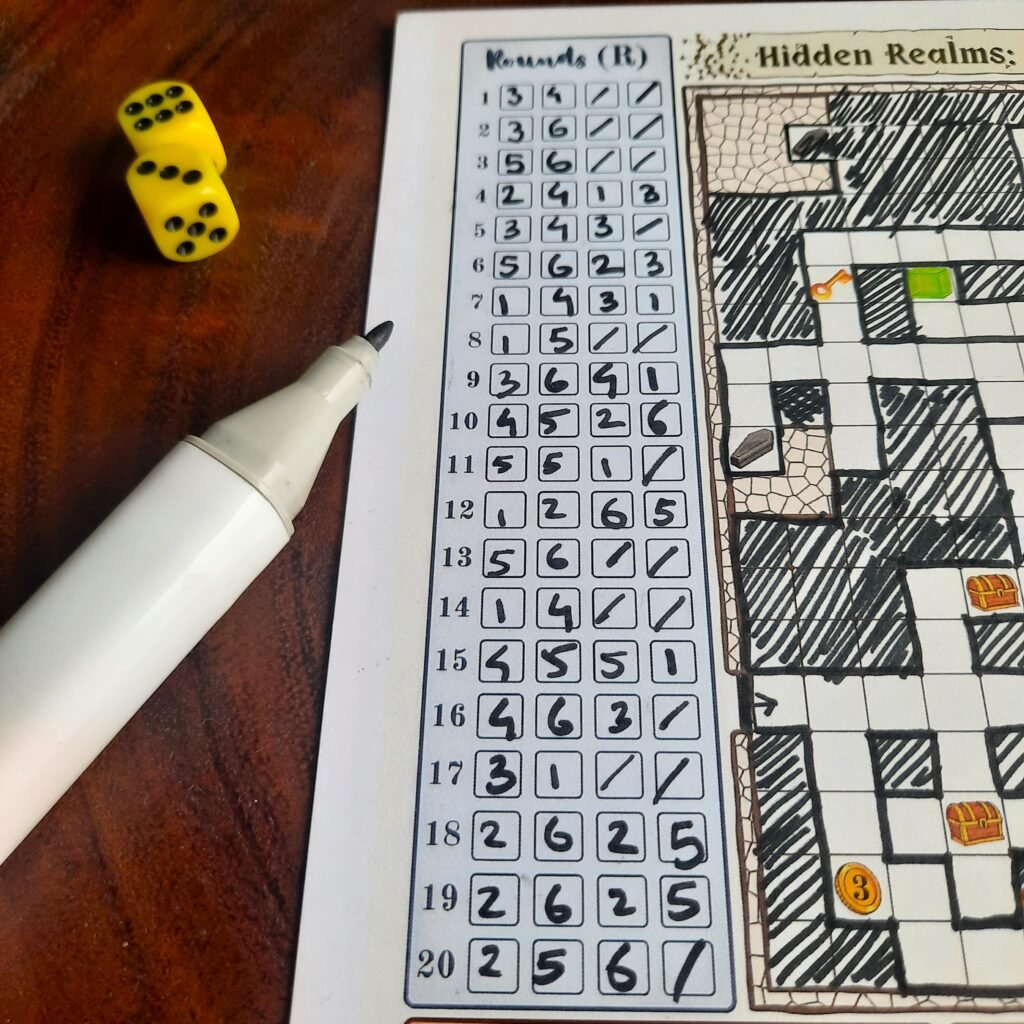
And you do not have all the time in the world to sort it out, either. The game runs for 20 rounds, which gives every move a little more weight. You cannot waste rounds forming passages just for the sake of it.
Knowing when to focus on expanding the tomb and when to start dealing with monsters is crucial. The game keeps asking you to balance both. If you get too obsessed with shaping the map, you miss chances to take on monsters, collect gold, and chip away at the Mummy. But if you spend too much time chasing monsters, your progress through the tomb starts to slow down.
Little things that make it big
A lot of this game’s charm comes from the smaller systems working quietly in the background.
Each round begins with two dice, but there is room to push that up to four if you play smart. Extra dice can come through the tile chart or by spending coins, which you can collect from the tomb itself, or earn it through defeating monsters. That means every round gives you a chance to do a little more, but only if you know how to make the most of what is available.
So you start looking at each turn a little differently. Is this the round to spend coins for more control? Is this the round to push for an extra die? And when those blank spaces begin piling up on the round chart, you can already feel your score slipping away…
And then there is the Mummy.
I liked how the game builds toward it. Defeating monsters does not just clear the tomb and give you rewards. It also feeds into your progress against the Mummy, little by little. On top of that, the round you are in affects the points you get, which gives the whole thing a nice sense of timing. You are not just trying to do well. You are trying to do well at the right moment.
Replayable?
To be fair, even one map feels replayable enough. Each map comes with four possible entry points, and each one gives you a fresh angle to start with. Add to that the many ways you can place the polyomino shapes, and it becomes the kind of game that can stay interesting across repeated plays.
And that is just one map. The Gamefound campaign includes three, and the stretch goals include a fourth map as well (already unlocked), which only adds more variety to the whole thing. So whether you stick to one map or end up exploring all four, there is plenty here to keep the adventure fresh.
A tomb worth getting stuck in?
After playing Hidden Realms: The Mummy’s Tomb about a dozen times, I can already see myself with a pen, a dice simulator, and the map sheet, playing it while commuting or travelling, with some ancient Egyptian playlist in my headset. Time to make that happen!
If it feels like your kind of game, you know what to do.
Recommended items
Game Overview
Designer: Spyros Kallos
Publisher: Tabletop for World
Number of players: 1
Difficulty level: Easy to medium
Rounds of gameplay needed to learn: 1 to 2 rounds
Game duration: 45 minutes
Available on: Gamefound
Theme: Roll-and-write | Map-building
Number of pages and color: 1 or 2 pages (color print)
Assembling difficulty level: Super easy. Simply print and play
Lamination: Recommended for longevity
Additional elements required: 2 dice and a pen/marker
Time to learn: Within 20 minutes
Travel-friendly: 10/10
Shelving friendly: 10/10
Rating from PnP Time: 8.75/10

Tas is a game designer and blogger based in Bangladesh, with the dream of exploring the world of games and introducing it to anyone new to it.