Forgotten Paths
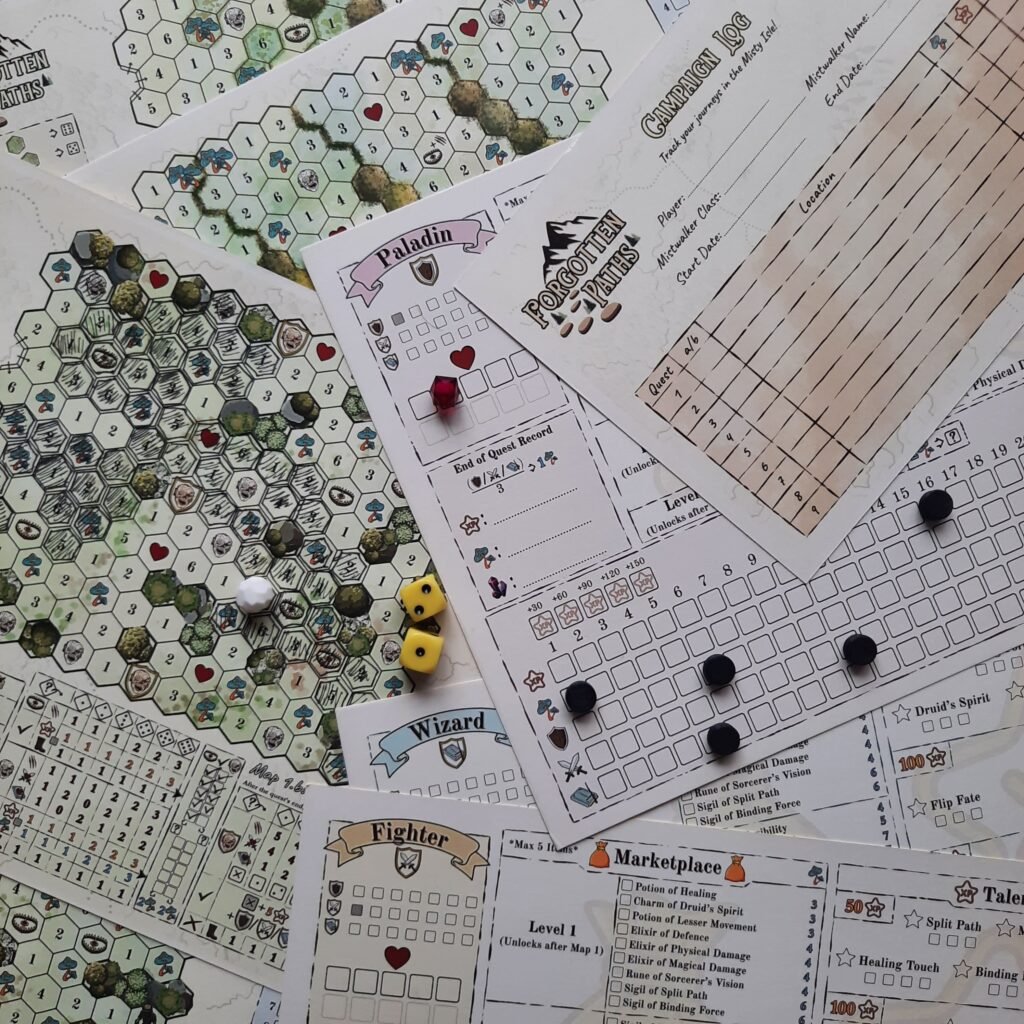
No one dares to stray beyond the settlements in the Misty Isle.
For beyond them lies the mist. And those who enter it… risk losing their memories.
Many who set out, never return. But you do. More like, you have to.
Cause you are a Mistwalker. The one keeping the mist at bay and keeping folks safe. And doing that means stepping into the mist yourself.
Out there, Lethebane helps you hold on to your memories, but that’s far from the only thing you’ll need.
Traps and foul creatures await in the mist, and you’ll need much more than sheer luck to tackle them all.
Are you ready to step into a series of quests and keep the Misty Isle safe?
Entry: before playing the game
First impression
I love seeing the style of different game designers come into play. Radek goes for building heavy systems. Chris and Parker have their super-catchy zero-assembly games that you can learn and play in no time. Florian keeps introducing crispy mechanics with his new games.
And now, after getting my hands on the second PnP from Spyros and Myrto (their first-ever being Hidden Realms: The Mummy’s Tomb), I’m starting to get a better feel for their style too. To be precise, there’s this puzzly format where you move about or navigate a space, mark spaces off, and work within a designated number of rounds while dealing with obstacles and managing resources.
The themes have been pretty interesting too. In Hidden Realms: The Mummy’s Tomb, I was literally building out the map of an Egyptian tomb as I explored it. Now, in Forgotten Paths, I’m on the Misty Isle, playing as a Mistwalker setting out on quests to help keep my folks safe.
That aside, I’m also looking at what appears to be my first proper roll-and-write solo CAMPAIGN!
I’ve come close to one with games like Harbor of Blight: Scenario Zero and its novella-style branching adventure, but Forgotten Paths has to be my first proper one. Unless my memory betrays me.
Owing to my curiosity about the stories behind creating games, I also got to learn that a big part of creating Forgotten Paths came from Spyros and Myrto simply going on long walks.
“One step at a time. That’s how we do our best work. Also walking. Lots of walking! When you’re stuck, go for a walk.”
And apparently, plenty of Forgotten Paths was figured out that way.
If you want the full story behind how those walks eventually turned into what the game is today, I covered Spyros and Myrto’s journey in a Behind the Scenes issue. Click here to check out the gem.
Time to find out more about the game!
A bit on the game
Forgotten Paths is a solo roll-and-write campaign played across nine quests. You choose a Mistwalker, keep that same character throughout the campaign, and use the Storybook to determine where the journey takes you next. There are 18 quest maps in total, with the Storybook presenting two quest choices at each stage of the campaign.
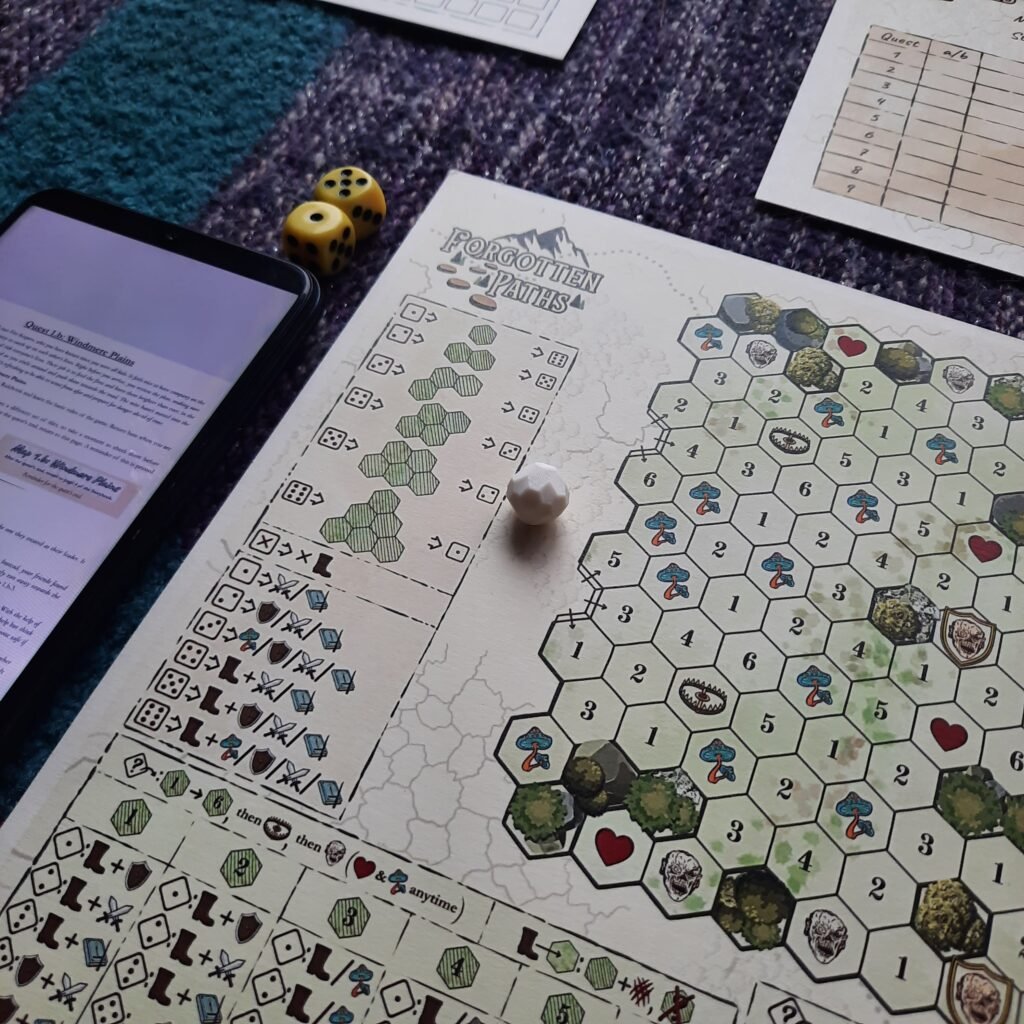
Once you enter a quest, you have a map to explore and up to 20 rounds to work with. At the beginning of each round, you roll two dice and use those values to perform actions. The main actions are explore, move, and prepare.
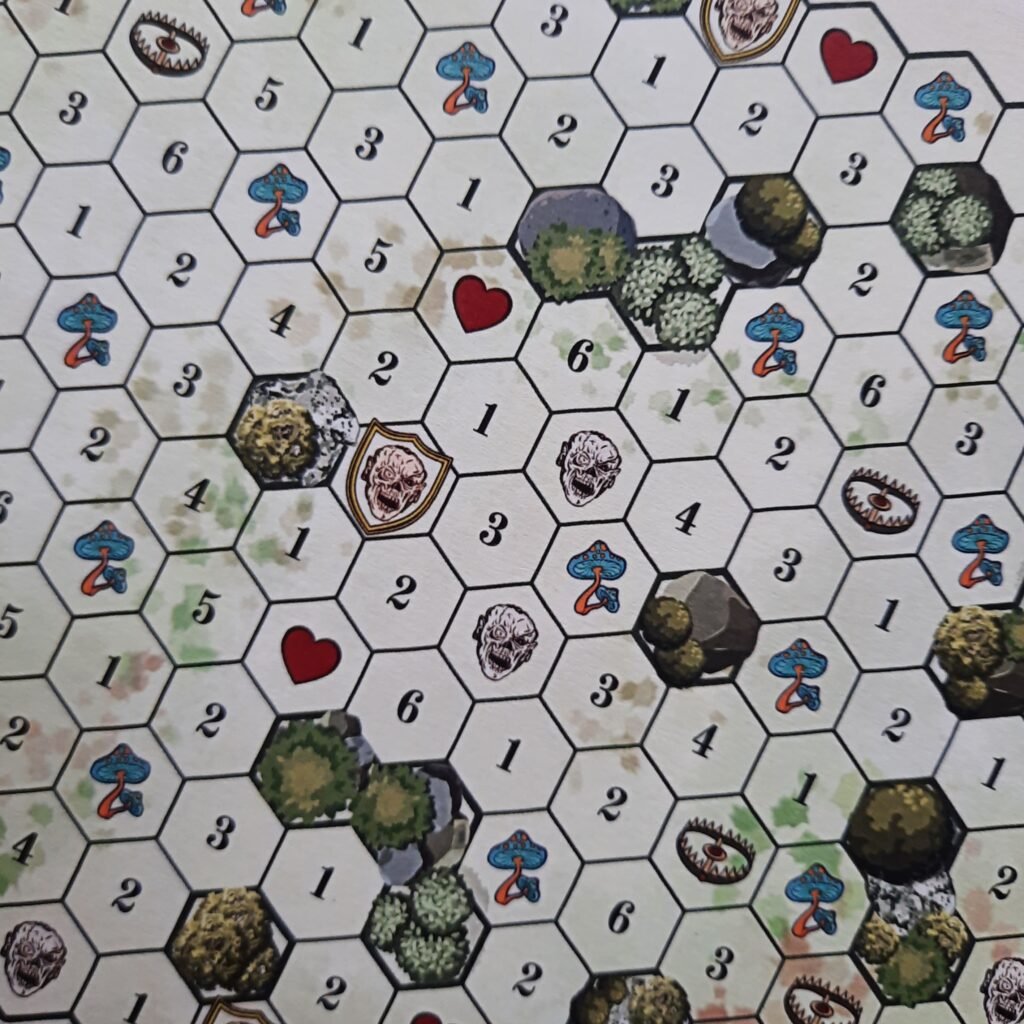
Exploring means using a die to determine the size of the polyhex you’ll fit onto the map, revealing new spaces around your character. Those spaces can lead to resources, Lethebane, healing, traps, monsters, and other things depending on the quest.
Movement is more straightforward. Spend a die and its value becomes the number of spaces you can move. You can even step into an unrevealed space if needed, although doing so comes at the cost of damage. Preparing, meanwhile, lets you spend dice to gather resources you may need later.
Those resources become important once traps and creatures start showing up. You’ll be managing Defense, Physical Damage, and Magical Damage to deal with what you encounter. Defeating monsters can earn XP and Lethebane, while mini-bosses and the boss are encounters you deliberately approach rather than randomly stumble into. Your goal is to eventually reach and defeat the boss within 20 rounds.
Lethebane, the mushroom native to the Misty Isle, helps people retain their memories against the mist. During a quest, it also works as a flexible dice resource: you can spend it to gain additional dice or manipulate values you’ve already rolled. Whatever Lethebane remains afterward can also be spent back in town on items from the Marketplace.
And that’s where the campaign side comes in.
After a quest ends, you update your campaign log and return to the Storybook. XP can be spent on Talents that permanently improve your character, while the Marketplace gives you single-use items to carry into later quests. More options become available as the campaign progresses.
The story can then change depending on the choices you make and how previous quests ended. Later maps also introduce their own special rules and objectives on top of the core explore-move-prepare system.
And that continues until you reach the end of your ninth quest and see where your path through the Misty Isle ultimately leads.
All you need
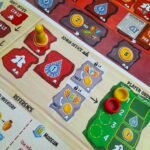
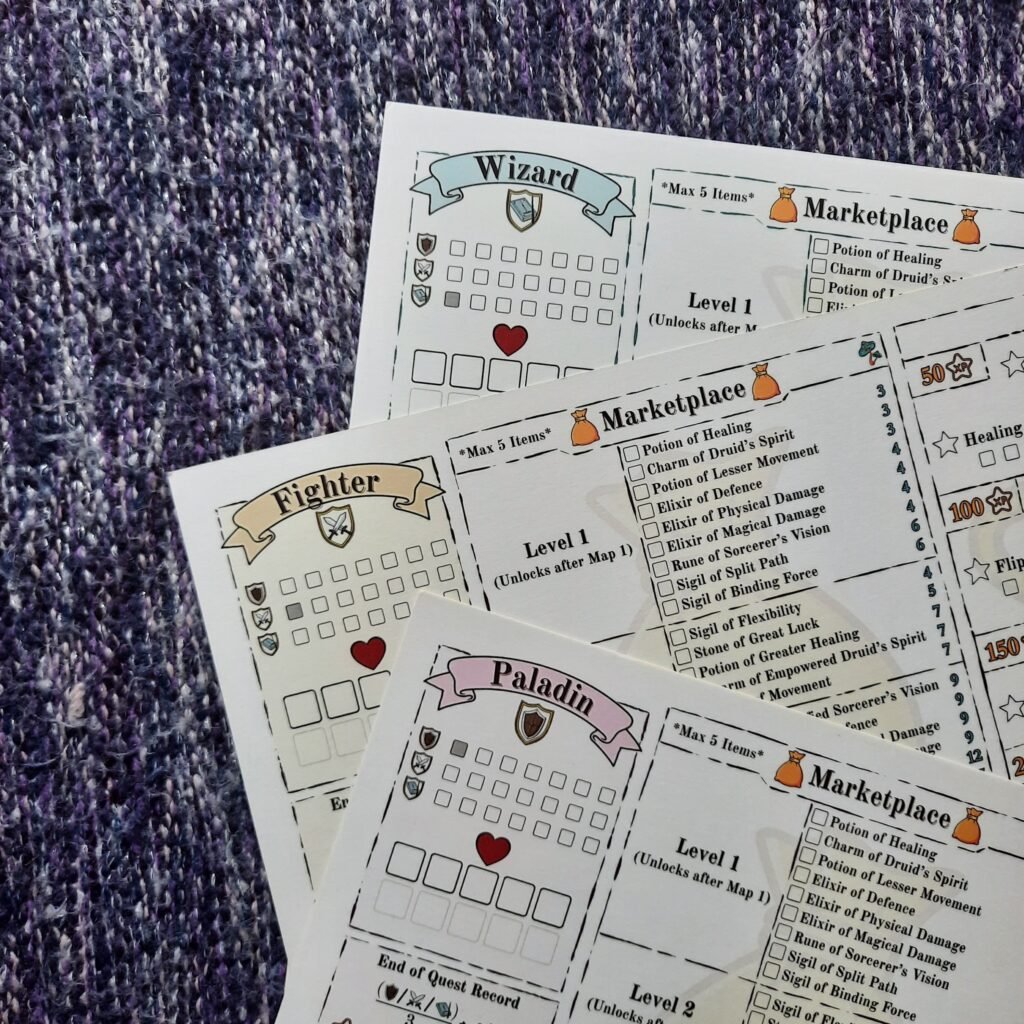
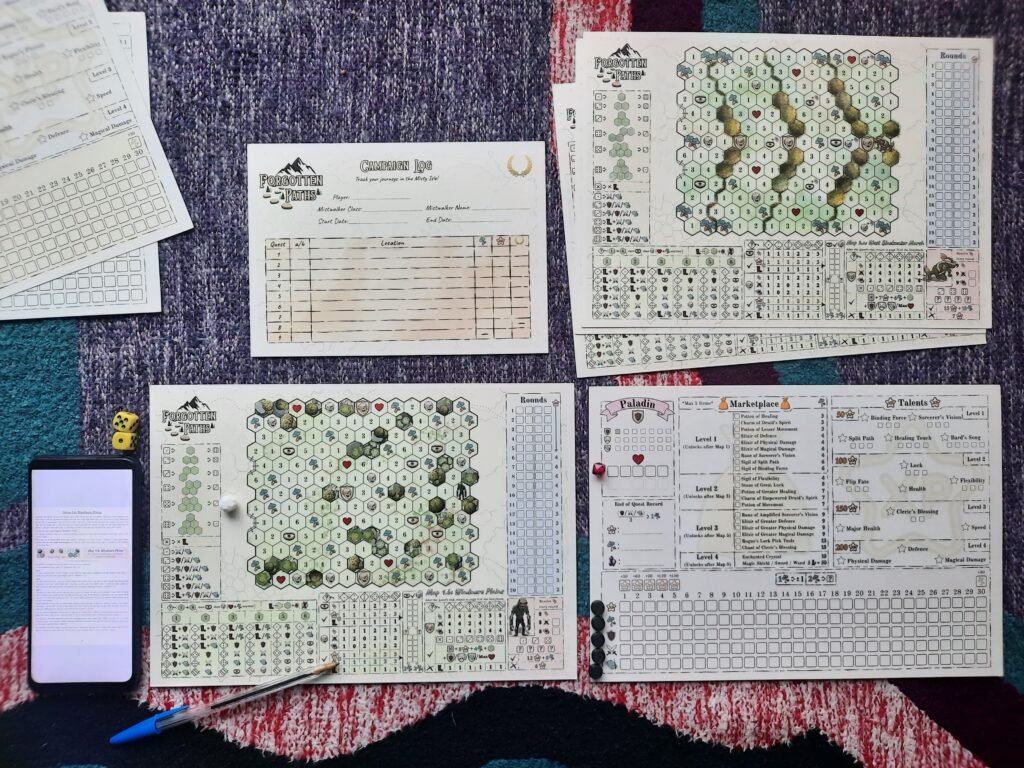
First up, you’ll need to print a character sheet. The game starts you off with three Mistwalkers to choose from: Fighter, Paladin, and Wizard. Think of them almost like different classes, with different starting strengths and abilities, plus their own Talents that you can unlock as the campaign progresses.
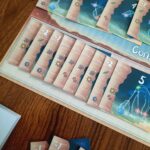
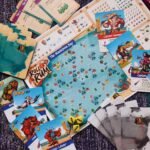
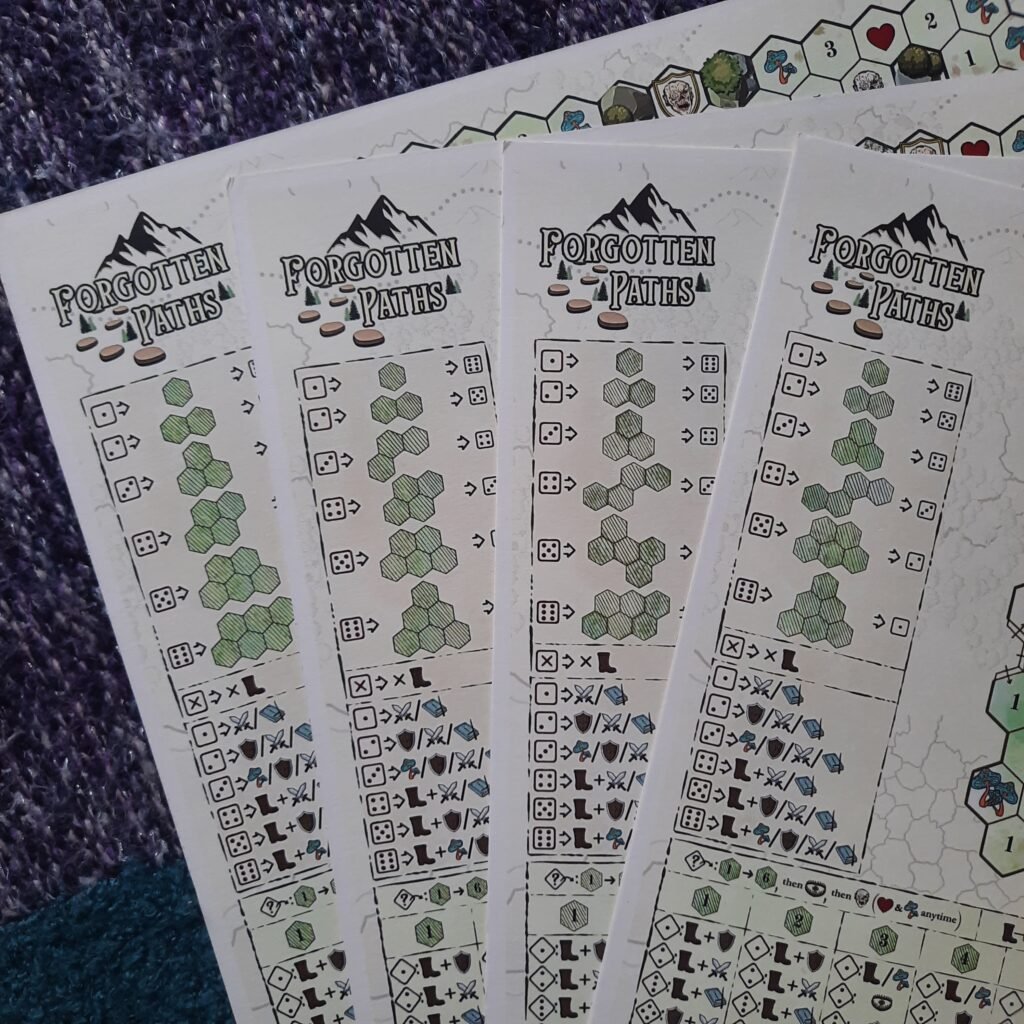
Then come the quest maps. There are 18 in total, though a single campaign takes you through 9 of them depending on the choices you make. These are the main sheets you’ll actually play on, with the hex-grid area you explore, the spaces you reveal, and the tables and trackers tied to that particular quest.
You can print the whole set upfront if you want everything ready to go, or just print the maps as they come into the equation. Your call.
You’ll also need a campaign log to keep track of the quests you’ve completed, your XP, Lethebane, Reputation, and the path your adventure takes.
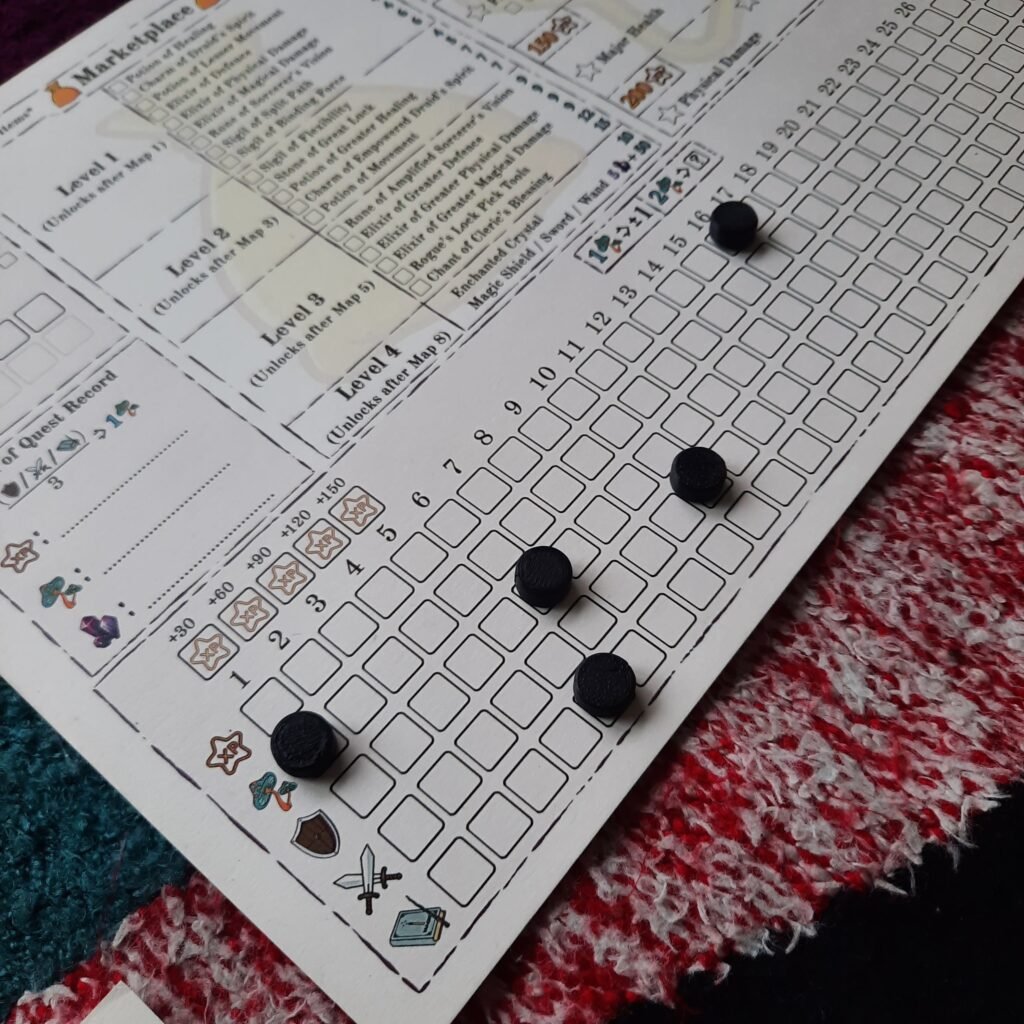
Then grab a bunch of cubes. One represents your Mistwalker on the map, while the others are used to track things like your health, XP, Lethebane, Defense, Physical Damage, Magical Damage, and a few quest-specific bits along the way. Some quests may need a couple of extra cubes too.
Add two D6 dice and a pen/marker. Certain characters or Talents may have you rolling an additional die, but two will get you started.
And since this is a campaign, you’ll obviously need the Storybook too. It’s 49 pages, and you don’t have to print the whole thing. Keep the Storybook and rulebook on your phone, tablet, or laptop, or print them if that’s your thing.
Optional: grab some snacks too. After all, this is a campaign!
Entry: after playing the game
Findings
Spyros and Myrto’s Formula
Like I mentioned earlier, Spyros and Myrto seem to have their own signature puzzly navigation style. In Hidden Realms, that came through polyominoes. In Forgotten Paths, we switch over to polyhexes, which for me feels like an upgrade.
With hexes, I could plan things out in every direction, as I found the shapes much easier to place around the map, visually speaking.
Then there’s the round limit. Each quest gives you a 20-round track to work with, something we also saw in Hidden Realms. What I liked from my first attempt through the full campaign is that the rounds didn’t feel rushed.
Campaigns are not meant to be rushed, and 20 rounds per quest gave me enough time to move about and do my thing. That made each quest feel a lot more like an actual adventure rather than a race against the clock.
And there’s quite a lot of “doing my thing” happening too.
You’re gathering Lethebane and the resources you’ll need to survive traps, monsters, mini-bosses, and eventually the boss, while collecting XP along the way. It sounds like a lot when I say it like that, but give it a few rounds and the whole thing starts clicking quite naturally.
Being a roll-and-write, there’s plenty of dice rolling, which inevitably brings randomness into the equation. But I liked how Lethebane gives you some control over that. Spending one unit can enable you to increase or decrease a die value by 1. Spending a couple can let you roll an additional die for that round. You can even spend multiple Lethebane to shift a value further.
And that comes in super handy, cause your dice pretty much dictate how you explore the Misty Isle.
Say you roll a 3. To use that 3 for exploration, you need a numbered 3 in an unrevealed hex right next to your Mistwalker. That also gives you a three-hex polyhex to work with, which you can rotate and place around that numbered space. Then you reveal what you’ve covered and resolve whatever you find.
So it becomes this loop of roll, look around, choose your die, fit the polyhex, reveal, and resolve.
And it’s quite fun as long as you don’t rush it. You’re not supposed to rush in the mist anyways. 😉
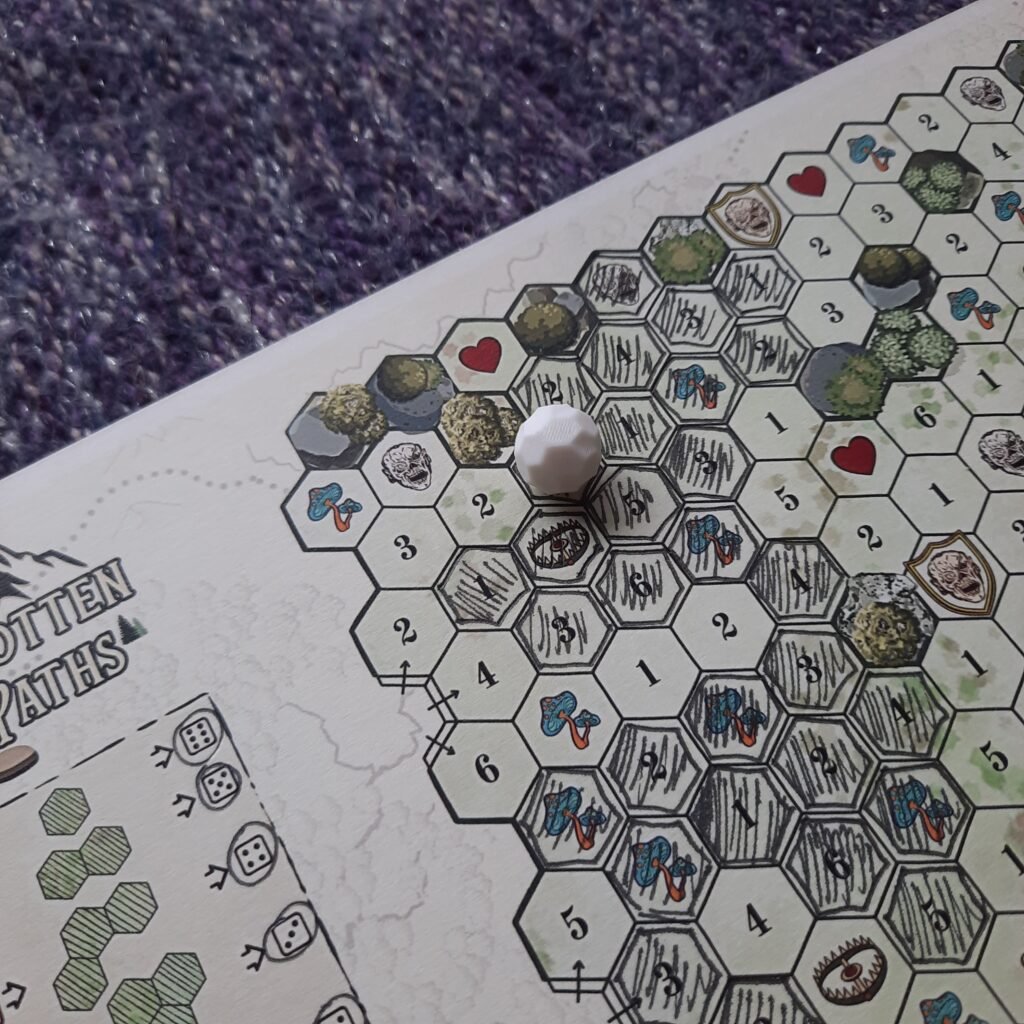
Sidenote though, I also really enjoyed shading in the hexes as I explored and marking off the spaces once I resolved them. Like I’d dealt with that little patch of the Misty Isle and could move on to the next!
My longest PnP playthrough ever!
Alongside being my first-ever solo roll-and-write campaign, Forgotten Paths also happens to be my longest PnP playthrough to date.
That is, EIGHT HOURS!
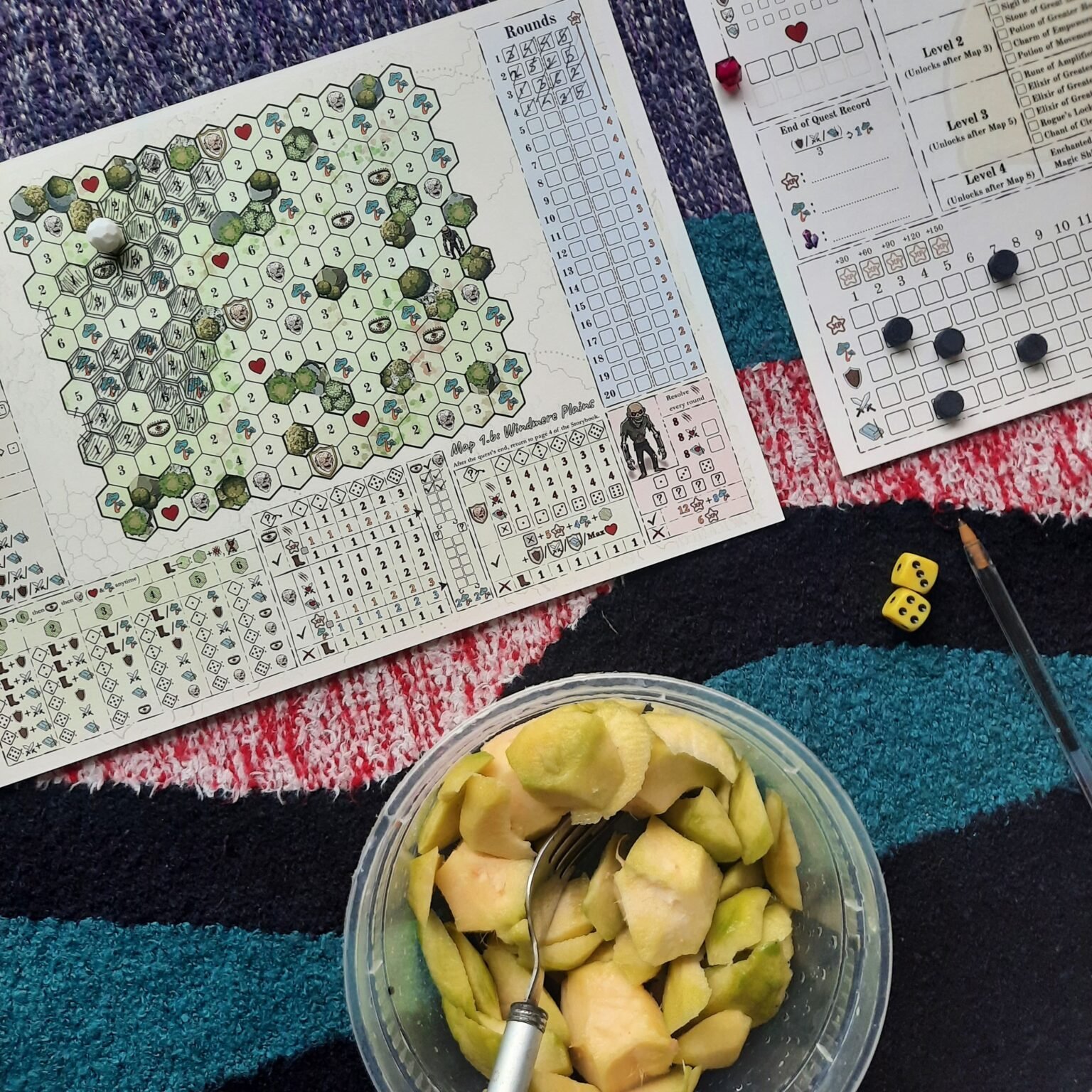
Of course, it wasn’t eight hours at a stretch. I spread it across four days, roughly two hours a day, and went through all nine quests of the campaign. And it’s been one fun ride!
I was immersed in the Misty Isle, reading through the Storybook between quests with a cup of tea in hand. Usually, I have a strict no-food-or-drinks-near-games policy since I don’t laminate them, but I made an exception this time and also indulged in some Amra (hog plums) along the way. In game terms, that was basically my Lethebane, haha.
I haven’t had the fortune of playing proper campaigns before this, but I have seen a handful of them online. And from what I’ve seen, campaigns seem to be more about the buildup than an immediate payoff.
You learn things along the way. You carry things forward. Your character develops. What happened before starts affecting what happens next. And it’s been a delight seeing Forgotten Paths work in that same spirit.
You can basically start the campaign with near-zero knowledge of how everything works yet know enough after a couple of rounds to keep yourself moving. And once a quest ends, whatever you earn starts feeding into the rest of the campaign. XP can be spent on permanent Talents, while Lethebane can be used at the Marketplace to pick up single-use items for future quests. Any XP you don’t spend also sticks around for later.
And while the base system stays familiar, the quests themselves don’t all feel like copies of one another.
The quest maps change. The polyhex shapes can change. The layouts, terrain, objectives, and special rules change. You’ll also be dealing with different mini-bosses and bosses along the way. After the opening quest establishes the basics, the rest start layering their rules on top. But the common gist stays intact.
And by the way, there’s no game-over midway through the campaign.
If a quest ends without you defeating the boss, that doesn’t end your campaign. You wrap up the quest, return to the Storybook, deal with whatever consequences came from how it ended, and keep going.
The branching pathways
I recently posted a newsletter issue on branching pathways and how I love them. Stemming from my experience with the Give Yourself Goosebumps series, all the way to experiencing them in games like Harbor of Blight, Essence, or Bravery, I’m a big fan of the concept. And Forgotten Paths makes the most of it.
At each stage of the campaign, you basically get two paths to choose from. Go here, or go there. And what I especially like is that choosing one doesn’t lock you into some predetermined route afterward.
Pick option A for your first quest? You can still pick A or B for the next one. And the next one. And so on.
Do the math across nine quests and there are 512 possible routes through the campaign! No, my math ain’t wrong, haha.
Now, that doesn’t mean there are 512 completely different stories. The story naturally meets back up at different points, while your choices and how previous quests went can still change things along the way.
But there are 18 quest maps in total, and you only play nine in a campaign. So if you finish one playthrough and come back for another, you can literally choose the opposite route every single time and go through nine completely different quests without repeating one from your first campaign.
The story
Of course, it’s a campaign, so I can’t say much about how the story unravels.
But I really liked how Myrto (who wrote the Storybook) didn’t overcomplicate it. It’s neat and it expands the Misty Isle without making things feel overwhelming.
The story never feels like it’s competing with the quests, rather complements them really well. So there’s a nice balance to it.
Can’t say more than that! One more word and I’d be spoiling the tale, haha.
And there’s more!
18 quests, 9 of which make up a campaign, plus three characters to choose from. That already makes Forgotten Paths pretty replayable in the context of a campaign. But Spyros and Myrto have more in store for you folks.
And as of writing this, all five stretch goals announced for its Gamefound campaign have now been unlocked!
That includes six additional characters, bringing the total roster from 3 to 9 Mistwalkers, alongside more stretch-goal goodies.
So there’s already a lot here to come back to.
A little full-circle moment
From watching Spyros and Myrto’s playthrough videos on YouTube to getting to play their second print-and-play, this feels extra special.
So a big thanks to you both for letting me experience Forgotten Paths!
If a branching solo campaign packed with exploration through the mist and whatever foul creatures may be lurking within it sounds like your thing, Forgotten Paths is currently live on Gamefound.
Recommended items
Game Overview
Designer: Spyros and Myrto
Publisher: Tabletop for World
Number of player/s: 1
Difficulty level: Easy to medium
Rounds of gameplay needed to learn: 1 to 2 rounds
Game duration: 45-60 minutes per quest, with a full campaign taking roughly 7-9 hours.
Available on: Gamefound
Theme: Roll-and-write | Exploration campaign
Number of pages and color: 22 pages (color) if you keep the Storybook and appendix on your phone
Assembling difficulty level: Super easy. Simply print and play
Lamination: Recommended for replayability, but feel free to skip it if you’re not a fan.
Additional elements required: 2 D6 dice (3 for certain characters/Talents), 12 cubes (maybe a couple extra for certain quests), a pen/marker, and a phone for the Storybook and appendix.
Time to learn: Within 20 minutes
Travel-friendly: 10/10
Shelving friendly: 10/10
Rating from PnP Time: 8.75/10

Tas is a game designer and blogger based in Bangladesh, with the dream of exploring the world of games and introducing it to anyone new to it.