Echoes of Tomorrow
You are trapped in a nightmare. A recurring nightmare that refuses to end.
And to make things even more intense, your regrets from the past, worries about your future, and insecurities of your present have taken the shape of nefarious beings…
Mythical Creatures.
Witch. Kraken. Minotaur. Genie. And many others…
And while they guard everything you want to be free from, you must find the Courage to confront what lies ahead and the Strength to overcome what still haunts you.
But every failed confrontation leaves a mark.
Can you take on the Creatures and break free from this nightmare loop?
Or will you succumb to your darkest thoughts…
Entry: before playing the game
First impression
Are you aware of what lucid dreaming is?
It’s a state where you can… sort of control your dreams. And not long ago, not only did it come naturally to me, but I also enhanced it to gain more control over my dreams. I eventually had to stop, though. A long story for perhaps another day. But by now, you know how fascinated I am by the dream world.
Getting to know about Echoes of Tomorrow took me down memory lane. Though it’s not about lucid dreaming, the whole aspect of dreams, or rather nightmares, recurring in a loop certainly gave me déjà vu…
It’s been three solid years since I started playing print-and-play games. And for a couple of years, I’ve also been in touch with lots of game designers who’ve shared their stories behind creating them with me. But I was yet to see a game start from scratch… until I saw Echoes of Tomorrow in the PnP Bundle contest.
It’s a competition held by Florian Fiedler and Chris Backe to bring projects by indie game designers to life, and Alec Hoptroff’s Echoes of Tomorrow ended up becoming the winner of the first-ever bundle through voting. I voted for the game too!
So, seeing it go from a concept to a fully fledged game was certainly quite an experience for me. I reached out to Alec to learn his side of the story behind creating the game, which he gladly shared, along with a few images of its earlier iterations. Check it out if you’re interested!
So, fusing my passion for dreams with the experience of watching a game bloom to life from scratch? Consider me super enticed!
A bit on the game
Echoes of Tomorrow is an 18-card game where you’re trying to escape a recurring nightmare by defeating six mythical Creatures.
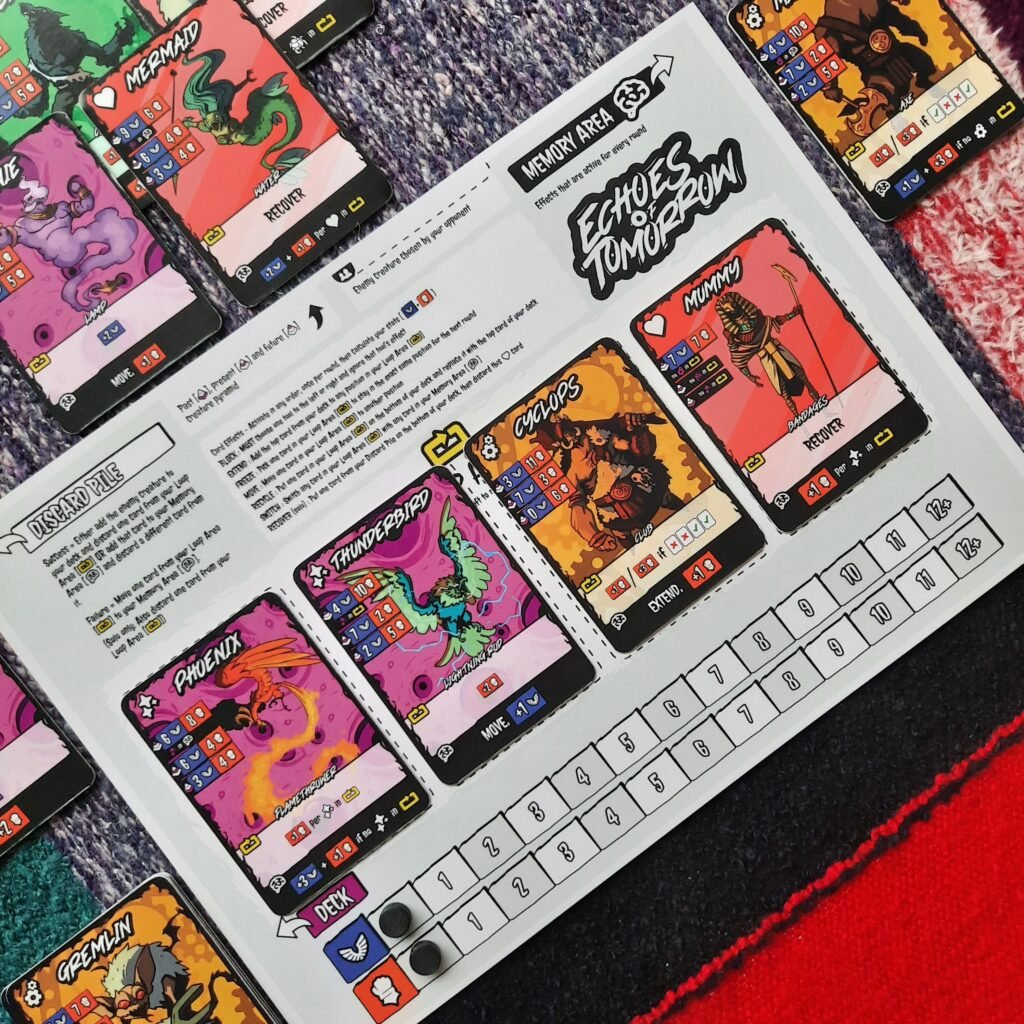
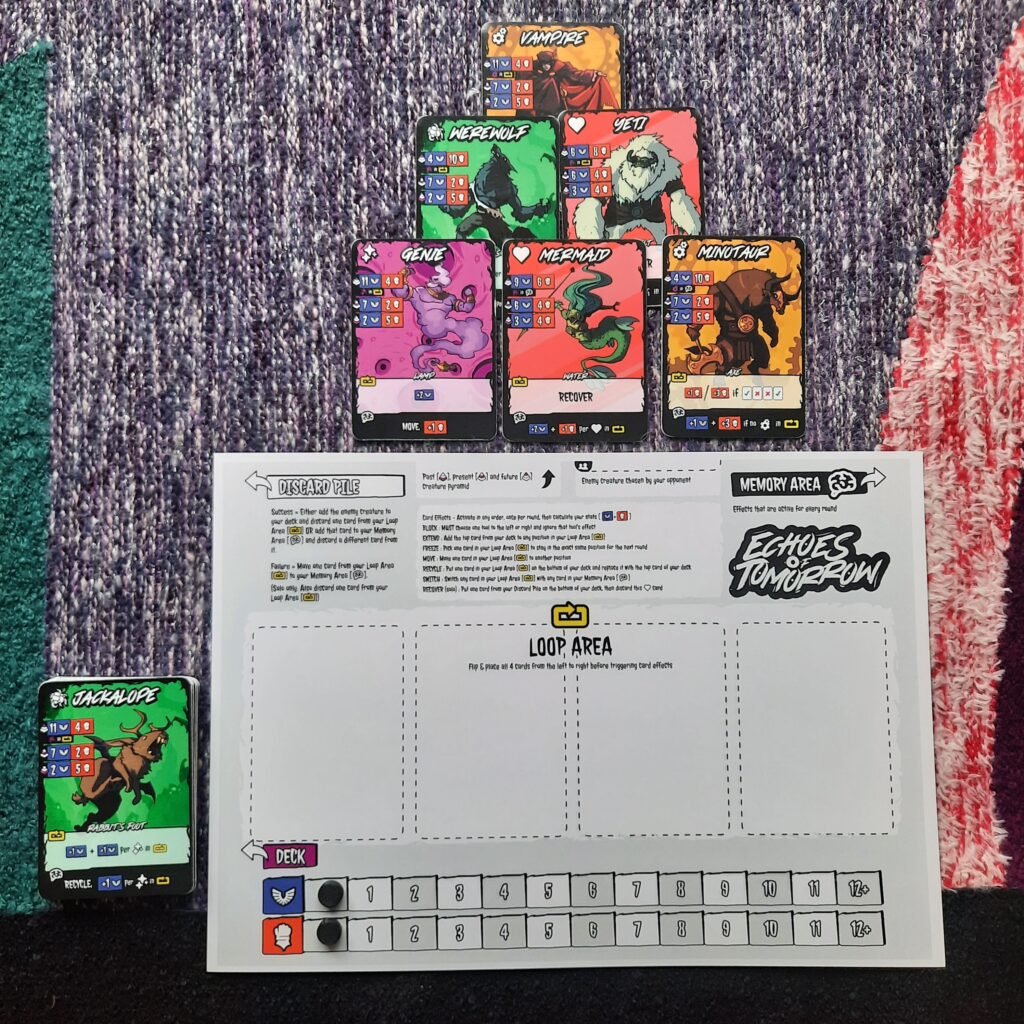
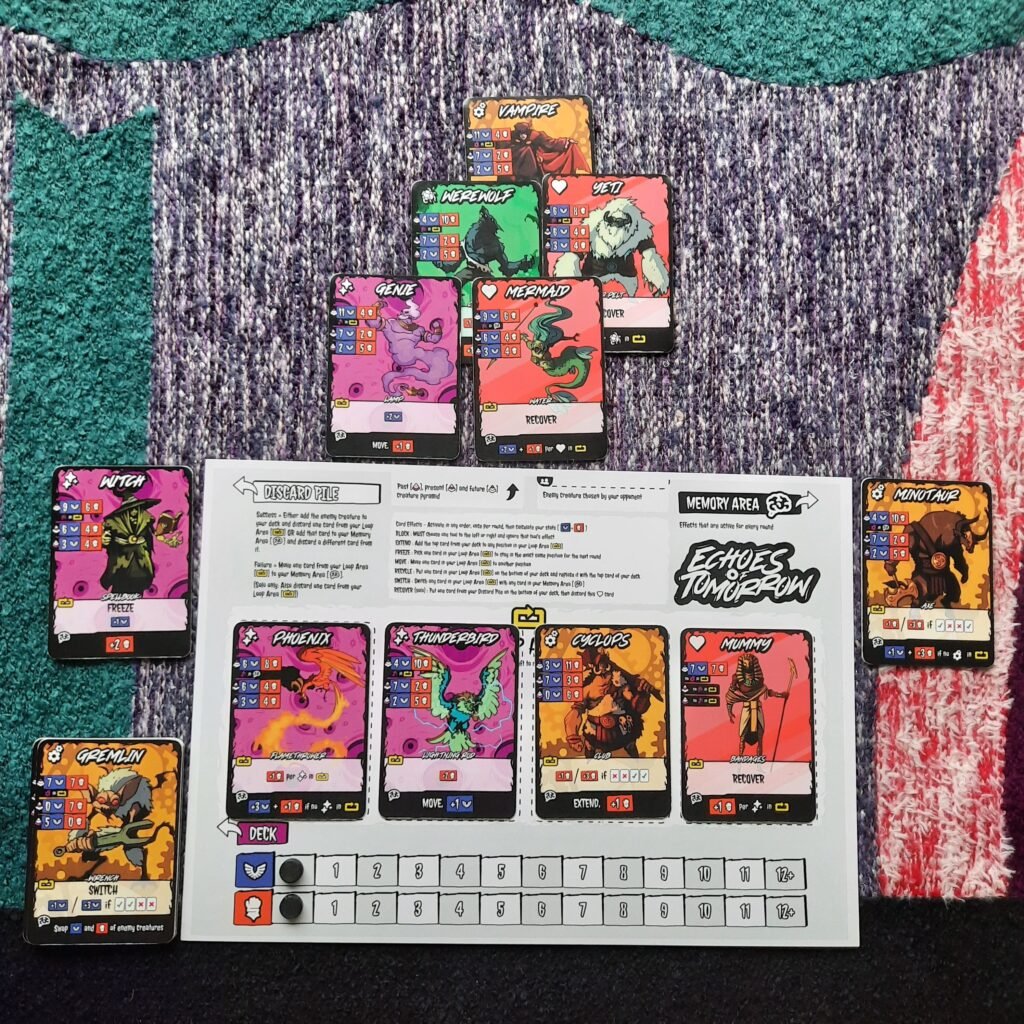
To begin, you’ll arrange them into a pyramid: three Creatures representing regrets from your past at the bottom, two representing worries about your future in the middle, and one representing the insecurities of your present self at the top. The remaining cards form your face-down deck.
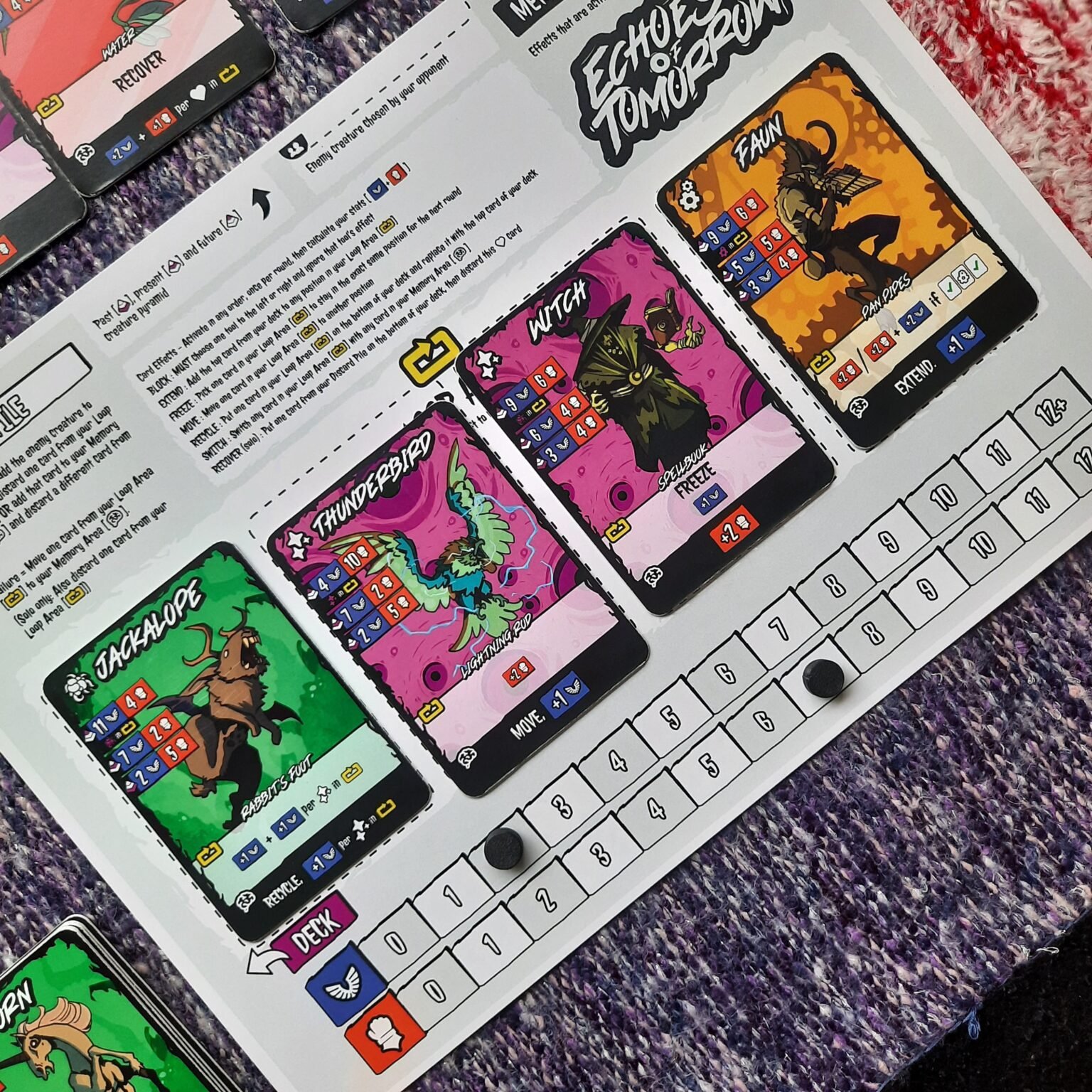
During each night (round), you draw four cards from the deck and place them from left to right to form your Loop. These cards provide different tools, along with Courage and Strength, which you’ll use to take on one available Creature. Some tools let you freeze, move, switch, extend, or otherwise manipulate the cards in your Loop before checking whether you meet the Creature’s requirements.
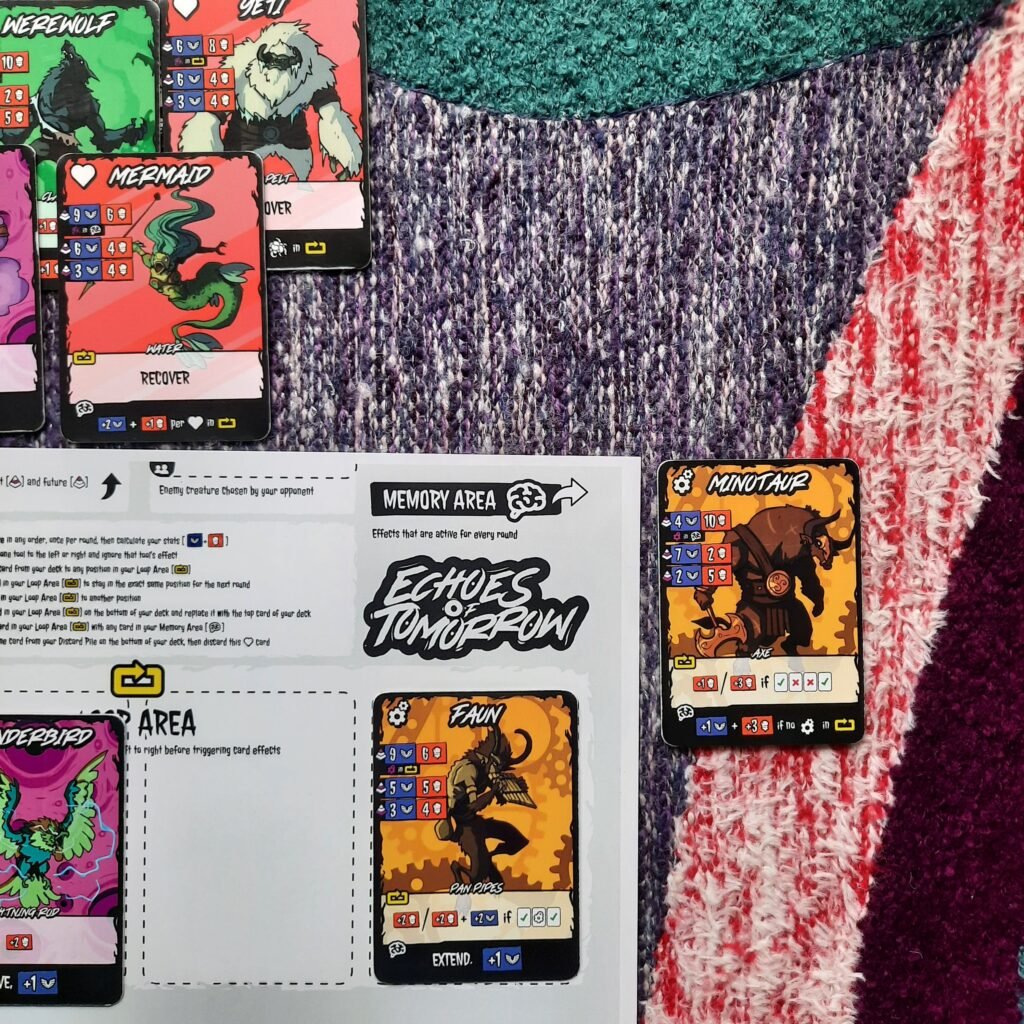
Defeat a Creature, and it can become part of your deck or Memory Area. Fail, and you must discard one card while moving another into your Memory Area, where it continues helping you during future nights.
After every night, the remaining Loop cards return to the deck before it’s shuffled again. Any Courage and Strength gained during that night are reset, and you’ll calculate them again from your new Loop and Memory during the next round.
Defeat the final Creature representing the insecurities of your present self to win. But if your deck ever has three or fewer cards remaining, regardless of how many cards are in your Memory, you succumb to the nightmare.
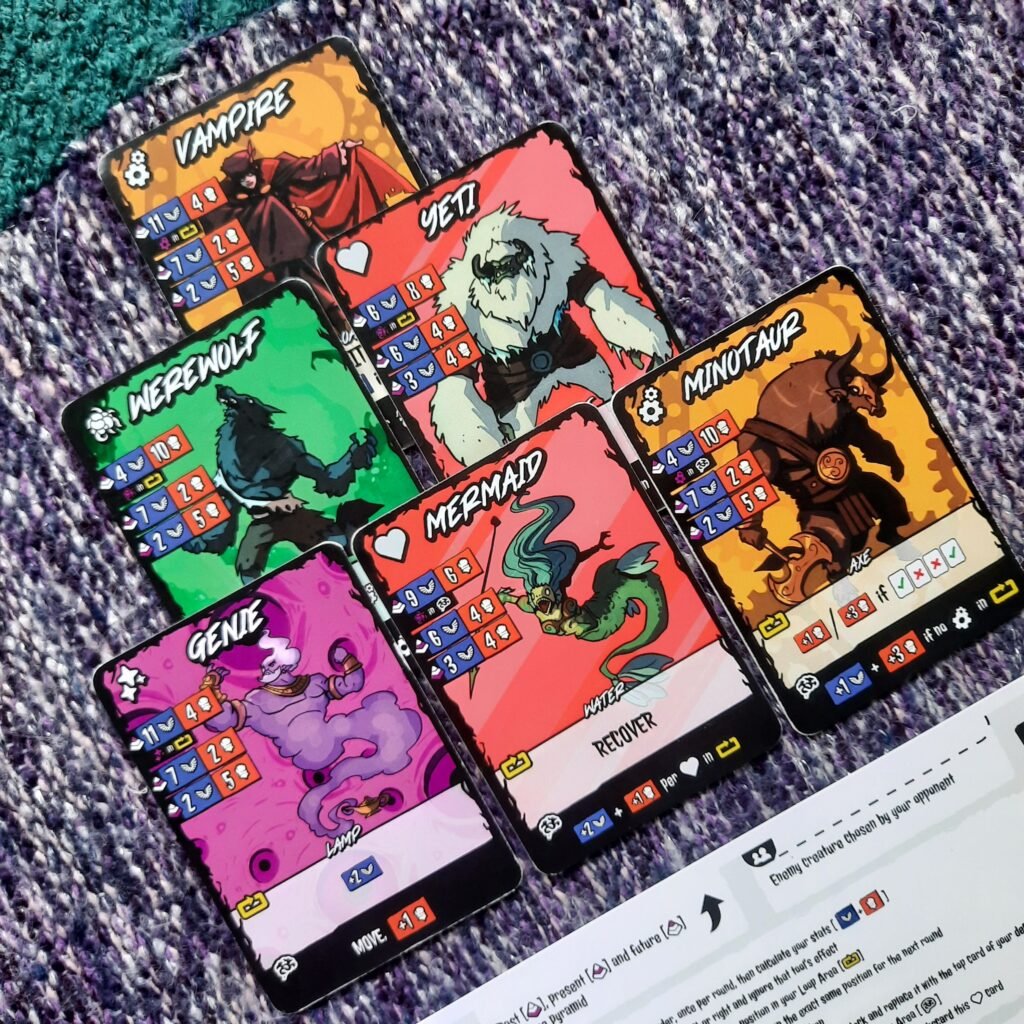
All you need
This is an 18-card game with a few additional elements: a printable playing mat and two tokens per player. Since I played solo, that meant 18 cards, one playing mat, and two tokens.
You only need to print five pages for the solo mode: four pages for the double-sided cards and one for the playing mat. Laminating the mat is optional, since there’s no writing involved. I had my cards laser-printed and rounded the corners with my Kadomaru Pro.
I really liked how both sides of the cards are utilized. One side is for solo, while the other is for the two-player mode.
I’m ready to enter my nightmare loop!
Entry: after playing the game
Findings
The flow of nightmares
It’s instrumental for a game’s story to be well integrated into its mechanics rather than feeling like an add-on, and Echoes of Tomorrow does that pretty well.
Every round represents another night in the nightmare. You draw four cards to create a new Loop, use the tools that appear, and once the round is over, return the remaining cards to the deck before shuffling everything for the nightmare to repeat. The cards may change from one night to another, but you never truly leave the cycle, making the Loop live up to its name. It becomes a recurring machine of facing your worst fears through the mythical Creatures.
The pyramid adds more to it, taking you through the different timelines of past, future, and present as the confrontations grow more demanding. You cannot simply rush towards the final Creature either, as the structure makes you earn your way upwards through the nightmare.
Add the ever-shrinking deck, and the stakes only rise. Everything combines to create this perfect atmosphere, and it’s not a one-way street towards victory or defeat either. You know you might be one Loop away from succumbing to the nightmare, yet you may still find a way to bounce back and finally break free.
There’s yet another game concept I really liked, which takes me to my next point.
Failing forward
Echoes of Tomorrow continuously cycles through nights where you either defeat a Creature or fall short. But what beautifully ties one round to the next is what happens in the transition.
If you cannot take down a Creature, you must discard one card from your Loop and move another into your Memory Area. This creates a fascinating push and pull. Failure costs you two cards from your active deck, bringing you closer to succumbing to the nightmare. Yet the card placed in Memory remains available throughout the game, offering ongoing Courage, Strength, or another useful tool.
This is essentially a fail-forward mechanism. You’re punished for falling short, but that same setback can equip you for what comes next. If planned well, the right card in Memory can become a turning point, reinforcing your future Loops and helping you defeat Creatures that previously felt out of reach.
But knowing which card deserves a place in Memory is crucial. And just like the game flows from one night to another, that takes me to my next point!
The Loop Engine
At first glance, Echoes of Tomorrow looked like a game where my decision space would be put to the test.
How so? Well, it all starts with the Loop Engine!
The instant you draw four cards into your Loop, this little puzzle begins. You’re trying to create the best possible combination to gather enough Courage and Strength to defeat a Creature, but the smartest moves often require you to think beyond the current round too.
That’s where the different tools come in. Freeze can preserve a valuable card in its current position for the next Loop. Switch can exchange a Loop card with one already sitting in your Memory, while Extend adds another card to the Loop and gives you even more to work with. Recover can bring a discarded card back into circulation, while Block, which shuts down a neighboring card’s effects, becomes something you must carefully work around.
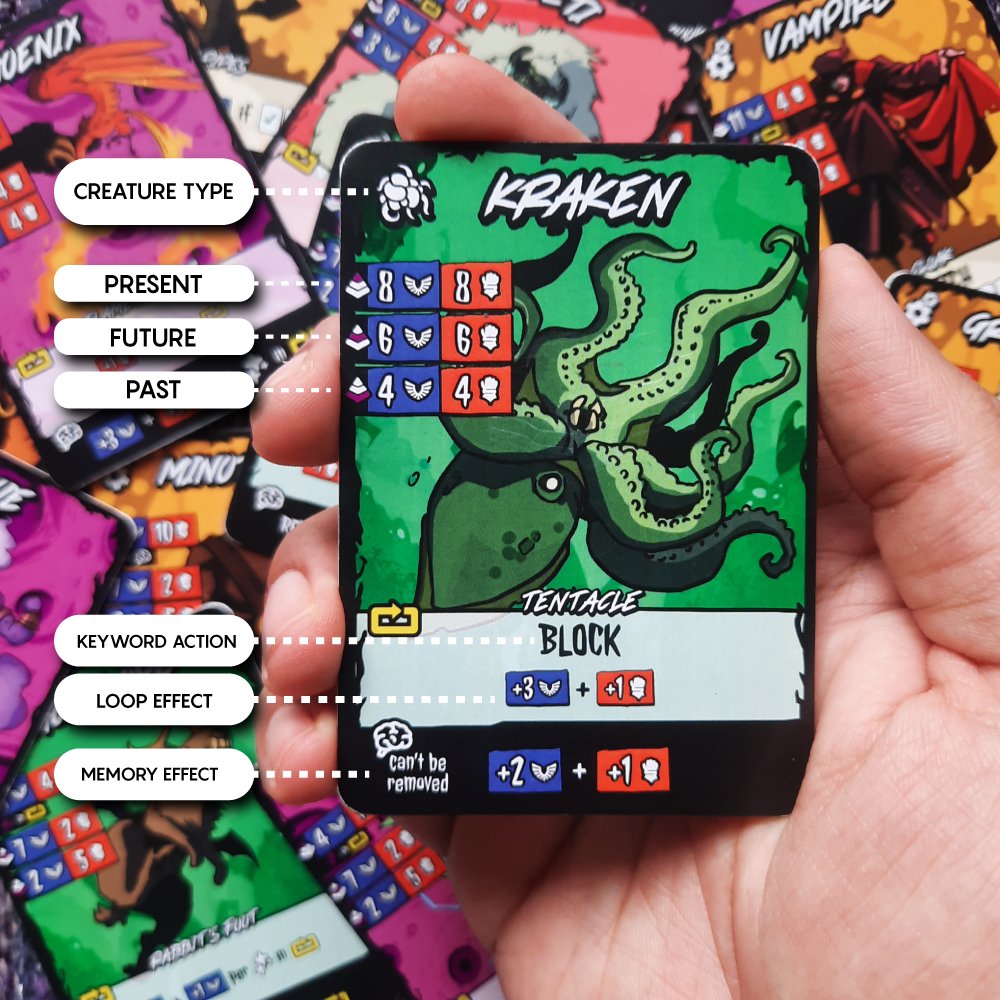
Then there are the Creature types. Arcane, Biological, and Crafted cards interact with one another, as several tools gain extra Courage or Strength depending on which types are present in your Loop. Others become stronger based on which cards surround them or where they sit in the Loop.
So, you’re not merely counting Courage and Strength. You’re studying the order, types, positions, keywords, and potential combinations of every card in front of you.
And the decision space stretches far beyond the Loop itself. Which available Creature should you confront, knowing you can defeat only one per round? After defeating it, should you place it on top of your deck or add it to your Memory? Which card can you afford to discard? And when you fail, which card deserves to become a lasting Memory?
Almost every choice affects not only your current confrontation, but the Loops waiting ahead.
The winning formula
Nope, there’s no cheat code or one specific move that guarantees a win. But there is one thing you should absolutely do before diving in: take a moment to go through all 18 cards. That’s it.
The mythical Creatures differ from one another. Their requirements vary, their tools behave differently in the Loop and Memory Area, and several gain bonuses depending on their position or the types of cards around them.
Understanding these differences helps a lot. So, the better you know the Creatures, the better your chances of escaping the nightmare.
Bringing the nightmare to life
This is the second game I’ve played that was illustrated by Vittoria Pomplani, and just like Essence: The Grim Expeditions, the artwork is absolutely stunning!
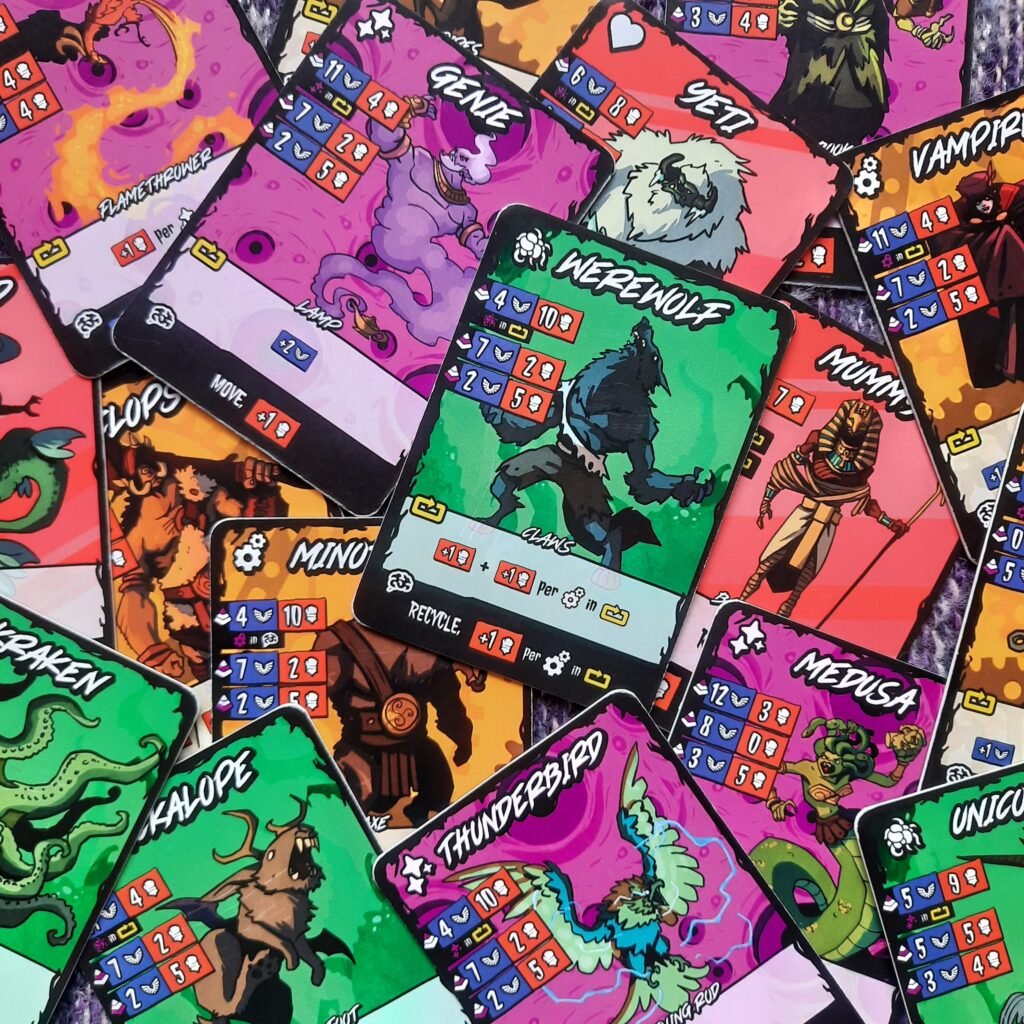
From Witch and Genie to Kraken, Minotaur, and Medusa, every mythical Creature feels distinct and full of personality. Their illustrations beautifully capture the eerie, dreamlike vibe of the game.
Despite having so much information on them, the cards never look cluttered. The Creature artwork, types, requirements, and separate Loop and Memory effects all remain easily distinguishable.
The story, game mechanics, and artwork complement one another beautifully, coming together to create this wonderfully cohesive game.
Ready to enter the nightmare?
It’s been a good while since I last played an 18-card game. There are a few additional components, sure, but the heart of the game still lies within those 18 cards. And this one felt even more special, as I watched it bloom from scratch.
A big thanks to Florian Fiedler and Chris Backe for bringing the game to life through the PnP Bundle contest. And, of course, a BIG thanks to Alec Hoptroff for creating such a brilliant game and putting it forward for the contest.
Now I can finally enjoy nightmares!
You have less than a week to enter your nightmare loop.
Recommended items
Game Overview
Publisher: PnP Bundle
Designer: Alec Hoptroff
Artist: Vittoria Pompolani
Number of players: 1-2
Difficulty level: Medium
Rounds of gameplay needed to learn: 1 to 2 rounds
Game duration: 20 minutes
Available on: Gamefound
Theme: Card manipulation | Escaping a nightmare loop
Number of pages and color: 5 pages (solo) or 6 pages (2-player)
Assembling difficulty level: Pretty easy. Crafting 18 both-sided cards
Lamination: Optional, for the printable playing mat
Additional elements required: 2 tokens per player
Time to learn: Within 20 minutes
Travel-friendly: 10/10
Shelving friendly: 10/10
Rating from PnP Time: 9.25/10

Tas is a game designer and blogger based in Bangladesh, with the dream of exploring the world of games and introducing it to anyone new to it.