Midtown Mall
A mall visit feels effortless when it’s just for fun.
A quick stop at the coffee shop. A glance at a storefront. A crowd gathering around the newest sale. Lights everywhere. Music in the background. Everything simply… works.
But keeping it that way is a whole different game.
Behind every busy hallway is a decision waiting to be made. Which stores need attention? Where should the next investment go? Is it time to push marketing, improve the products, or study the market before taking the next step?
The doors are open. The customers are coming in.
And now, you are on the other side of it all. The mall is yours to grow.
Entry: before playing the game
First impression
“I wanted to capture the satisfying feeling of building a business from the ground up.”
Said Romin Khazai, creator of Midtown Mall, while sending me the game files last month.
The idea of playing a real-life management-style game already piqued my curiosity. Not fantasy. Not dungeons. Not a strange creature waiting around the corner. But something far more real. A shopping mall. A place most of us easily connect to, but rarely think about from the other side.
A refreshing route to take? Absolutely.
After looking at Midtown Mall a bit more, I reached out to Romin to ask about the thoughts behind creating it. He kindly shared quite a bit, and I dedicated a full newsletter issue to that side of the story. He also mentioned that the game has been in the works for the past couple of years, with around a hundred playtesters involved in testing and improving it before its Kickstarter campaign.
I always love hearing the stories behind games, especially when the game itself takes a route that feels different from most.
But enough about the story behind it. Time to open the mall doors.
A bit on the game
Midtown Mall is a solo economic roll-and-write where you take on the role of managing and growing a shopping mall over 15 rounds.
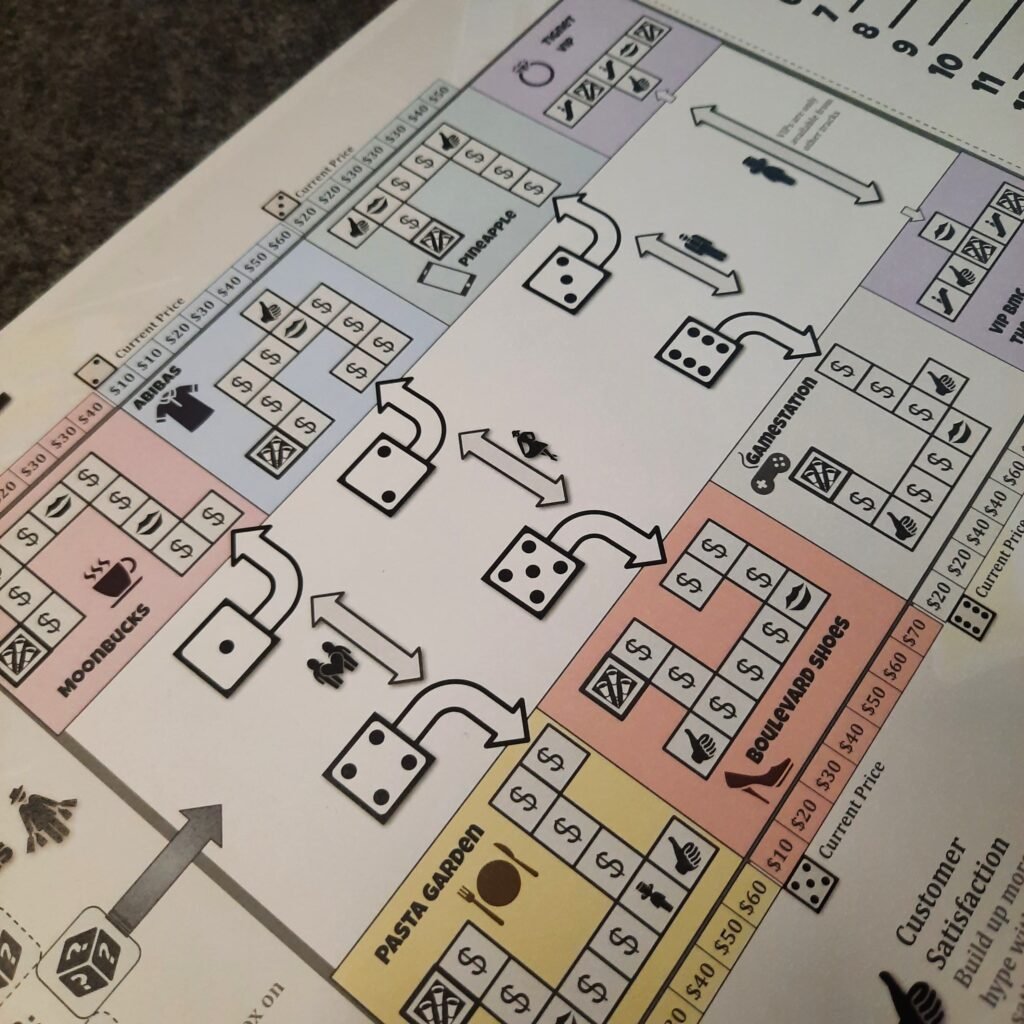
Each round, you roll 3 dice. One die goes into Marketing, another into Product Development, while the remaining die becomes a Customer die. As the game progresses, you can unlock additional dice and rerolls.
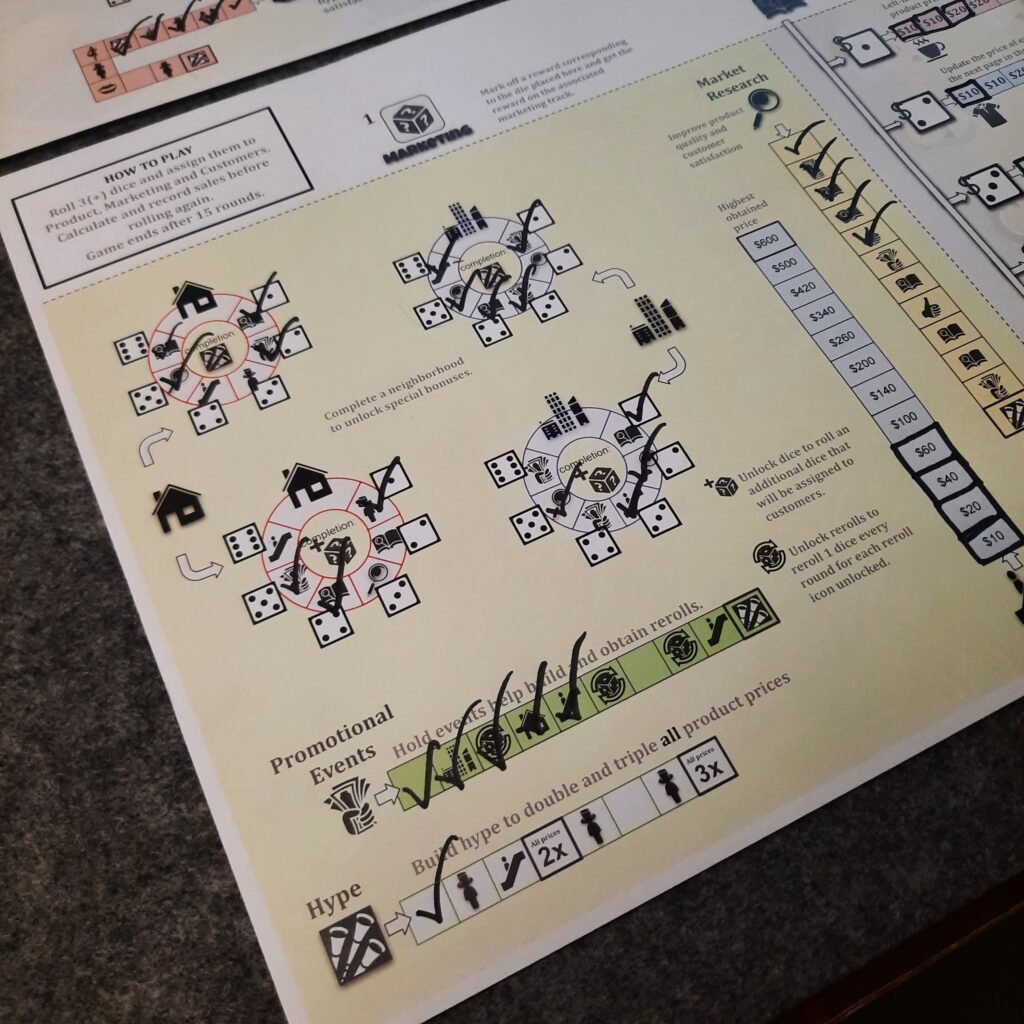
The Marketing area lets you mark off houses or apartments based on the die value you place there. Each marked space rewards you with different bonuses tied to systems like promotions, hype, market research, facilities upgrades, customer satisfaction, rerolls, additional dice, and more. Completing an entire location also unlocks a central bonus reward.
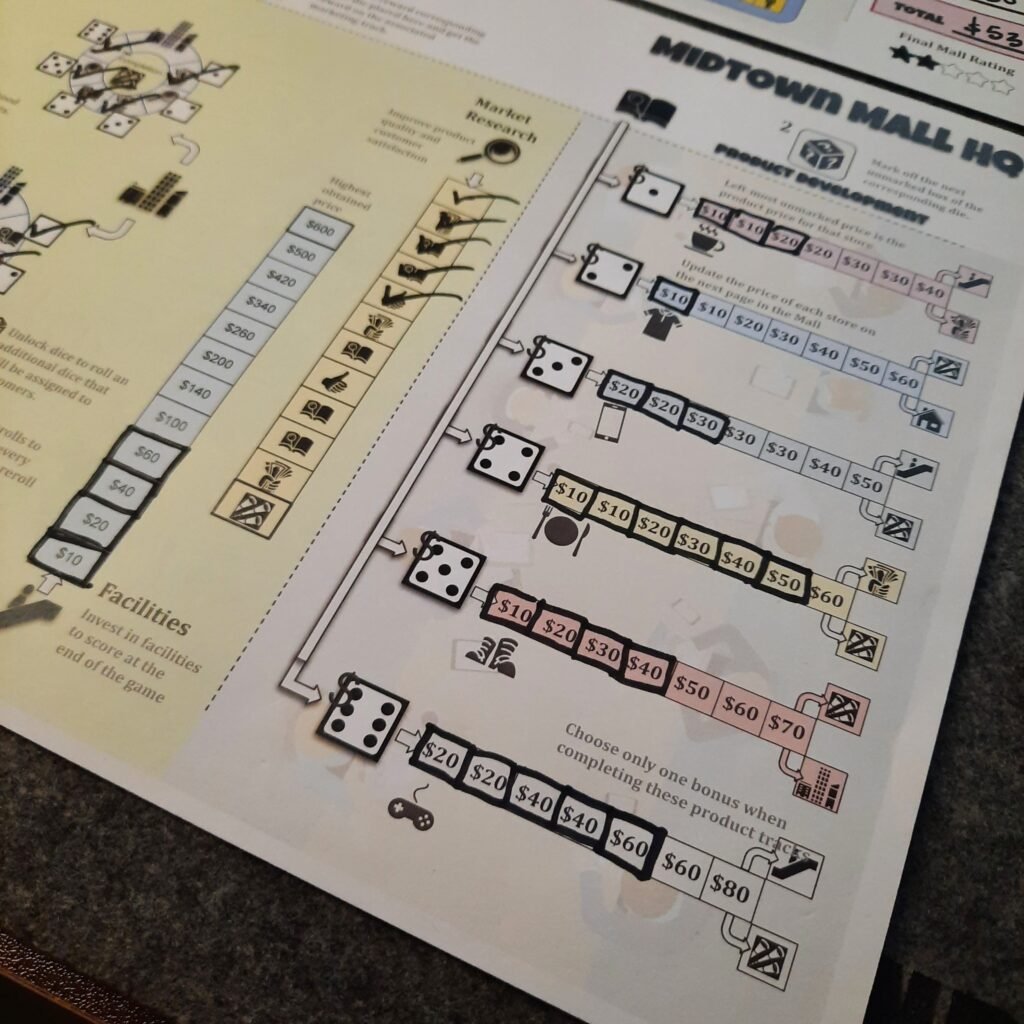
Product Development is where you improve the stores in your mall. The die value determines which product track you mark, and each marked space updates the current price of the matching store.
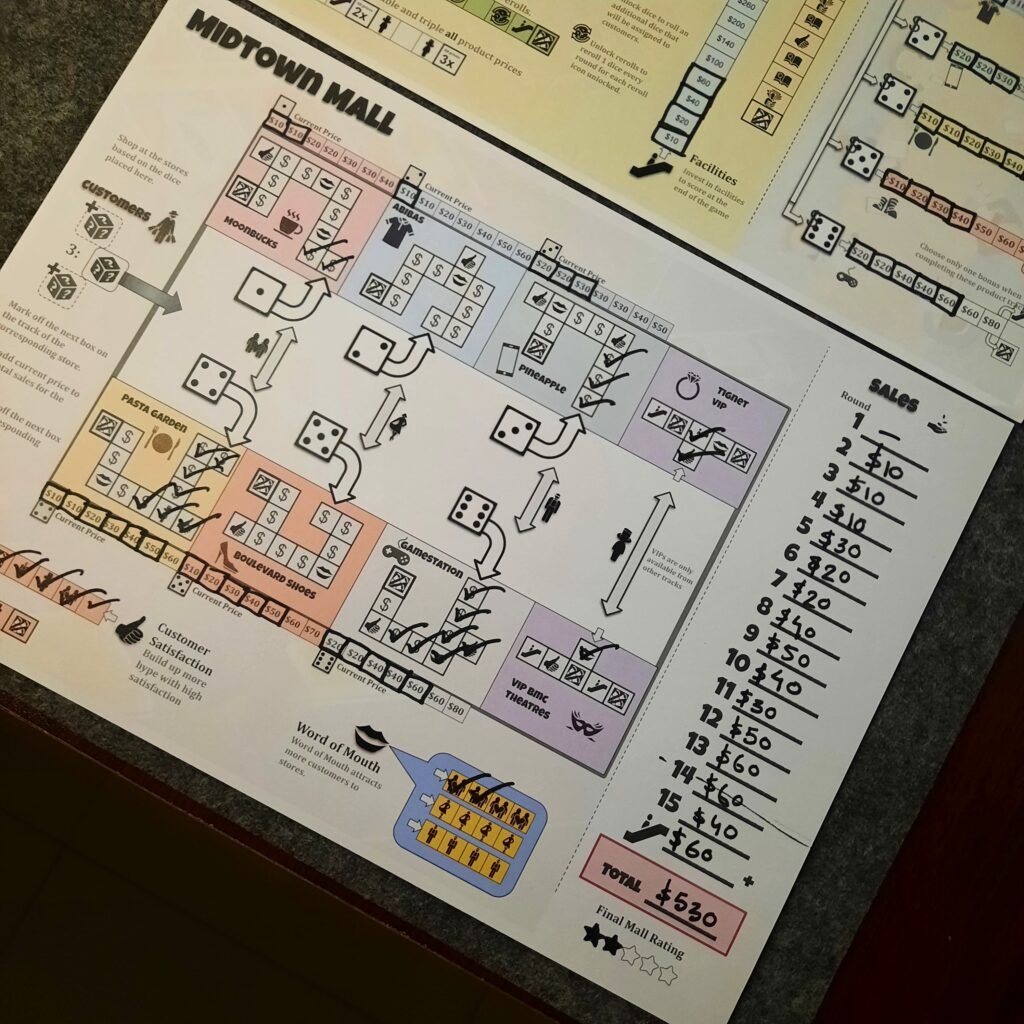
Customer dice are then placed in the mall itself. These dice move customers through the different stores inside your mall, where marked spaces may trigger sales, bonuses, or other effects. Whenever a marked space shows a dollar symbol, you add that store’s current price to your sales for the round.
There are also systems like Word of Mouth and VIP stores that further expand how customers flow through the mall and how your strategies develop over time.
After 15 rounds, you total your sales, add your facilities upgrade bonus, and compare your result to the final mall rating.
All you need
Quite a minimal setup, honestly.
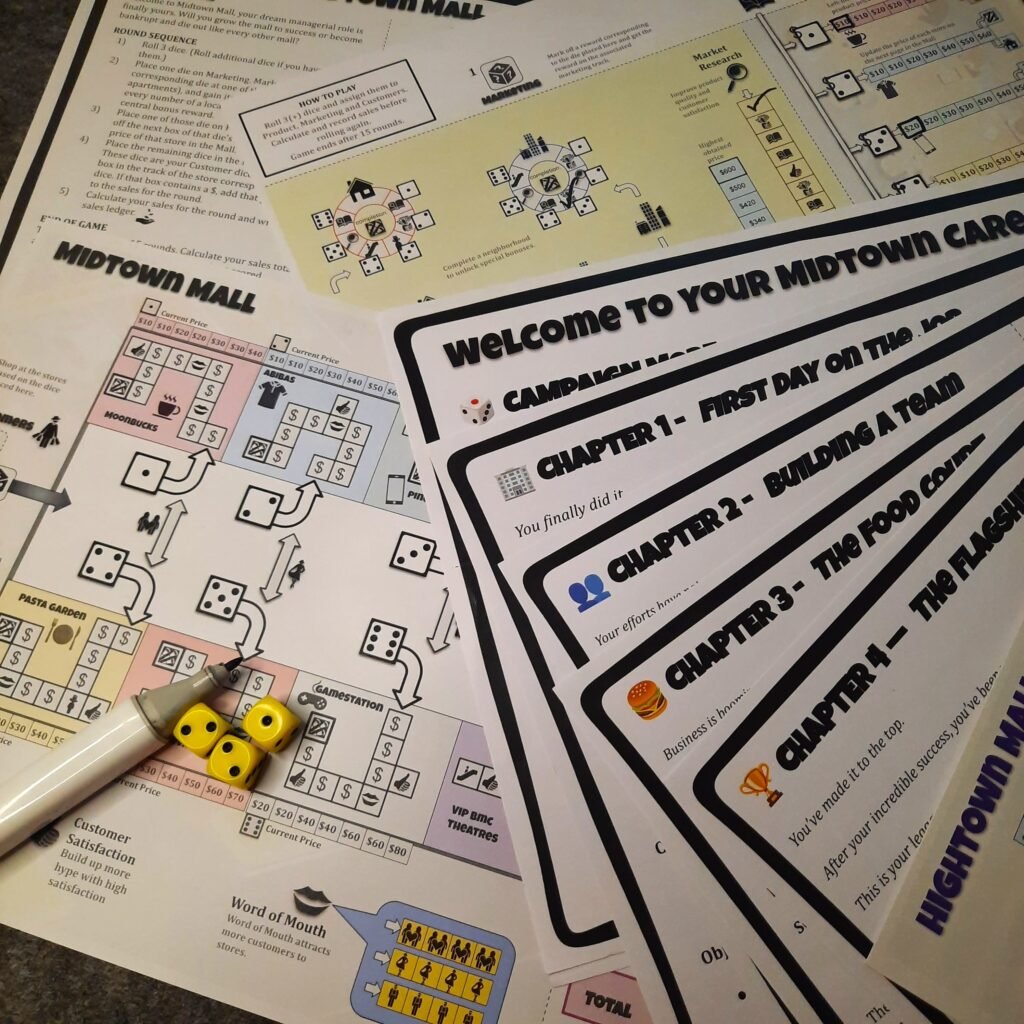
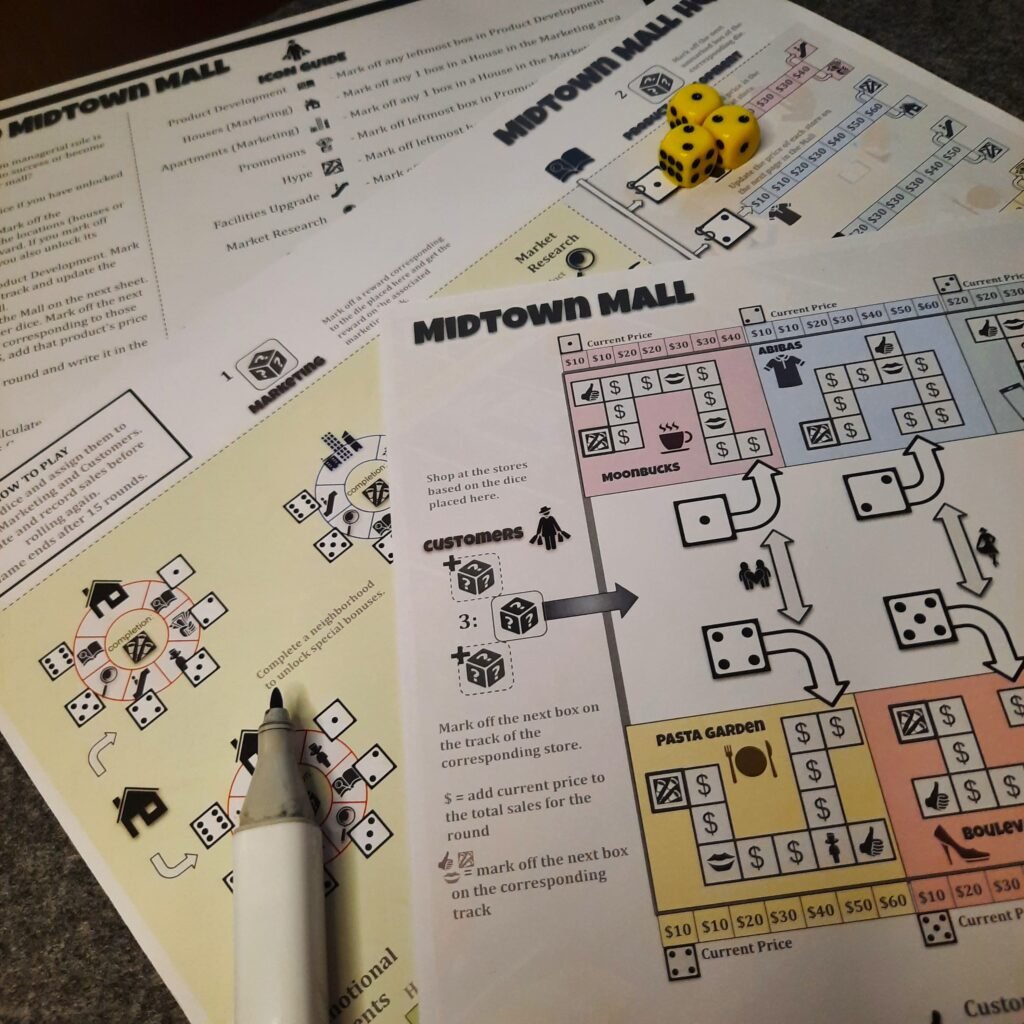
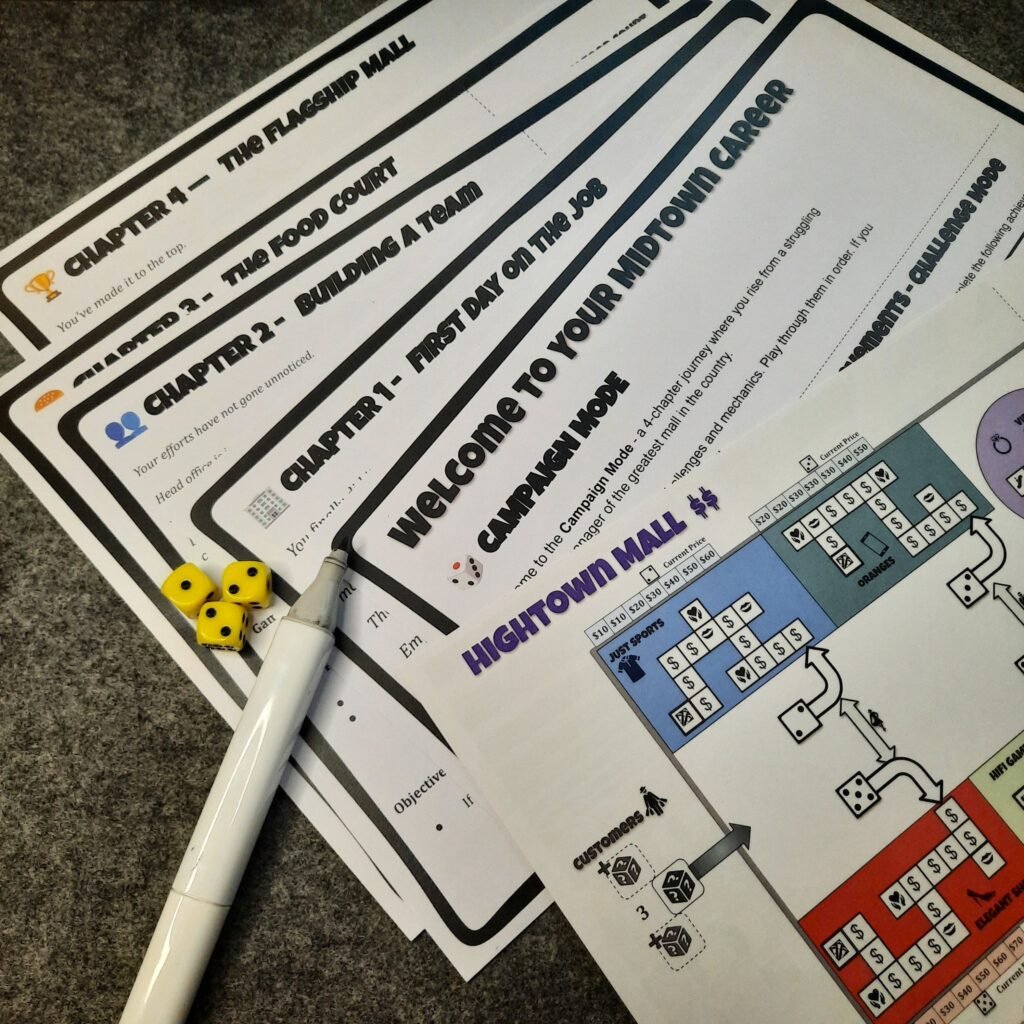
Print 2, at most 3, offset papers in color, grab 5 D6, a marker, and you are all set.
You can laminate the sheets for replayability if you want to, but you already know my methods by now. No lamination. No glare nightmare.
Time to run a mall!
Entry: after playing the game
Findings
A fun little realistic engine builder
Midtown Mall is an engine builder. One that slowly grows into a rather satisfying web of connected systems.
And what I appreciated the most was how naturally the theme settled into those mechanics.
Marketing does not just exist as a side track. It feeds into promotions, hype, research, facilities upgrades, customer satisfaction, additional customers, and more. As it should, in real life.
Product Development increases the value of your stores, which directly affects how much money those stores generate once customers start flowing in. Again, as it should.
Then there are logical systems in place, like Word of Mouth and the different customer demographics. Couples naturally lean towards places like coffee shops or restaurants. Fashionistas boost clothing and shoe stores. Techies help gadget-focused stores. Everything feeds into something else.
The flow felt really good too. Everything is connected. As it should be in a business.
Manager smarty pants or safe play?
A lot depends on the route you decide to take.
Much like real-life management, Midtown Mall makes you wear multiple hats. You cannot just sit in one corner of the business and expect everything else to take care of itself. Marketing needs attention. Product Development needs attention. Research, hype, facilities, VIPs, customer satisfaction, all of them slowly start asking for your time.
I learned that the slightly messy way.
On my first attempt, I was so busy developing a few specific stores that it was not until around the 10th round that I realized how much else I had been ignoring. VIPs. VIP stores. Hype. Facilities. So many systems that could have helped if I had started investing in them earlier.
Somehow, I redeemed myself a little and ended the 15 rounds with $530 in sales.
A one-star mall.
I gave myself two stars though. One extra for the first-time attempt. Do not do that, by the way.
So, dear aspiring mall manager, do not just play safe. Play smart. Right from the first round.
Builds up pretty well
I love it when games execute a good old domino effect well, and Romin has done exactly that with Midtown Mall.
It may not happen immediately. In fact, most of the satisfying chains need to be planned from the start. But once they begin to connect, the game starts opening up nicely.
Picture this. You allocate a die to the Marketing area, which leads you to Market Research. After reaching the fifth stage of that track, you improve Customer Satisfaction, which then brings more couples into places like the cafe and restaurant.
Result? More sales.
And that is just one of the many chain effects Midtown Mall has waiting inside it. Some are short. Some take longer to set up. Some ask you to keep multiple tracks in mind before the payoff arrives.
You just have to keep your eyes open and build toward them.
A little nod to the store names too, by the way. Adibas, Moonbucks, Pineapple… any guesses which brands they are representing? Haha. Neat touch, Romin.
There’s a campaign mode!
As if the base mode was not enticing enough to tickle the little entrepreneur in me, there’s also a campaign mode.
The campaign takes you through 4 chapters, starting from your first day on the job and slowly building toward managing the flagship mall. Along the way, new layers get added in. Employees enter the picture, bringing special abilities. A food court expansion joins the mall. And eventually, the game moves into a bigger Hightown Mall setup.
So, instead of just asking you to beat your score, the campaign appears to build a little career arc around the whole thing. You start small, learn the systems, and then get handed more to manage as you move forward.
I am yet to play the campaign mode, and honestly, I do not think I can hold on much longer.
Will surely let you folks know once I do.
Possible sequels?
While playing Midtown Mall, I could not help but think about how much room the system has to grow further.
New departments? HR, Accounts, Inventory? More store types? Different mall layouts? The foundation already feels flexible enough to support all sorts of future additions without feeling forced.
And honestly, that is usually a very good sign for an engine builder like this.
Midtown Mall already has plenty going on in its current form, but it also feels like a system that can comfortably expand into future editions or expansions down the line.
And I really hope Romin decides to explore that route someday. Big please.
Let’s go to the mall?
Have you ever played an economic roll-and-write that gives real-life business simulation vibes? I hadn’t, until Midtown Mall appeared on my table.
And yes, I initially wondered whether this would be my kind of game…
But after several rounds, and after getting to know the story behind its creation, it completely won me over.
If you feel like taking a small break from dungeons, monsters, and combat, and want to settle into something that takes a very different route, Midtown Mall is definitely worth stepping into.
So, will I see you at the mall?
Recommended items
Game Overview
Publisher: Dozens of us Games
Designer: Romin Khazai
Number of players: 1
Difficulty level: Medium
Rounds of gameplay needed to learn: 1 round
Game duration: 20 minutes
Available on: Kickstarter
Theme: Economic roll-and-write | Grow your shopping mall
Number of pages and color: minimum 2 pages, maximum 9 (base + career mode), in color
Assembling difficulty level: No assembly required
Lamination: Recommended for replayability
Additional elements required: 5 D6 dice and a marker
Travel-friendly: 9/10
Shelving friendly: 10/10
Rating from PnP Time: 8.5/10
Tas is a game designer and blogger based in Bangladesh, with the dream of exploring the world of games and introducing it to anyone new to it.