Rope Walkers
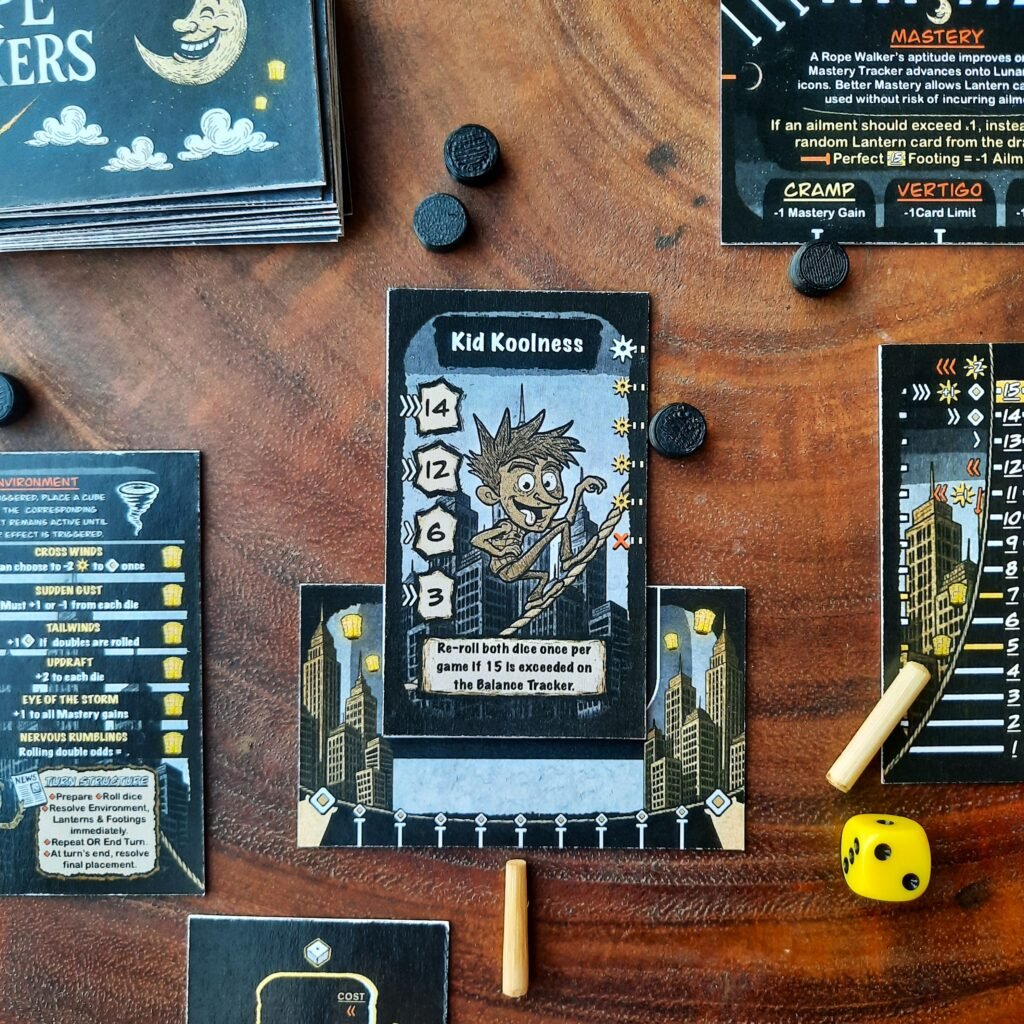
The world, as you know it, split in two.
A comet struck our planet. Oceans tore apart, mountains gave way, and the sky itself cracked open.
And somewhere in that chaos, one man did something absurd. Brilliantly absurd.
He tied a rope to join the two halves.
No one knows how it held. Maybe it shouldn’t have. Maybe it still shouldn’t. But it did.
And every year since, when the world remembers how close it came to falling apart, the Knot Festival begins.
Lanterns rise. Crowds gather. Music fills the night. And above it all, that same rope stretches on, waiting.
Because tradition demands it, someone must climb that rope and make the crossing, recalling the day when everything could have ended, but didn’t.
Are you game?
Entry: before playing the game
First impression
About seven months ago, I was introduced to Curry’s games through a very chaotic little print-and-play where goblins fought over the pettiest things imaginable: Teeny Tusslers.
It was quick, scrappy, clever, and packed with more decisions than its tiny size had any right to carry. I loved how the goblins weren’t just there for flavor either. Their madness shaped the puzzle, their personalities pushed the decisions, and somehow, the whole thing felt beautifully controlled while still being wonderfully chaotic.
So when Rope Walkers came my way, I knew Curry wasn’t about to hand me something ordinary.
The premise alone had me hooked. Earth split in two. A rope holding the halves together. A festival built around walking across it every year. That’s wild.
And after Teeny Tusslers, I already knew Curry had a knack for taking a strange idea and giving it proper mechanical teeth. So, consider me enticed.
Time to find out if Rope Walkers could keep its balance. No pun intended.
A bit on the game
Rope Walkers is a pocket-sized solo card game where you attempt to cross a rope that connects two split halves of the world.
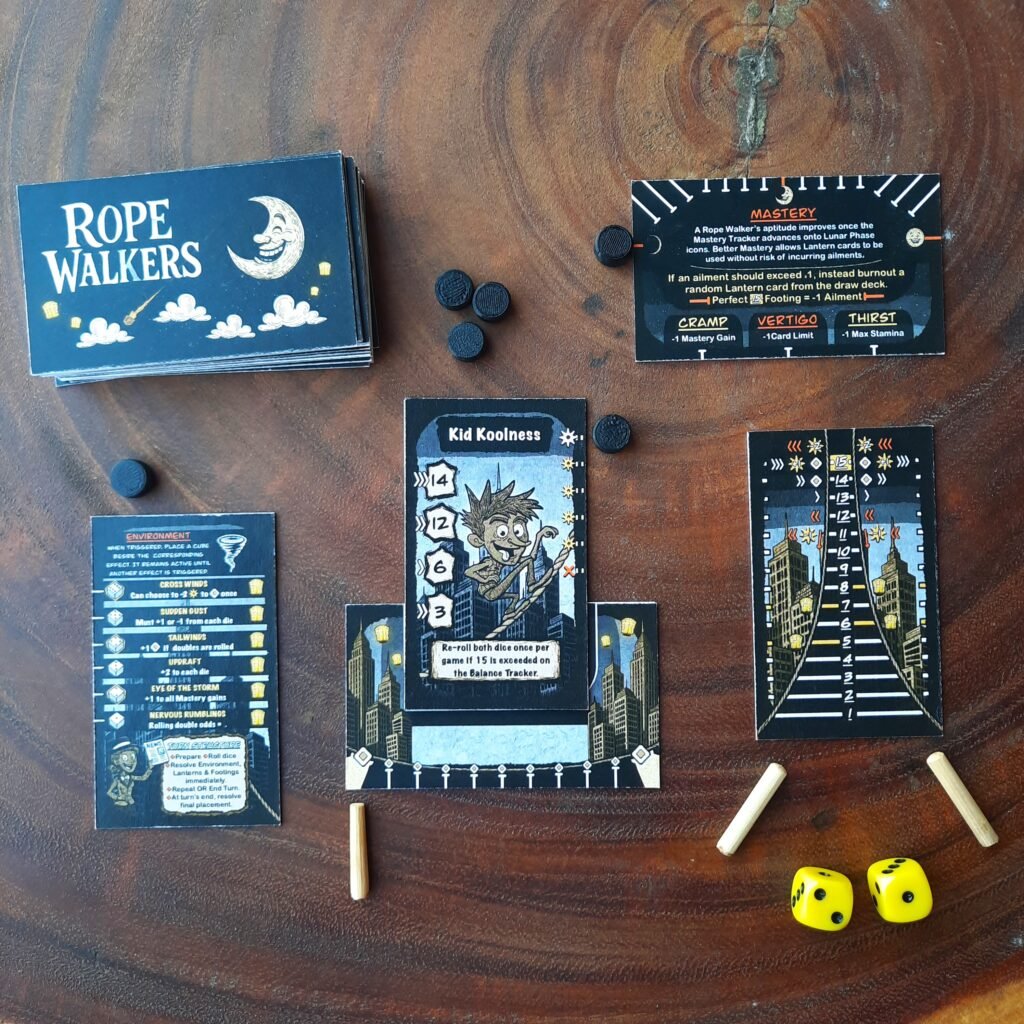
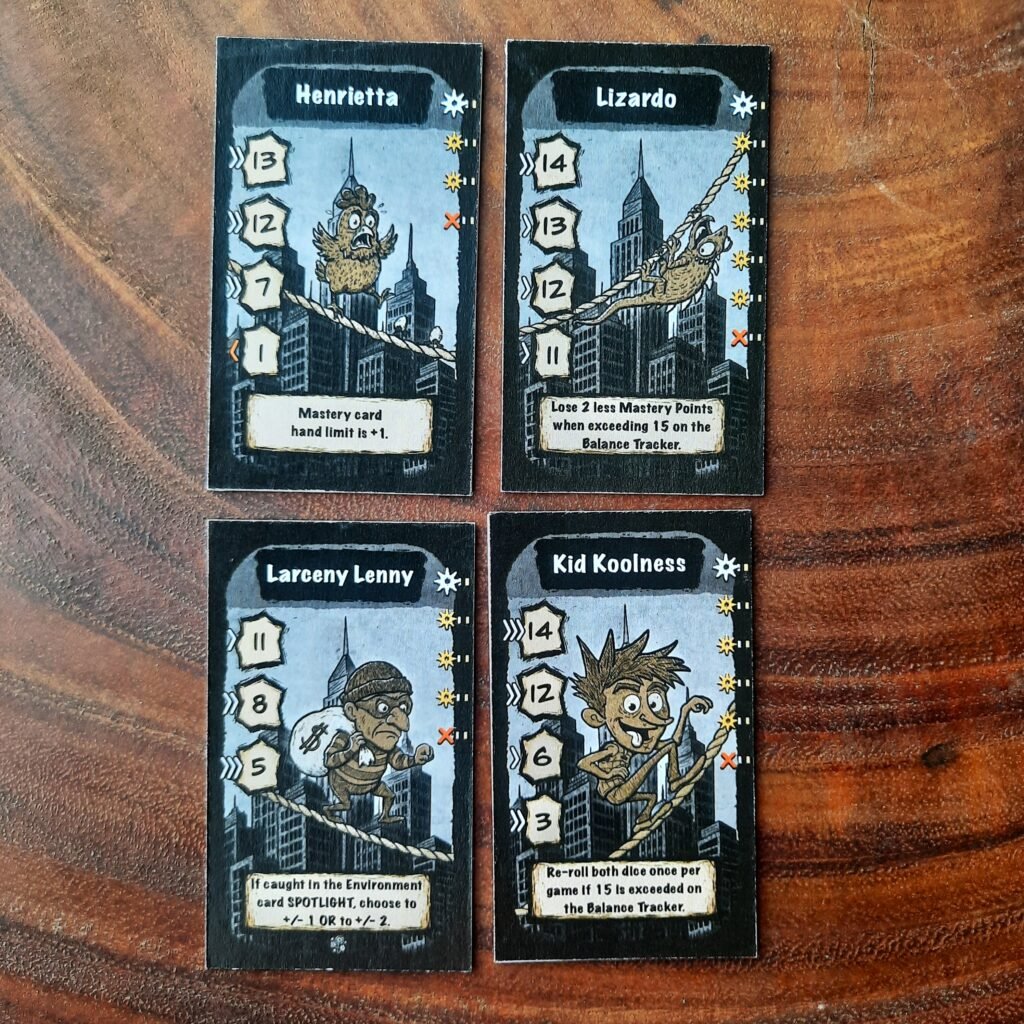
To begin, you choose one of four walkers, each with their own footing numbers and special ability. You also set an Environment card, which changes the conditions of the walk and introduces different effects during play.
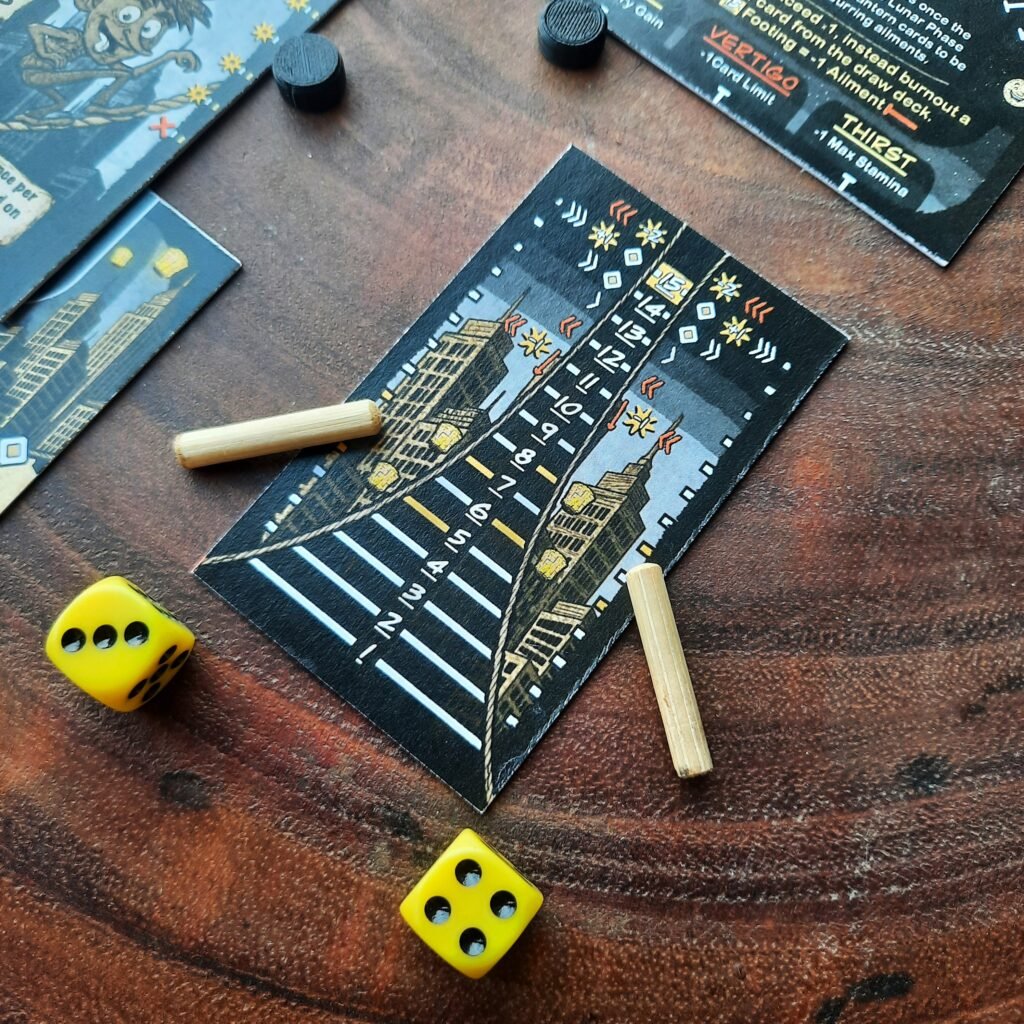
On your turn, you roll two dice and assign one die to each side of the Balance Tracker card. The values move your trackers upward, and the spaces you land on determine what happens next. Some results give you Mastery Points, some reduce your stamina, and the key numbers, 14 and 15, allow you to move forward on the Rope Tracker card.
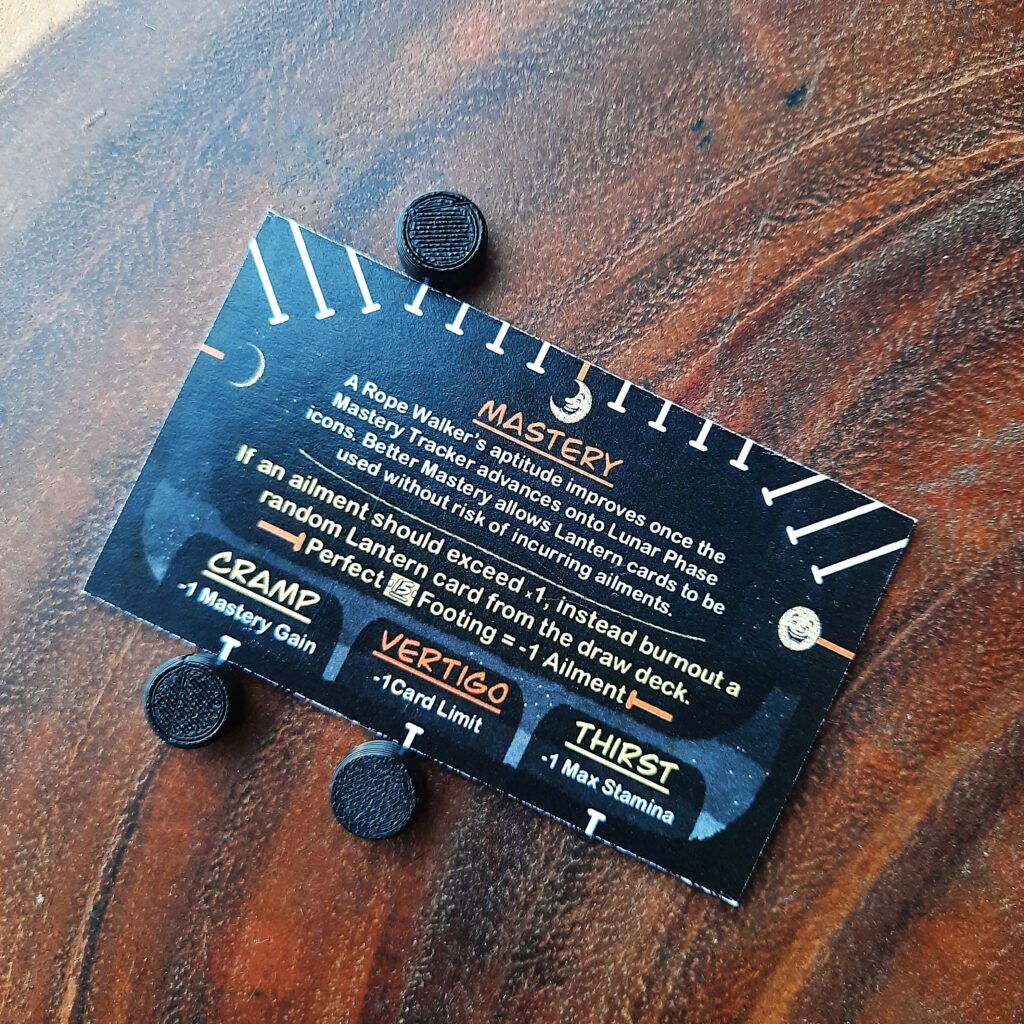
Along the way, you may land on Lantern spaces. These let you draw a Mastery card, which can give you useful one-time effects. However, using these cards may also bring in drawbacks depending on your current mastery level, such as cramp, vertigo, or thirst.
If your stamina reaches zero, you fall. At that point, the game shifts into a catcher mini game, giving you one final chance to recover and continue the crossing.
Your goal is to reach the end of the rope before the walk goes completely wrong.
All you need
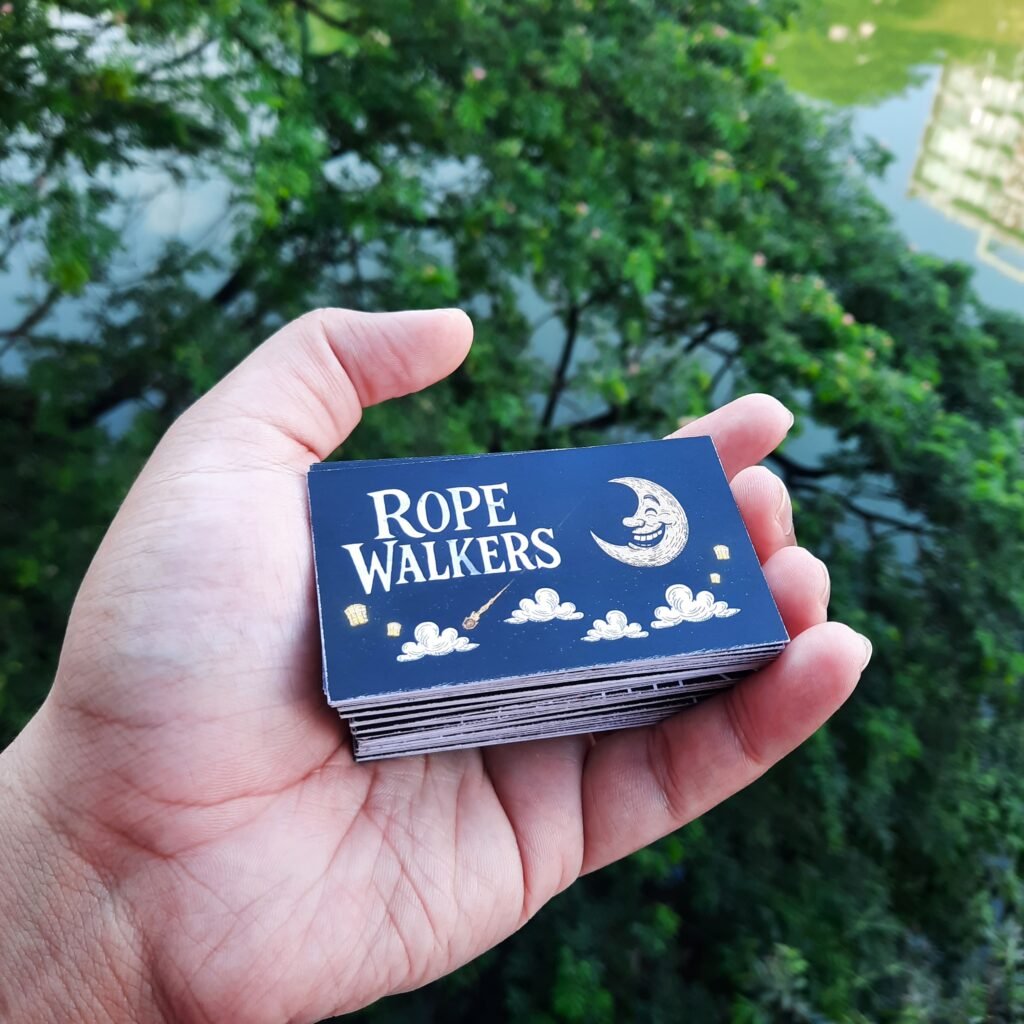
Print 9 pages in total. The card dimensions are quite unique, small enough to sit right in your palm. In total, you’re looking at 34 cards, and sleeving isn’t really an option here. The size doesn’t quite allow for it, at least for me.
Once the prints are sorted, grab 2 D6 dice, preferably in different colors, and 9 markers.
For the markers, you can get a bit creative. I used cut-out chopsticks for the Rope Tracker and Balance Tracker, which oddly fit the theme quite well, since rope walkers usually have a balancing pole in hand. But honestly, anything that works for you will do just fine.
With that sorted, you’re ready to step onto the rope!
Entry: after playing the game
Findings
Balancing at the heart of it
Imagine walking across a rope, one step at a time. Not too wide, not too narrow. Every shift of weight matters. Lean too far one way, and you feel it immediately. That sense of constant adjustment sits right at the core of Rope Walkers.
Each turn, you roll two dice and assign one to each side of the Balance Tracker card. From there, both values climb independently, and where they land determines everything that follows. Lower results can cost you stamina and mastery. Mid-range numbers start to stabilize your run. And the high-value targets, especially 14 and 15, are what actually push you forward along the rope.
Each turn does not have to stop after a single roll either. You can keep rolling, keep assigning dice, and try to climb higher on the Balance Tracker card. That is where things get tricky. The higher you go, the closer you get to those ideal numbers. But you also move dangerously close to overstepping, and the game is quick to punish that confidence.
What makes this even more interesting is that you are assigning the dice yourself, so every roll becomes a small decision. Do you stack one side higher and play it safe on the other, or try to balance both? That choice alone carries more weight than it initially seems.
It reminded me a bit of allocating dice to the gain-or-lose track in Escape the Living Library, but this feels tighter and more deliberate. The balance here is not just a theme layered on top. It is baked right into the mechanics.
Different walkers, different conditions
This is not exactly a space launch where you expect everything to happen under perfect conditions. You are walking across a rope in the middle of a festival, so of course the conditions shift.
At the start of each game, you roll a die to determine the Environment card, and that sets the tone for the entire walk. These environments do not directly hand out ailments, but they do interfere with your dice, your options, and your outcomes. Some twist your rolls, some force tough choices, and some make managing your turn just a bit more uncomfortable than you would like.
And then there are the walkers themselves.
You get 4 Rope Walkers to choose from, each with different stamina, footing numbers, and a special ability that subtly changes how you approach risk. My favorite so far is Kid Koolness, mainly because of the safety net. With Kid Koolness, if things go a little too far, there is still a way to pull it back once, which fits perfectly with how the game tempts you to push just a bit more.
Each walker also looks amusing. The artwork is spot on, giving them personality, so they feel like performers, not just stat cards.
Put the two together, and Rope Walkers builds variety through small shifts. A different walker, a different environment, and suddenly the same rope feels like a very different walk.
A climb that feels real
Theme integration is everything when it comes to games like this, and Rope Walkers does a solid job of making its systems feel like they belong on the rope.
The more you walk, the more you start dealing with mastery. It is not just a score going up for the sake of it. Mastery represents your walker slowly becoming more capable, more confident, and more prepared for the madness happening around them. That matters because the cards you gain through lanterns are not simple bonuses.
When you hit a Lantern on the Balance Tracker card, you draw a Mastery card. That card gives you a useful effect, but it also interacts with the current environment through the die icon at the top of the card.
So a Lantern is not just “yay, free card.”
It can shift what is happening around you as well.
And the cards themselves are properly tempting. Some let you reroll, adjust dice, recover stamina, advance on the rope, avoid falling, or even set a Balance Tracker to 15. These are not small perks. Used at the right time, they can completely rescue a turn.
But they have their cons too.
If your mastery is not high enough, using those cards can bring in ailments like cramp, vertigo, or thirst. And those are not just flavor words. Cramp can slow down your mastery gain. Vertigo can limit your hand. Thirst can reduce your max stamina. Suddenly, that clever little boost you wanted comes with a physical consequence, which fits the theme beautifully.
Add that to changing environments, dwindling stamina, and the constant pressure of getting close to 14 or 15 without overdoing it, and the game starts to feel like a very compact version of a dangerous climb.
A very real climb. At least, on a tabletop.
Game in a game!
If you run out of stamina, the endgame is triggered. You fall. Or at least, that’s what you expect to happen.
But Rope Walkers has other plans.
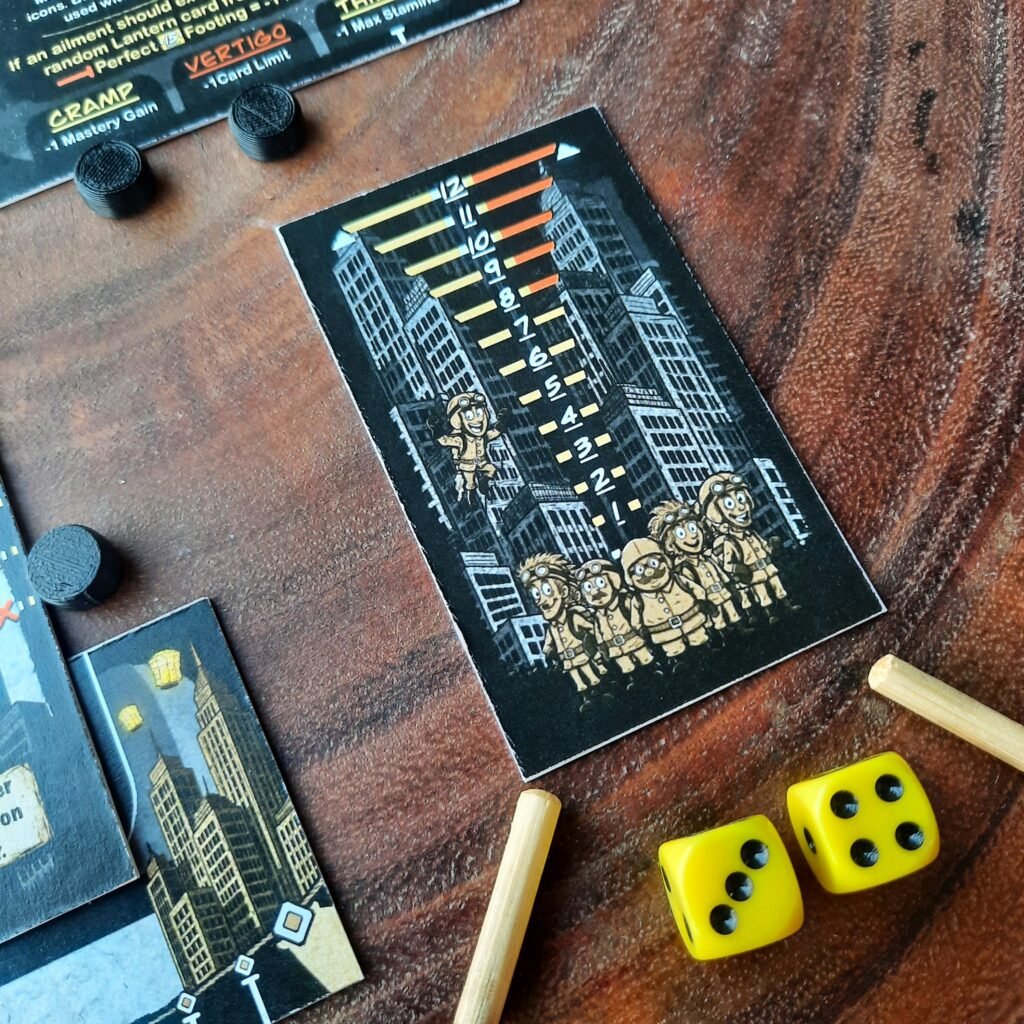
The moment your stamina hits zero, the game flips, quite literally. You turn over the Balance Tracker and step into a mini game that acts as a last-ditch attempt to recover. It is not just a quick roll and hope either. It carries the same DNA as the main game, built around balance, positioning, and careful decision-making.
You are still managing dice. You are still trying to stay within a safe range. But now, everything is tighter, more desperate, and far less forgiving.
Succeed, and you grab onto the rope, reset your stamina to 1, and keep going.
Fail… and that’s when you actually lose the game.
It is such a clever little twist. What looked like a fail state suddenly becomes a second chance, one that demands just as much control as the climb itself. And because it mirrors the core system instead of replacing it, the transition feels seamless.
Replayable?
Let’s do the math.
4 Rope Walkers, 5 unique environments, 17 Mastery cards bringing new pros and cons, two difficulty modes on the Rope Tracker card, and two sides of the Balance Tracker card, thanks to the catcher mini game.
Each walker changes how you approach the rope. Each environment shifts the conditions. Each Mastery card can open up a neat little advantage while quietly asking what you are willing to deal with in return. And the Rope Tracker card lets you decide how harsh you want the crossing to be.
Prognosis?
Highly replayable.
The artwork helps too. It is captivating, full of personality, and makes the whole thing easy to return to. Not just because the game plays differently, but because the world is fun to step back into.
Ready to step onto the rope?
Rope Walkers is the first game I tried from the Micro May event on Kickstarter this year, and honestly, it could not have been a better start.
If this is your kind of game, a tense little solo walk with just enough chaos to keep things interesting, I’d keep an eye on this one.
The campaign launches soon.
And something tells me… this rope is going to get crowded.
Recommended items
Game Overview
Publisher: Curilla Games
Designer: Curry
Artist: Curry
Number of players: 1
Difficulty level: Medium
Rounds of gameplay needed to learn: 1 to 2 rounds
Game duration: 30 minutes
Available on: Kickstarter
Theme: Push-Your-Luck Balancer | Cross the rope, or fall trying!
Number of pages and color: 9 (color print)
Assembling difficulty level: Medium, prepping the 34 cards
Lamination: Not required
Additional elements required: 2 D6 dice and 9 trackers
Travel-friendly: 9/10
Shelving friendly: 10/10
Rating from PnP Time: 9/10
Tas is a game designer and blogger based in Bangladesh, with the dream of exploring the world of games and introducing it to anyone new to it.