Cavern Shuffle | Maze of the Minotaur
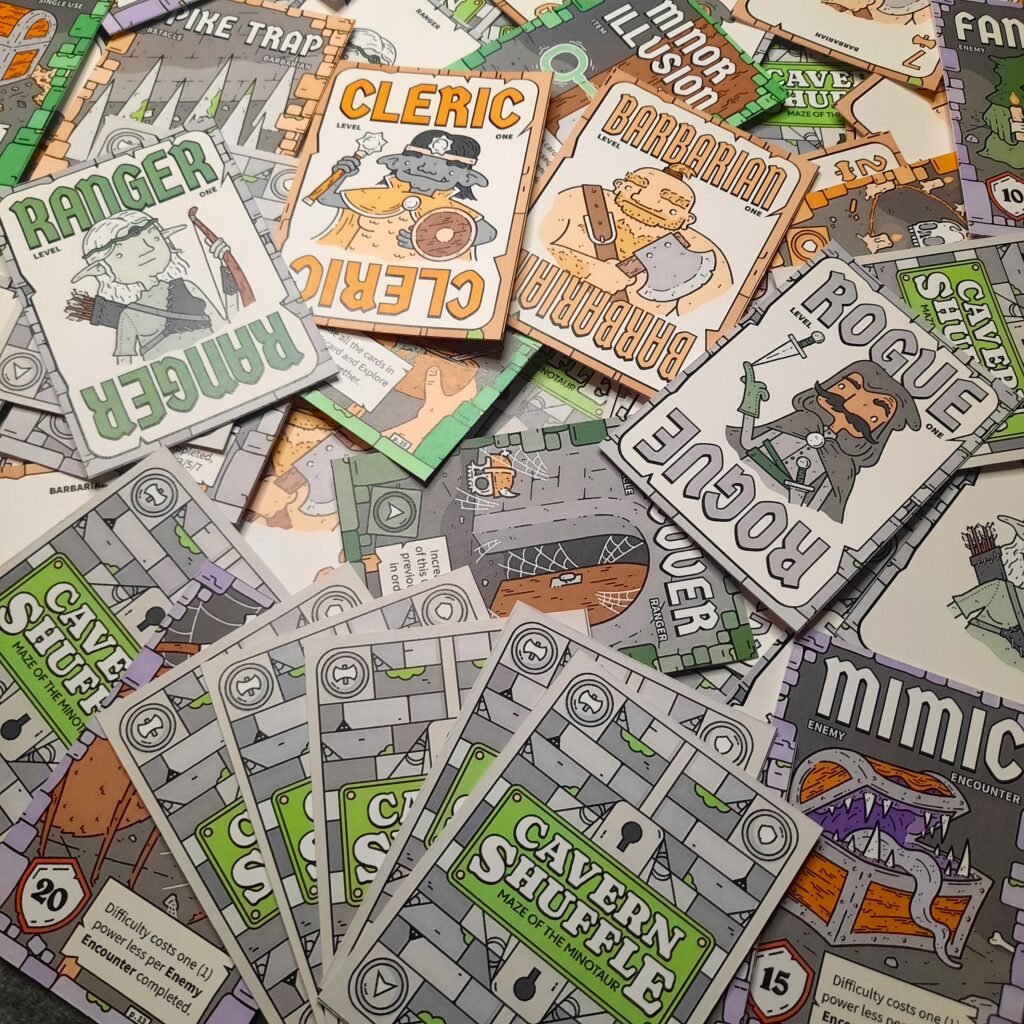
Seven corridors lie in front of you.
You can see parts of them, but never the whole. You start exploring slowly.
Some friendly faces are revealed. Some unpleasant ones too.
Some paths open up possibilities, while others block your way entirely. Gah, obstacles. Not every reveal helps…
You move things around, trying to make sense of what is in front of you. Building sequences. Clearing space. Hoping the next reveal gives you something to work with.
And then, as things begin to fall into place, something shifts. A presence moves across the corridors…
Closing off options. Forcing you to rethink your moves. Guess who? The boss enemy, Minotaur.
Are you ready to take on the Minotaur and gain control over these ever-changing corridors?
Entry: before playing the game
First impression
Nostalgia. That one word summarizes my first impression of this game.
While going through the rulebook, tutorials, and the game files, I couldn’t help but keep looking back to my golden days, roughly 20 years ago. Being a game built on the foundations of solitaire, Cavern Shuffle took me back to the very first time I was introduced to it in 2005, playing it on Windows XP.
I didn’t know the rules at first, so I winged it most of the time until I slowly figured out how it worked. I didn’t even know its name back then, haha.
I don’t know about most of you, but the internet arrived in my country around 2006. So my pre-internet days were filled with offline games, and solitaire easily makes it into my top 30.
So, jumping 21 years forward (goodness, I’m old), seeing a game with catchy artwork and the essence of my childhood, naturally my curiosity spiked.
A bit on the game
Cavern Shuffle is a solo, solitaire-inspired card game built around sequencing and progression.
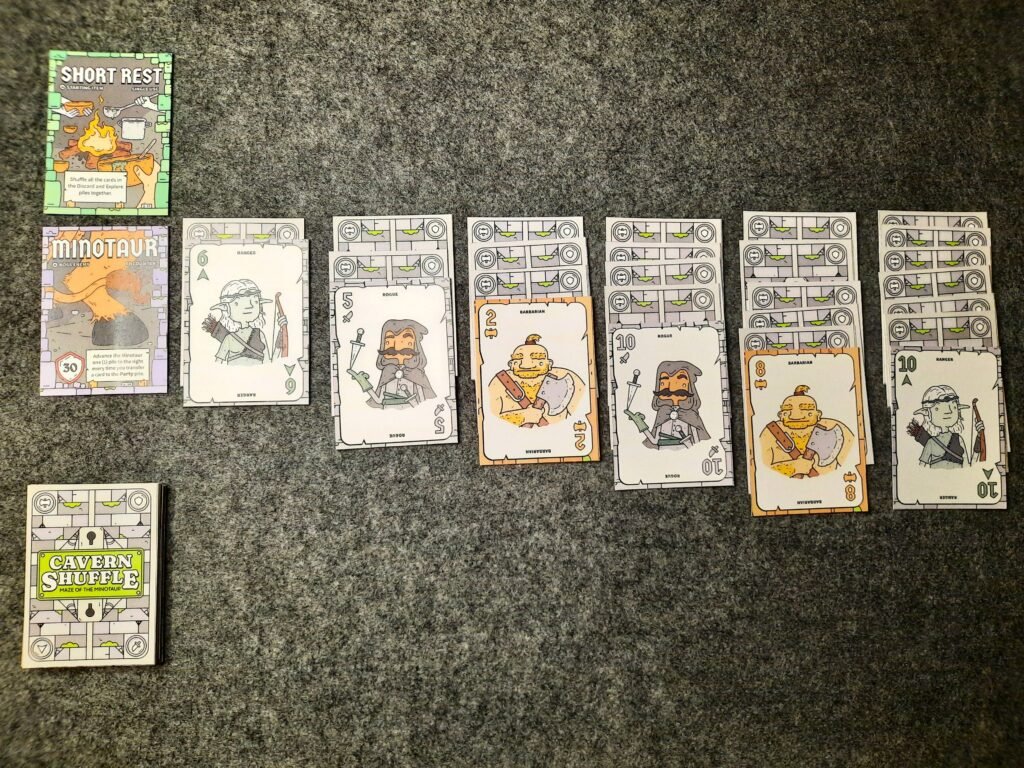
The game is played across seven columns, referred to as the dungeon. Cards are dealt into these columns with a mix of face-up and face-down cards, much like traditional solitaire. Your objective is to uncover cards, build valid sequences, and gradually move Adventurers into your Party area.
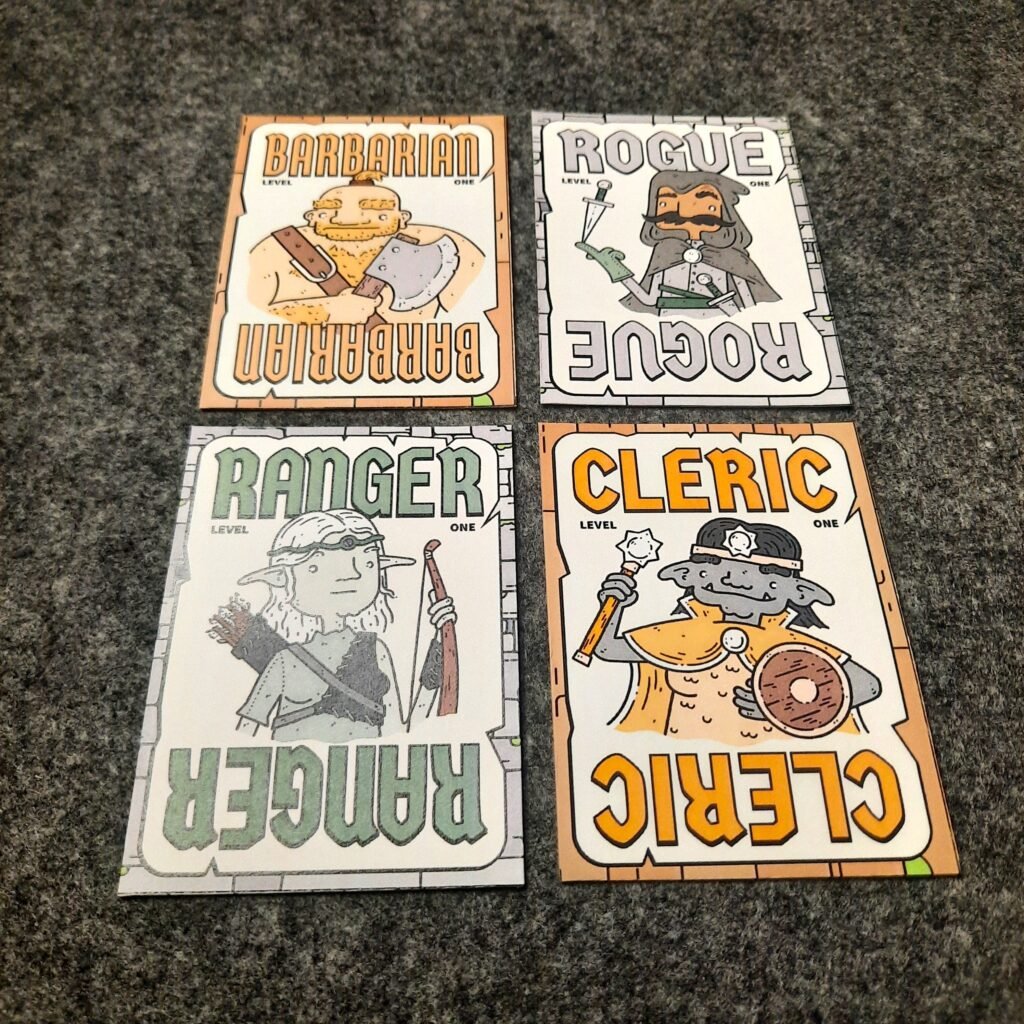
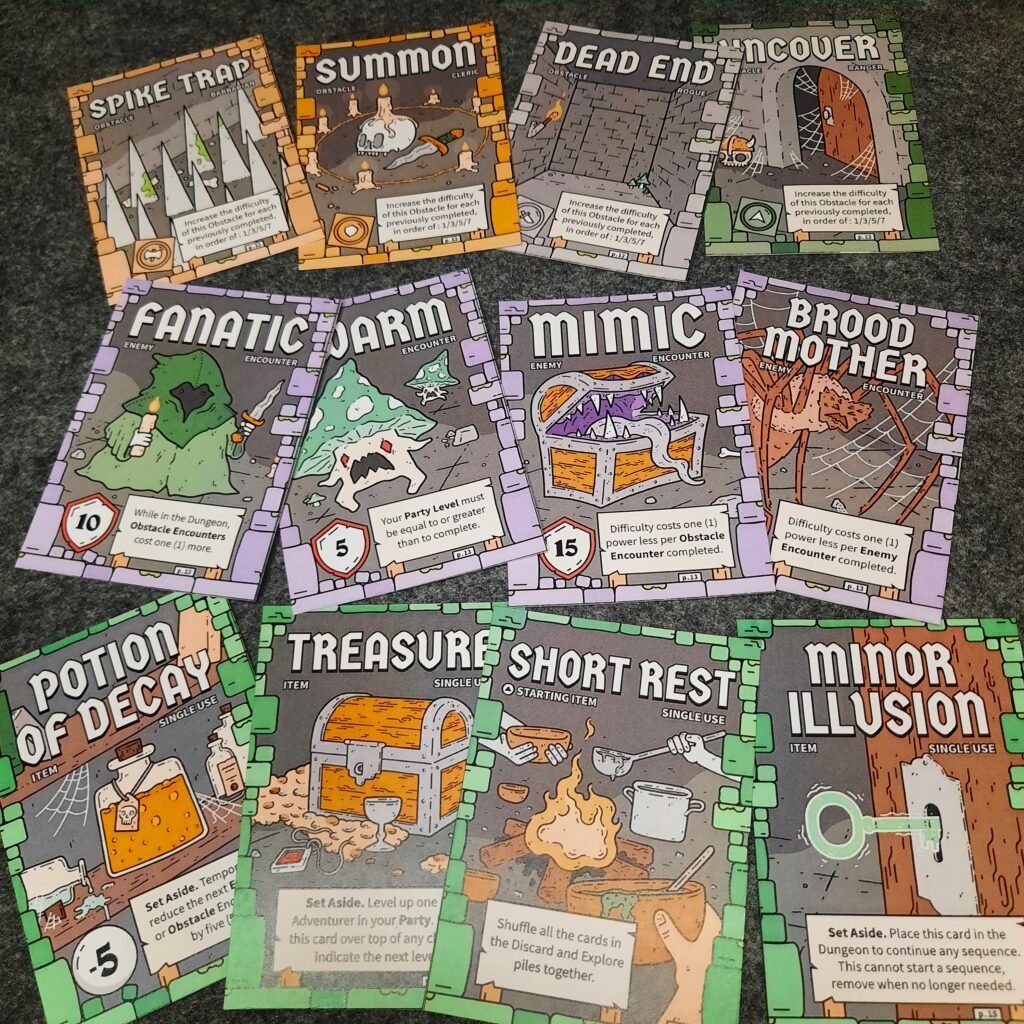
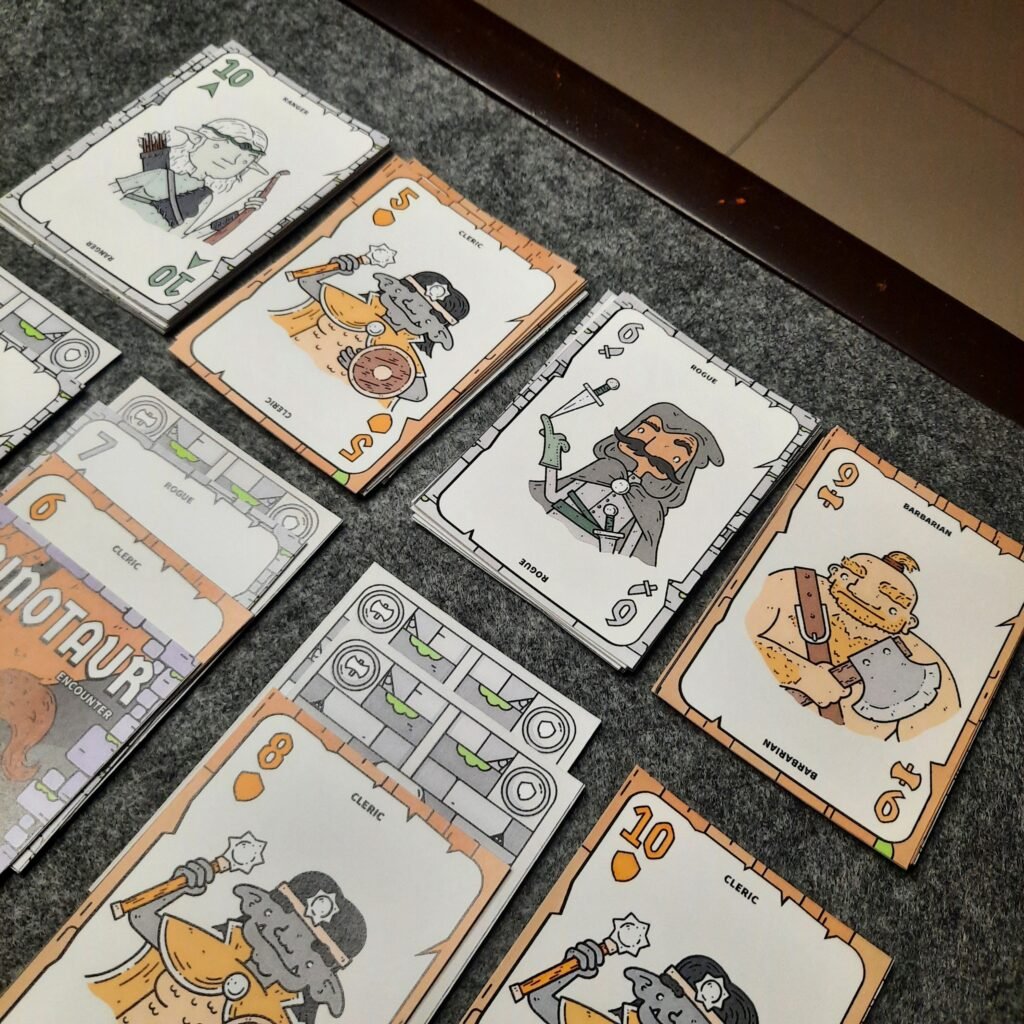
There are four types of cards in the game: Adventurers, Enemies, Obstacles, and Items. Adventurers function similarly to suits, each with levels ranging from one to ten. You form descending sequences in the dungeon by alternating between two alignments, Lawful and Chaotic.
As you build these sequences and reveal hidden cards, you begin to move Adventurers into your Party in ascending order. The strength of your Party is determined by the combined levels of these Adventurers.
Enemies and Obstacles act as blockers. Items, on the other hand, provide one-time effects that can help manipulate the dungeon or overcome difficult situations.
A key element of the game is the Minotaur, the boss enemy. It moves across the dungeon as you progress, blocking columns and restricting movement. This adds an additional layer of challenge, as available spaces can change over time.
The game continues as you reveal cards from the Explore pile, build sequences, and strengthen your Party. Victory is achieved when your Party becomes strong enough to defeat the Minotaur.
All you need
The game consists of 54 cards. Printing them would take a total of 12 pages. Card sleeves are a solid option. No additional components are required to play the game.
There is also a boxed version available, which is a gem in itself. More on that later.
Entry: after playing the game
Findings
Did the new elements click?
At first, it does feel like solitaire. You are building sequences, uncovering cards, trying to make space. But the moment Obstacles and Enemies start showing up, you start to feel otherwise.
From simply moving cards around, you begin asking yourself if you are ready to deal with the challenges the game throws at you.
Take an Enemy sitting in your way, for example. It’s not going anywhere until you deal with it. Do you have enough total strength in your Party to take it on now, or will it keep showing up at the wrong moments to ruin your plans?
Obstacles operate differently. They slow you down by asking for the right Adventurer, not the total strength of your Party. Like Enemies, they are not going anywhere until you deal with them.
And then came the Items. They felt like small pockets of control that could turn the tide in your favor. I found myself holding onto them longer than I should have, waiting for the perfect moment. Sometimes it paid off. Sometimes it did not. But that decision of when to use them added a layer to the game that made it stand out.
The elements did not feel forced, though. They just gave the familiar flow a little more to chew on.
Solitaire vs Cavern Shuffle
In one word? Control.
Solitaire often gives you that feeling of being stuck, where the cards stop cooperating and all you can do is hope the next reveal changes something. Cavern Shuffle still has luck in it, no doubt, but it did not leave me feeling helpless in the same way.
A big part of that comes from elements like Items. Having them around meant there were moments where a dead end did not quite feel final. There was still a chance to work around a problem and buy myself some breathing room.
And then there is the Minotaur. It is not there to help, obviously. If anything, it does the opposite by threatening to block a corridor just when things start looking neat. But that pressure also made the game feel more alive.
That is where Cavern Shuffle stood apart for me. There is still uncertainty, but also more room to respond. More ways to keep going. More to work with when the game starts tightening around you.
And then comes the theme. Instead of feeling like just another round of solitaire, this one feels like a dungeon crawl. There are Adventurers to build up, Enemies in the way, and a boss blocking your paths. That alone gave the game more of a mission, and more reason to keep pushing forward.
What else can solitaire be?
After playing Cavern Shuffle: Maze of the Minotaur, my mind naturally wandered a bit.
If solitaire can be reworked like this, with Items helping you out of tight spots, Enemies and Obstacles getting in the way, and the Minotaur constantly threatening to ruin a neat setup, then what else can be done with this foundation?
Could there be new Items?
Could the Enemies become nastier?
Could the whole mission shift into something even more distinct?
Turns out, Ryan was already one step ahead.
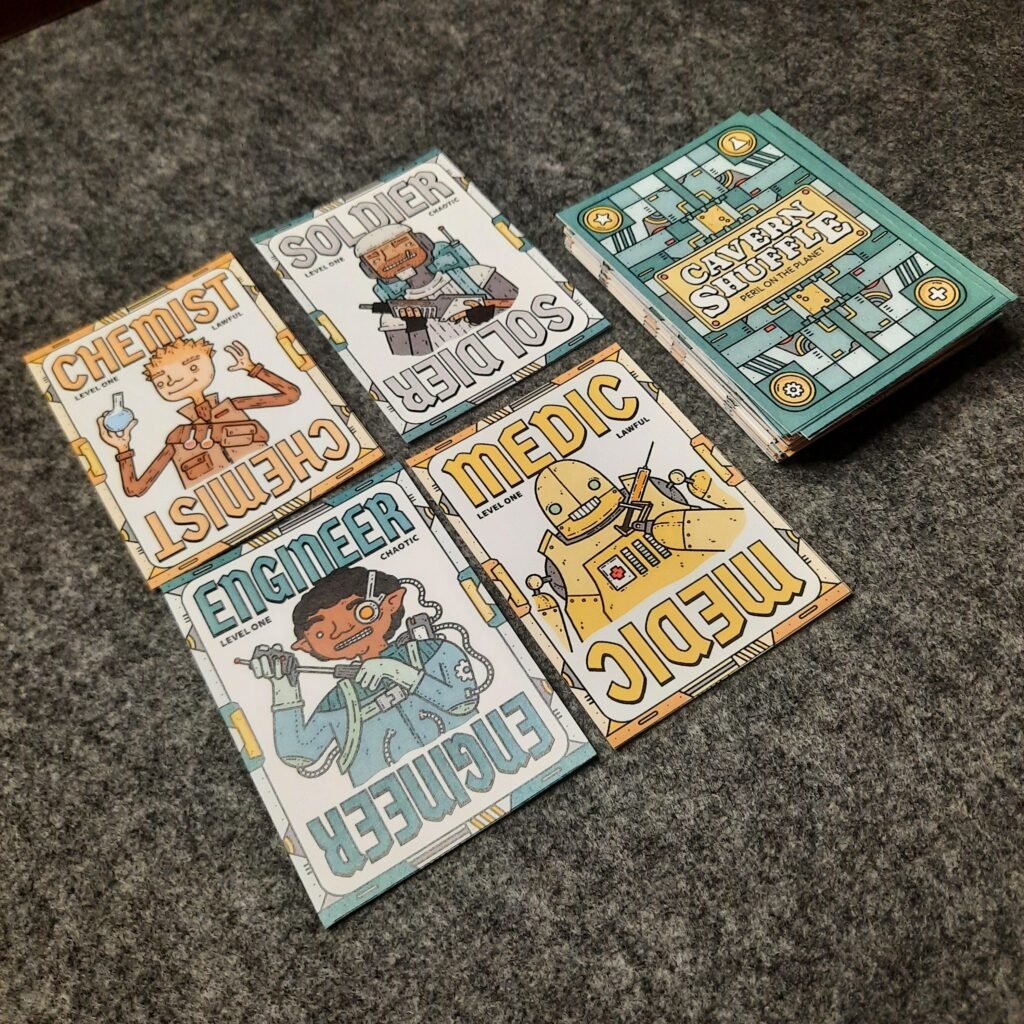
The ongoing Kickstarter campaign does not just bring back Cavern Shuffle. It also introduces two new editions built on that same foundation: Lair of the Lich and Peril on the Planet.
Lair of the Lich leans harder into the danger. Here, Skeletons make up the Lich’s growing army, and they scale based on how many of them you have already defeated. That alone changes the texture of the challenge. On top of that, elements like the Jar of Souls lets you collect those defeated Skeletons to weaken the Lich, giving the whole thing a sharper push-and-pull than before.
Peril on the Planet, on the other hand, takes the system somewhere completely different. Instead of sticking to the dungeon, it shifts the game onto a newly terraformed planet, where you deal with a rogue mech harvester called the Crawler. It also introduces two new mechanics, Infection and Specimen, which already made it clear that this one brings more than just a new setting.
The dungeon is waiting
I may be a bit late to the party, with Cavern Shuffle launching way back in December 2024, but the arrival of these brand new editions has me excited to try them out as soon as I can get my hands on them.
All three editions of the game can now be backed on Kickstarter. There is a PnP pledge up for grabs too.
So if you are up for a nostalgic trip down memory lane, now in a few new flavors, this might be one worth checking out.
Recommended items
Game Overview
Designer: Ryan Dawson
Publisher: Gravy Boat Games
Number of players: 1
Difficulty level: Easy to medium
Rounds of gameplay needed to learn: 1 to 2 rounds
Game duration: 20 minutes
Available on: Kickstarter
Theme: Solitaire-like Dungeon Crawl
Number of pages and color: 12 pages (color print)
Assembling difficulty level: Cut and sleeve the 54 cards
Lamination: Not recommended
Additional elements required: None
Time to learn: Within 20 minutes
Travel-friendly: 10/10
Shelving friendly: 10/10
Rating from PnP Time: 8.75/10

Tas is a game designer and blogger based in Bangladesh, with the dream of exploring the world of games and introducing it to anyone new to it.