Essence: The Grim Expeditions
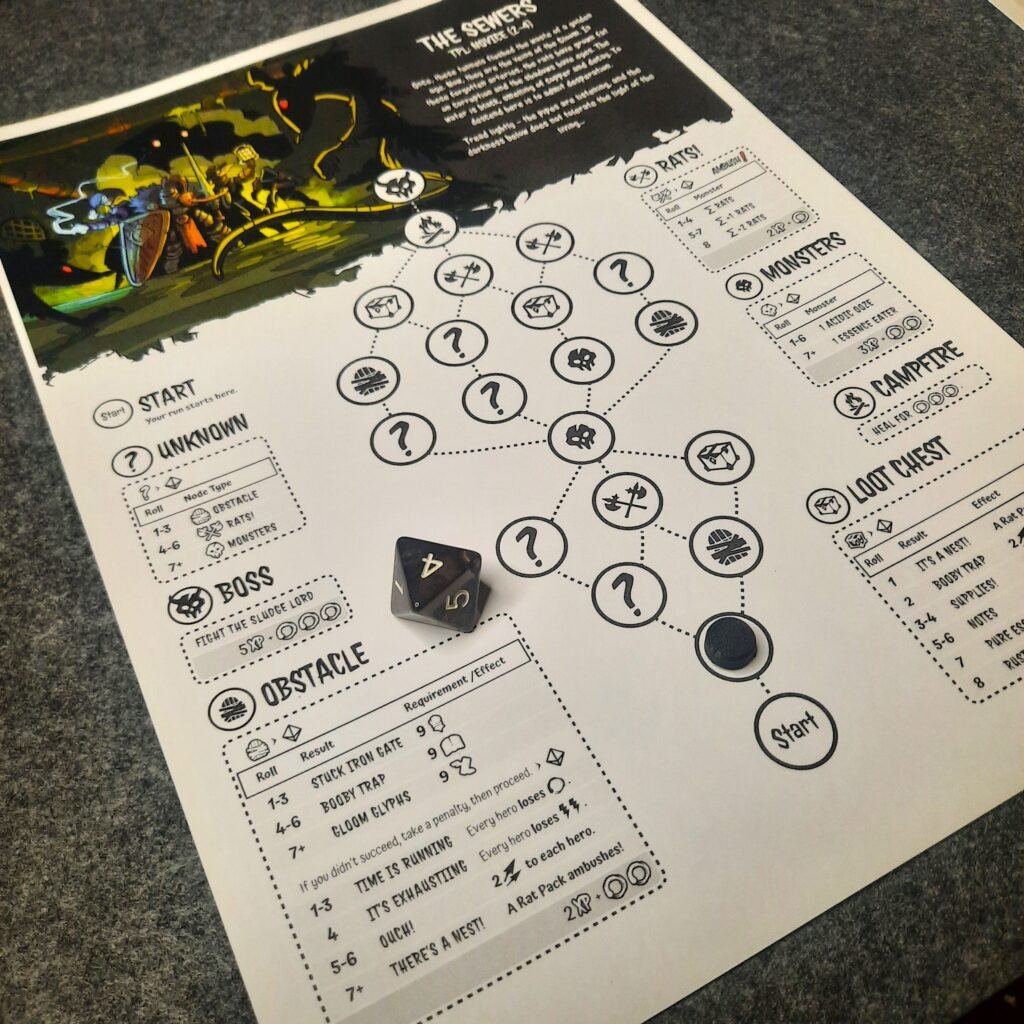
The world you remember is gone.
Not burned or shattered. Swallowed.
The Gloom did not arrive with fire and thunder. It arrived quietly. And it never left.
Empires fell. Gods went unanswered. And somehow, you survived. Not because you were chosen. Because you were overlooked. An outcast the Gloom failed to digest.
It is not food that has kept you alive all this time. It is Essence. A fading ember within you that weakens with every step you take.
And the only way to survive is to descend into the sewers and hunt the monsters of the Gloom, tearing their Essence away before yours runs dry.
So tell me. Do you still have the fight in you to live another day?
Entry: before playing the game
First impression
It hasn’t been long since I last played one of Florian’s games. Whether it’s exploring deep space with VoidRoll or playing chess as a grandmaster in Rook & Ruin, they tend to resurface on my table every now and then.
Beyond the games themselves, I also interviewed Florian a few months ago to better understand his inspirations behind game design. Having recently launched PnP Bundle with Chris Backe to help indie designers bring their games to crowdfunding with professional support, and opening PnP Stash with Robin Metz as a dedicated home for print-and-play titles, Florian’s efforts for the community deserve a tip of the hat.
As for Essence: The Grim Expeditions, I knew only a couple of things before diving in.
- The artwork is done by Vittoria Pompolani (@bonedstuff), which is honestly wild. I’m already a fan, and seeing her take on Florian’s project only amplified my anticipation.
- I received a heads-up from Florian that the attack mechanism is, in his words, very interesting. I’ve always appreciated his experimental approach to game design, so naturally, I was curious to see what he had cooked up this time.
A bit on the game
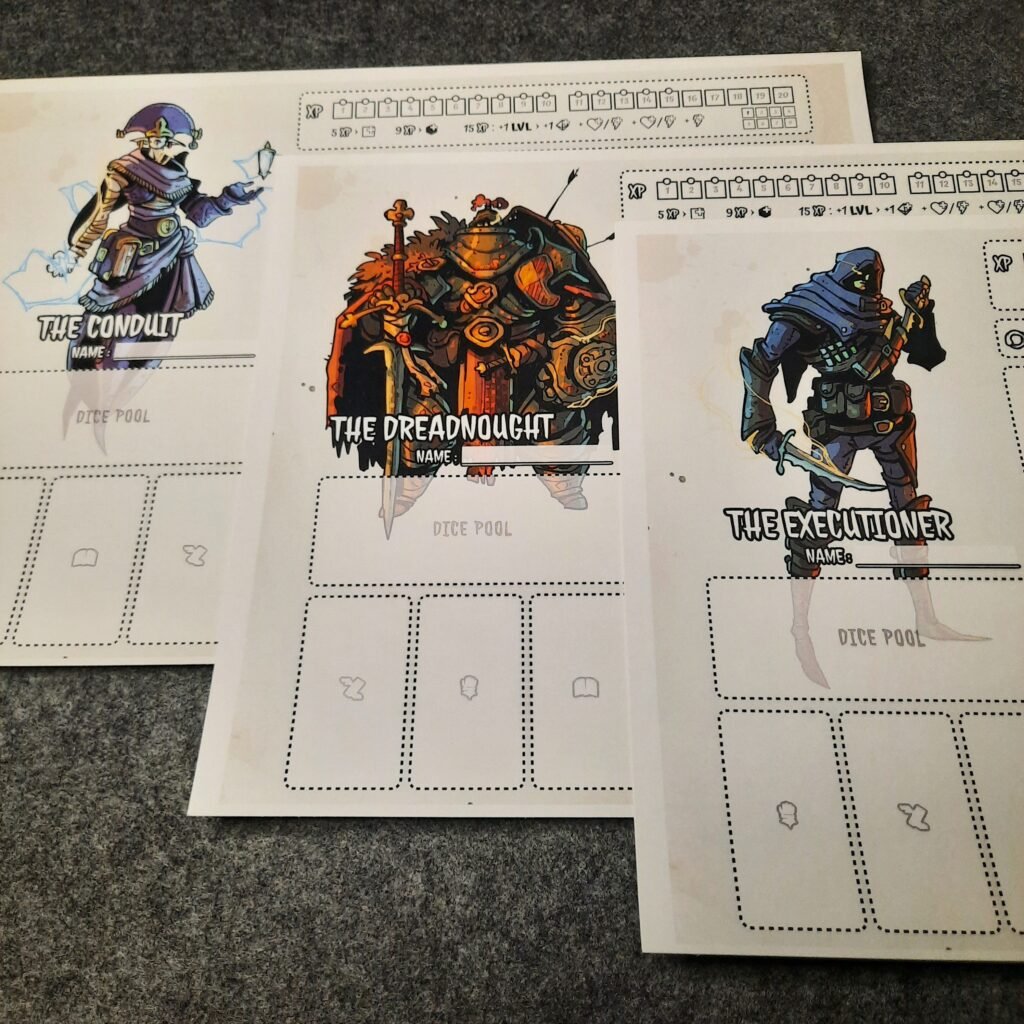
Essence: The Grim Expeditions places you in a world consumed by the Gloom, where survivors (Outcasts) descend into corrupted depths to sustain themselves. In the sewers, your goal is not conquest, but survival.
You navigate a branching path of encounters that may lead to monsters, obstacles, unknown events, or the occasional opportunity to gather resources. Each cleared encounter pushes you forward, bringing you closer to the final confrontation waiting at the end of the route.
The game revolves around managing Essence, a shared lifeline that represents your ability to keep going. Defeating monsters restores Essence, while injuries, failed checks, and prolonged encounters drain it. If Essence reaches zero, the expedition ends. Along the way, your heroes gain experience, strengthen their abilities, and improve their odds of surviving what lies ahead.
The result is a system built around dice generation, resource management, and threshold-based outcomes forming a compact but layered loop.
All you need
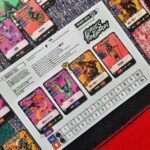
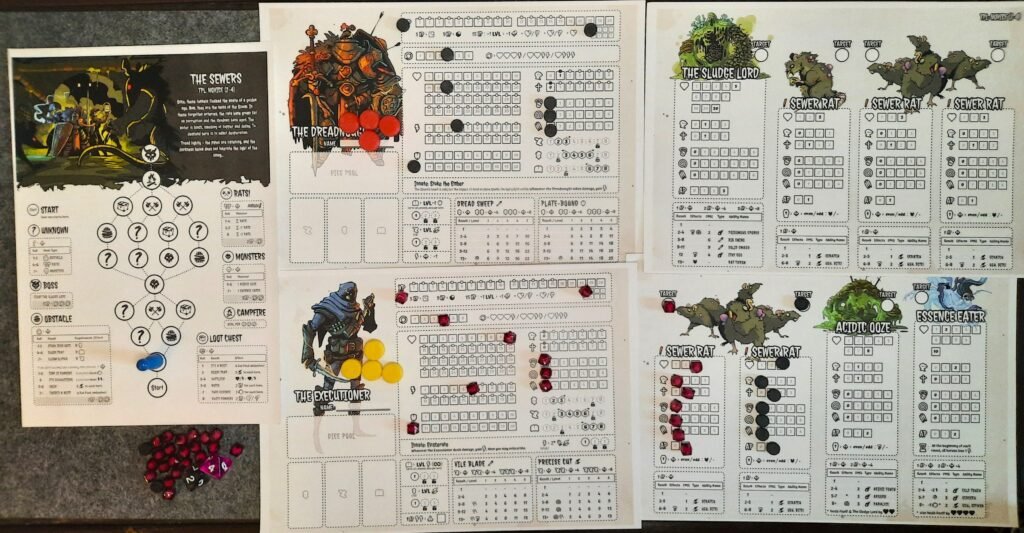
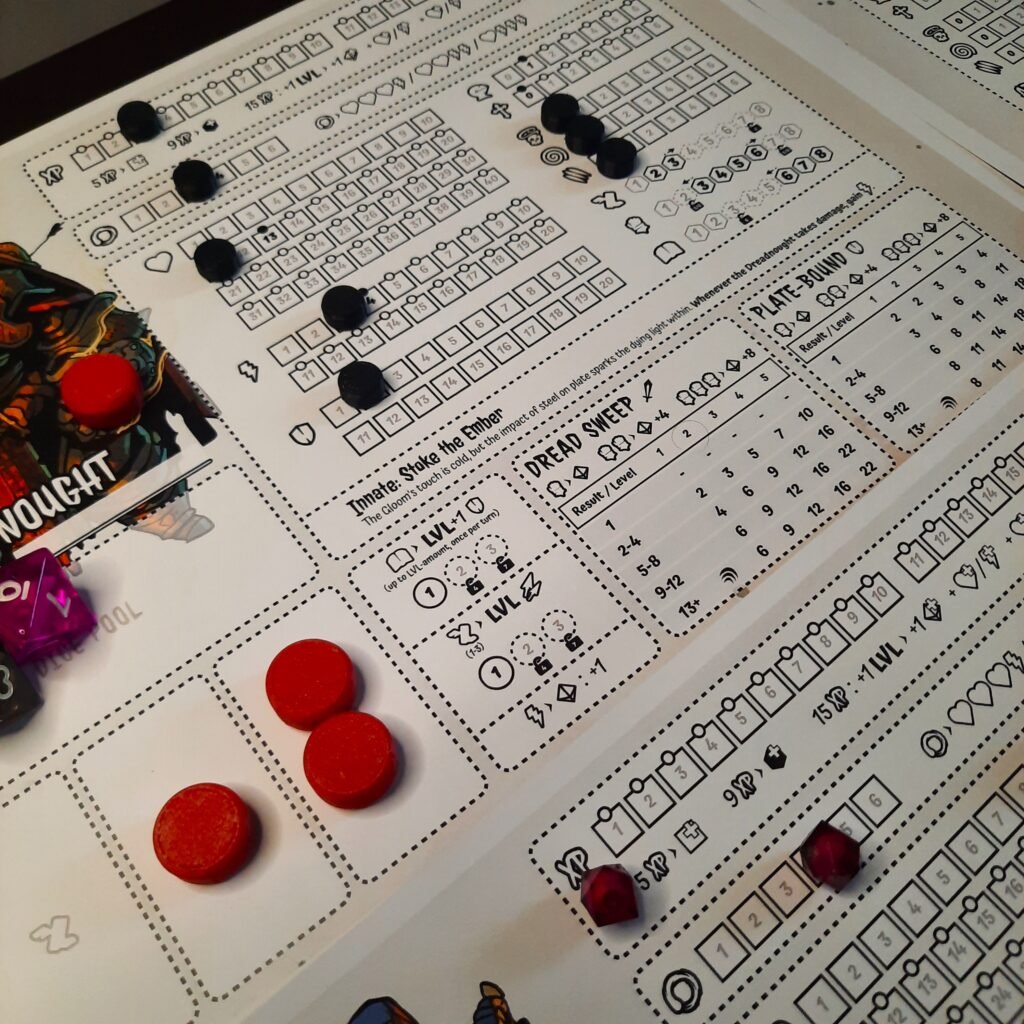
If you’re playing solo, you’ll need to print a couple of Hero sheets, the Node sheet, and the relevant monster sheets for the run you’re attempting. There are multiple heroes available, so feel free to print a few and mix and match. I went with Dreadnought and Executioner for my playthrough.
You’ll also want a handful of D8 dice. Three per hero for generating action points for a start, plus one for resolving abilities and checks. If physical dice aren’t within reach, a dice simulator does the job just fine.
As for tokens, keep around 20-25 cubes on hand; max 40. You’ll be tracking HP, Focus, Essence, monster health, and the occasional status effect. You won’t use them all at once, but it helps not having to reshuffle components mid-run. If you are playing with two heroes like I am, go for two unique colors of cubes/tokens.
Entry: after playing the game
Findings
Branching pathways
After having a terrific experience with branching narratives in Harbor of Blight: Scenario Zero, a solo RPG, I was glad to see a similar structure surface in Essence.
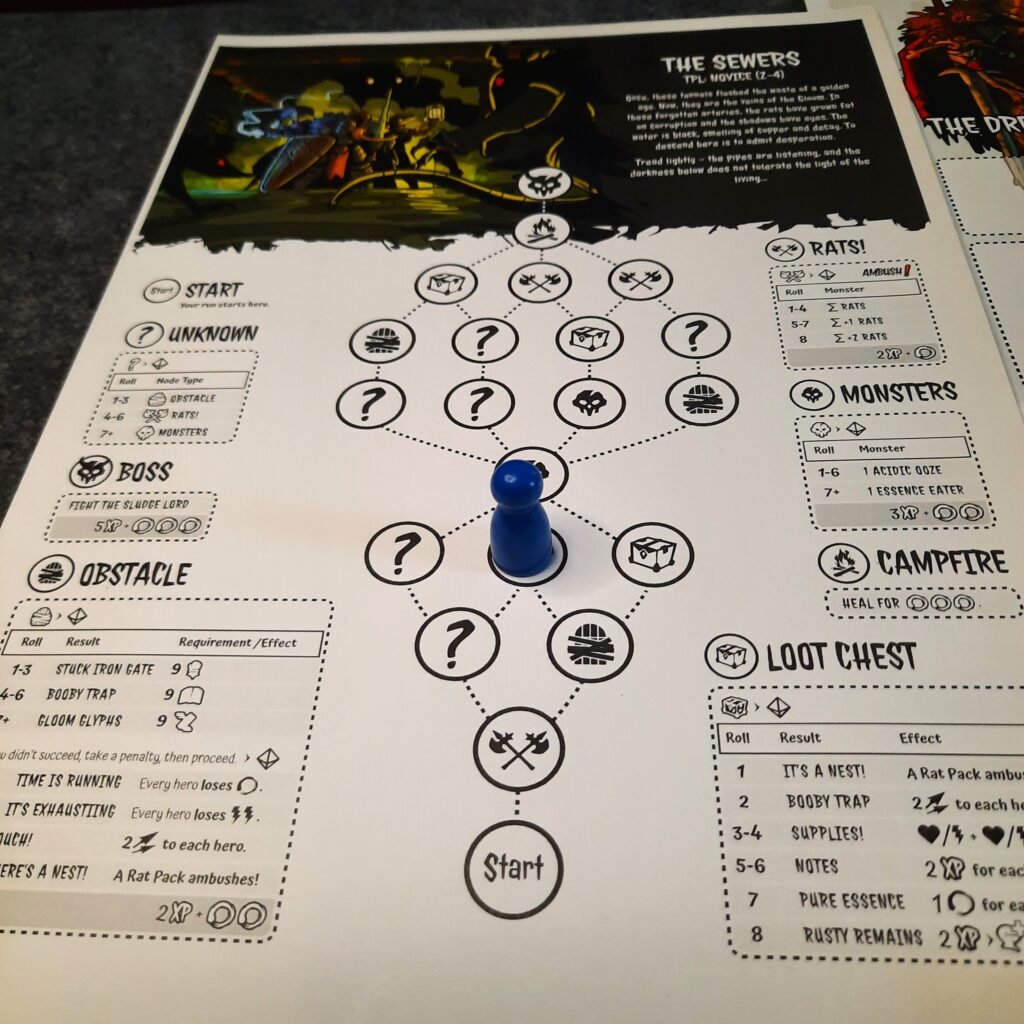
The expedition spans nine rounds in total, if you make it all the way. And on the second, third, fifth and seventh round, you are presented with multiple options on how to proceed.
Do you step into the Unknown, or opt for Obstacle? Face the Sewer Rats, or test your luck with a Loot Chest? Push forward aggressively, or preserve what little you have left?
The path you take inevitably shapes the flow of the run. Some routes may feel safer. Others more rewarding. But each decision subtly shifts your momentum, your resource pool, and your odds at the end. I found myself gravitating toward certain choices, only to realize that exploring the alternatives revealed entirely different experiences. That alone gives the game a healthy replay value.
Se7en faces of the Expeditions
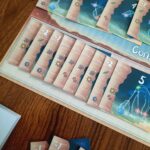
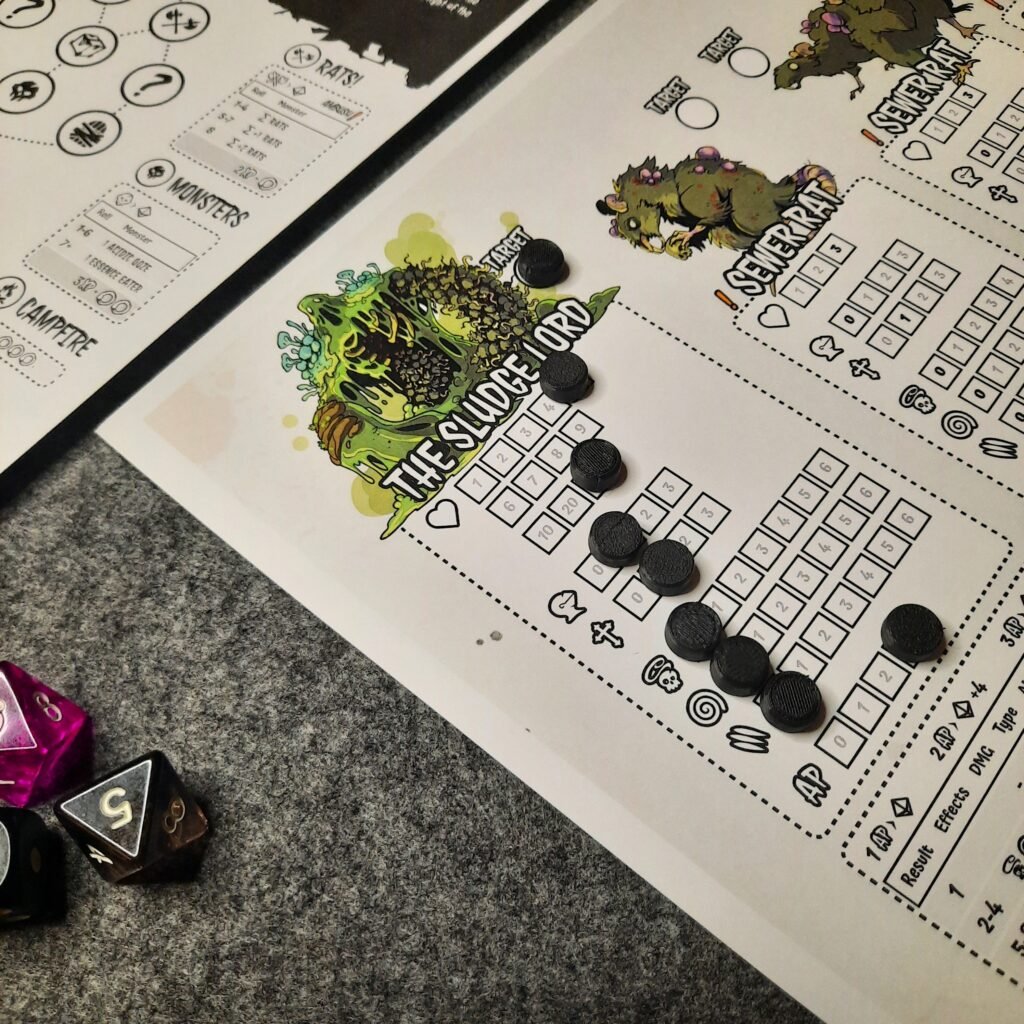
One thing I really liked about the Node sheet is how clearly it frames the variety of experiences you can encounter during a run. The expedition is not just combats stitched together. It rotates between seven distinct node types, each altering the rhythm in its own way.
Rats serve as the constant pressure. Small threats that test your resource management and strategy before things escalate. You can’t underestimate them, they’re extremely persistent!
Monsters raise the stakes. Tougher enemies with heavier consequences if mishandled. Say, death.
Obstacles shift the focus from damage to checks, prompting you to strategize differently. Failing to tackle Obstacles will cause damage, though!
Unknown nodes introduce uncertainty. You roll first, then deal with whatever reveals itself; be it Obstacles, Rats or Monsters.
Loot Chests offer potential upgrades or recovery, but rarely without risk. Wanna take the gamble?
Campfires provide a moment to recalibrate, restore, and prepare for what is ahead. There’s just the one before the final boss battle. The calm before the storm.
And at the end, the final Boss waits. A culmination of every choice, loss, and gain that brought you there.
Each node type nudges the expedition in a slightly different direction, creating a loop that feels varied without becoming chaotic.
The combat
Florian mentioned he had been waiting to try the combat mechanics he used in Essence for a long time. He sounded particularly invested in how it would land. And after going through a few encounters, it became clear why.
You are not rolling dice to determine damage. You roll three D8s to generate action points (AP) based on your hero’s attribute bands. Each result can translate into a specific type of AP, which then dictates what abilities you can activate. A Dreadnought might convert results into Strength AP to fuel heavy physical strikes. A Conduit might rely on Wisdom AP to cast area spells. The roll does not tell you what happens. It tells you what you are allowed to attempt.
Once you commit to an ability, you roll a separate D8 to resolve its effectiveness. The more AP you invest, the more you can modify that outcome. That creates a layered decision: how much do you spend now to secure this hit? Do you push for the higher damage tier? Or settle for something modest and keep resources for the next turn?
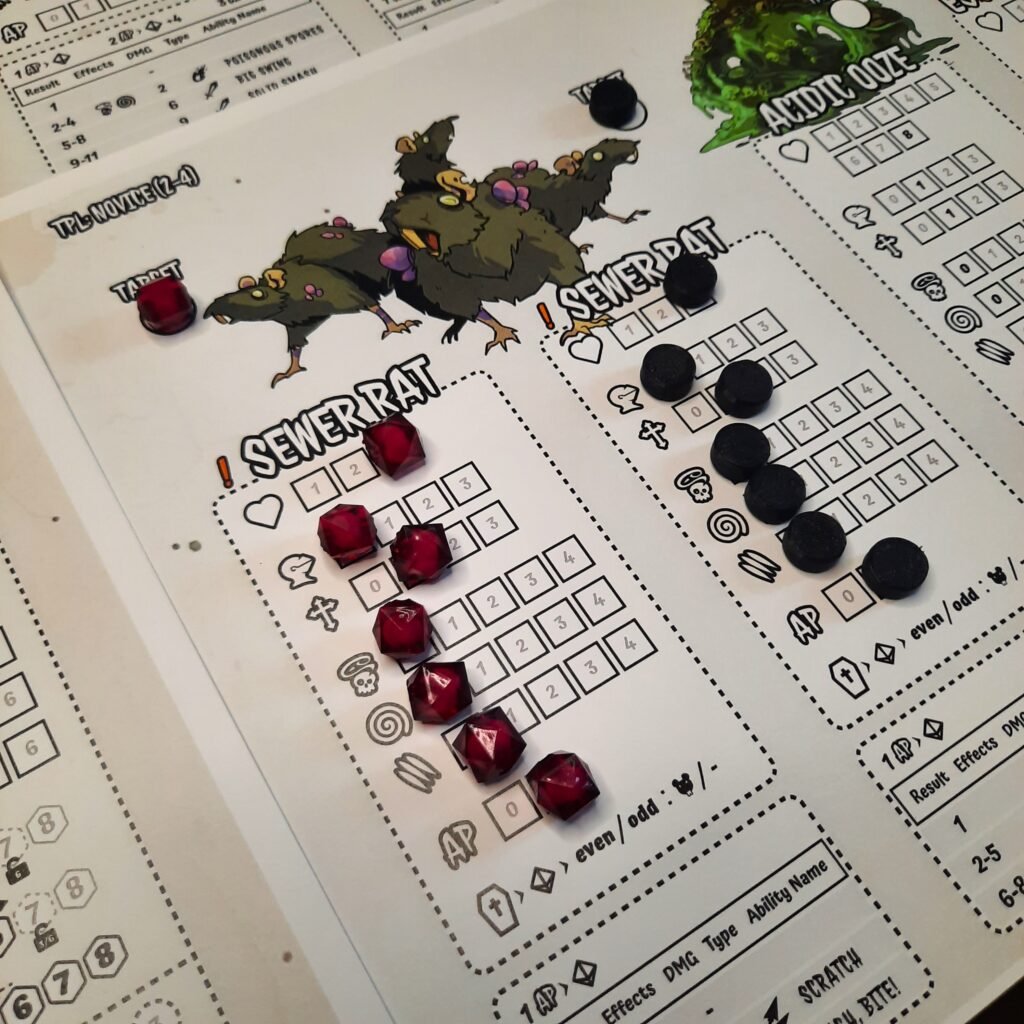
Monsters operate differently. Each has a printed AP value that determines how many actions they take during their activation. They roll, consult their attack table, and resolve the result. The structure is consistent, but tougher monsters escalate the impact with higher AP values, multi-target attacks, and added effects. Heroes convert potential into decisions. Monsters execute defined patterns that grow more punishing as the expedition progresses.
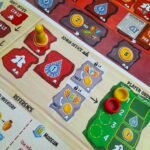
All of this ties back to vitals. HP is chipped away. Armor reduces incoming damage before it reaches HP. Focus enables certain abilities. Essence sits above everything as the expedition’s timer. Every turn becomes a small calculation. Not just whether you hit, but whether you allocated well.
A Foundation in the making
The combat system aside, there are a few structural decisions that gives Essence its own identity.
The Total Party Level (TPL) system scales the expedition without bloating it. Bringing two heroes feels different from bringing four. Enemy brackets shift. Pressure adjusts. It is not complexity for the sake of it, but a framework that keeps the same run viable across compositions.
With additional Expedition Runs already unlocked, a fifth hero on the horizon, quest items and boss drops entering the pool, and entirely new environments like Inferno being shaped during its Gamefound campaign, Essence feels less like a standalone and more like a growing system. The sewers are clearly a starting point.
It feels like the first chapter of something that intends to expand.
And I’m curious to see just how far this expedition goes.
You ready?
Recommended items
Game Overview
Designer: Florian Fiedler
Artist: Vittoria Pompolani
Number of players: 1 to 4
Difficulty level: Medium
Rounds of gameplay needed to learn: 1 to 2 rounds
Game duration: 40-80 minutes
Available on: Gamefound
Theme: Tabletop Roguelite | Dice-Crawler
Number of pages and color: At least 6 pages (color print)
Assembling difficulty level: Zero assembly required
Lamination: Recommended for replayability
Additional elements required: Approx. 12 D8 dice (minimum 7), and max 40 cubes/tokens (20-25 tokens works too)
Time to learn: Within 20 minutes
Travel-friendly: 10/10
Shelving friendly: 10/10
Rating from PnP Time: 9.5/10


Tas is a game designer and blogger based in Bangladesh, with the dream of exploring the world of games and introducing it to anyone new to it.