One Card Dungeon: Hell's Door
Hell is no longer sealed.
Fire pours through the cracks. Shadows twist along scorched stone. Something ancient stirs beneath the surface, no longer content to remain sealed away.
Every step downward feels like the last. The deeper you descend, the clearer it becomes that this was never meant to be a fair fight.
At the bottom of it all waits the Lord of the Inferno, claiming dominion over everything that burns and breaks.
The only way out is downward. One last battle. One last chance to seal Hell’s Door forever…
Entry: before playing the game
First impression
There are a handful of games I keep revisiting, and the base version of One Card Dungeon is one of them. Packing twelve levels onto a single card to create a dungeon, with monsters on each level that grow progressively tougher to the point where victory feels impossible, is a masterpiece. I rarely get a taste of victory in One Card Dungeon, but when I do, it is absolutely worth it.
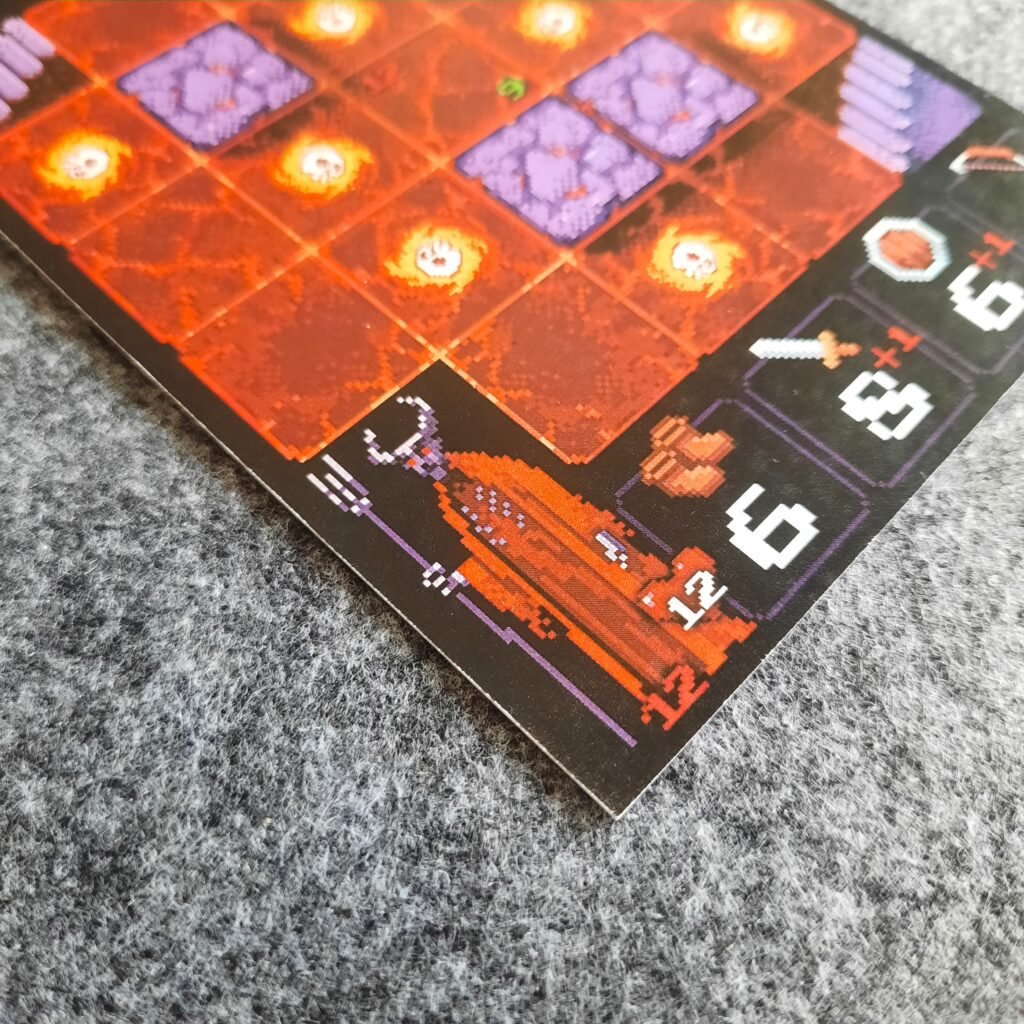
Jumping to the game’s latest expansion, I assumed there would be more components compared to the base version, which only requires a single card and a handful of dice. After receiving the game files, that assumption was quickly confirmed.
Even before I got to the rulebook, the added elements felt like they belonged there. I would be lying if I said they didn’t make me a little giddy!
A bit on the game
One Card Dungeon is a solo dungeon crawl where you descend level by level, managing energy, positioning, and combat on a single card. Each level introduces a new monster, and the deeper you go, the harsher the odds become.
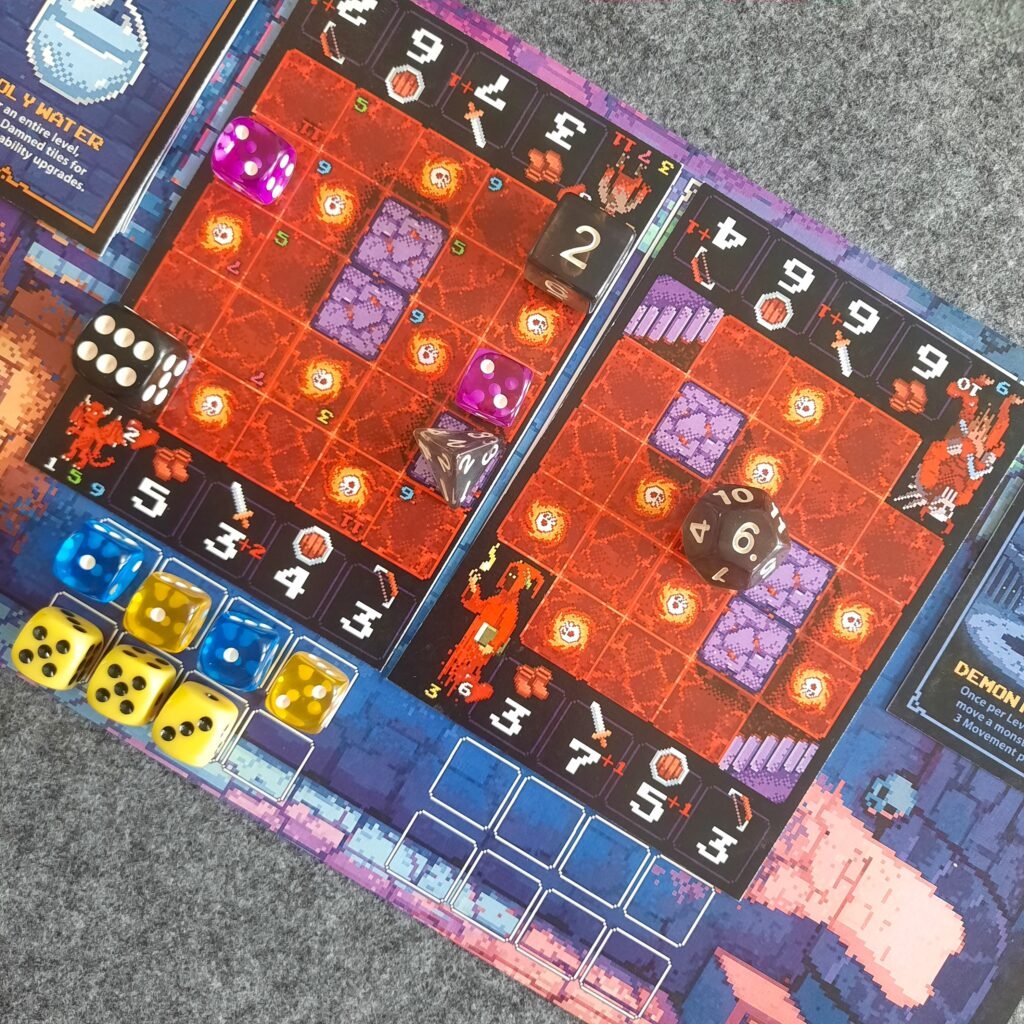
Hell’s Door follows that same structure but introduces new points of escalation. After levels three, six, nine and twelve, you are forced into dedicated Hellish Boss encounters using a separate Boss Dungeon card. At the end of the twelfth level, it all peaks with a final showdown against the Lord of the Inferno.
And then there are the extra layers that keep poking you mid-run. Each level features a Treasure Chest, represented by a die placed on the stairs opposite the entrance. Once opened, that die becomes a small pool of extra energy you can spend across turns.
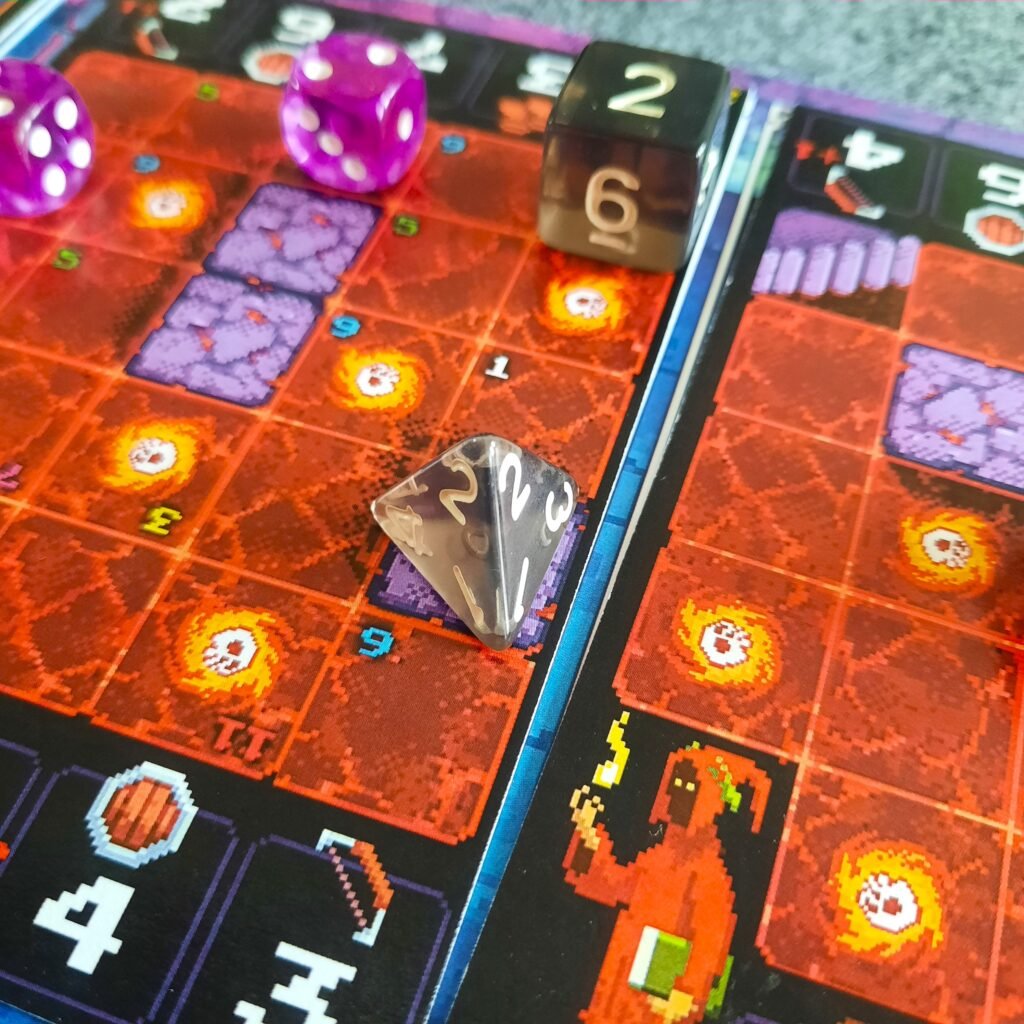
On top of that, Hell’s Door adds Damned Tiles that can boost monsters when you step onto them, plus the Stone of Perdition, which can hit every creature on the map, including you. A new class and item cards are also part of the package, adding more strategy to the game and giving you that little advantage you need to turn things around.
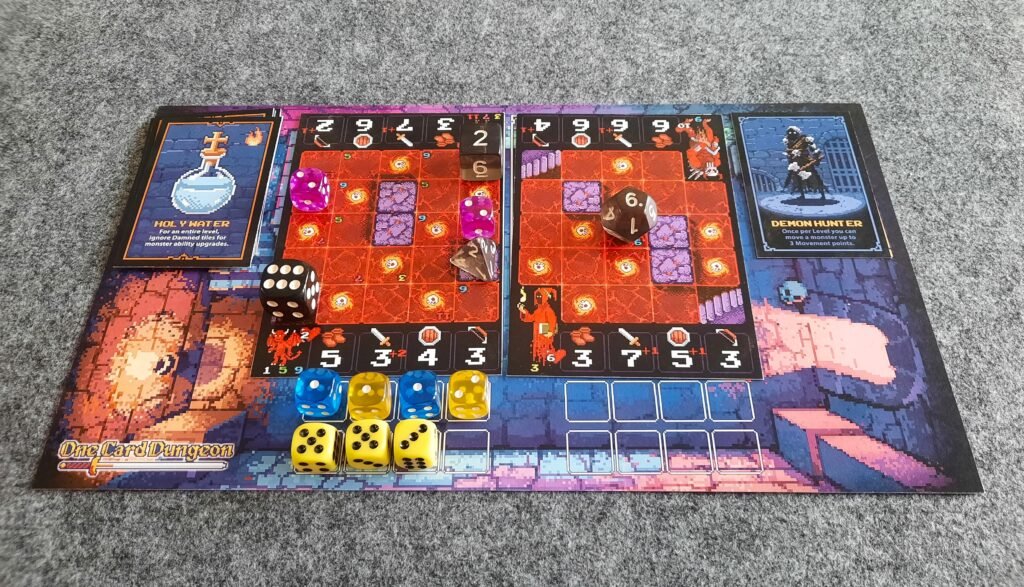
Did I say there’s also a printable playmat? It looks pretty cool.
All you need
For Hell’s Door, you need to print a total of three pages. One for the couple of dungeon cards, one for the class and item cards, and a third for the playmat.
Alongside the twelve D6 dice from the base game, you will need an additional D4, D6, and D12. The D4 is used for the Stone of Perdition, the D6 for the Treasure Chest, and the D12 for the Hellish Bosses on the Boss Dungeon card.
All set? Let’s crack on!
Entry: after playing the game
Findings
Bringing the balance
Like I mentioned earlier, One Card Dungeon is not an easy game. Hell’s Door does not change that, but it does open up more avenues that can give you a fighting chance when things start to spiral. These additions feel less like safety nets and more like tools you have to earn and time correctly.
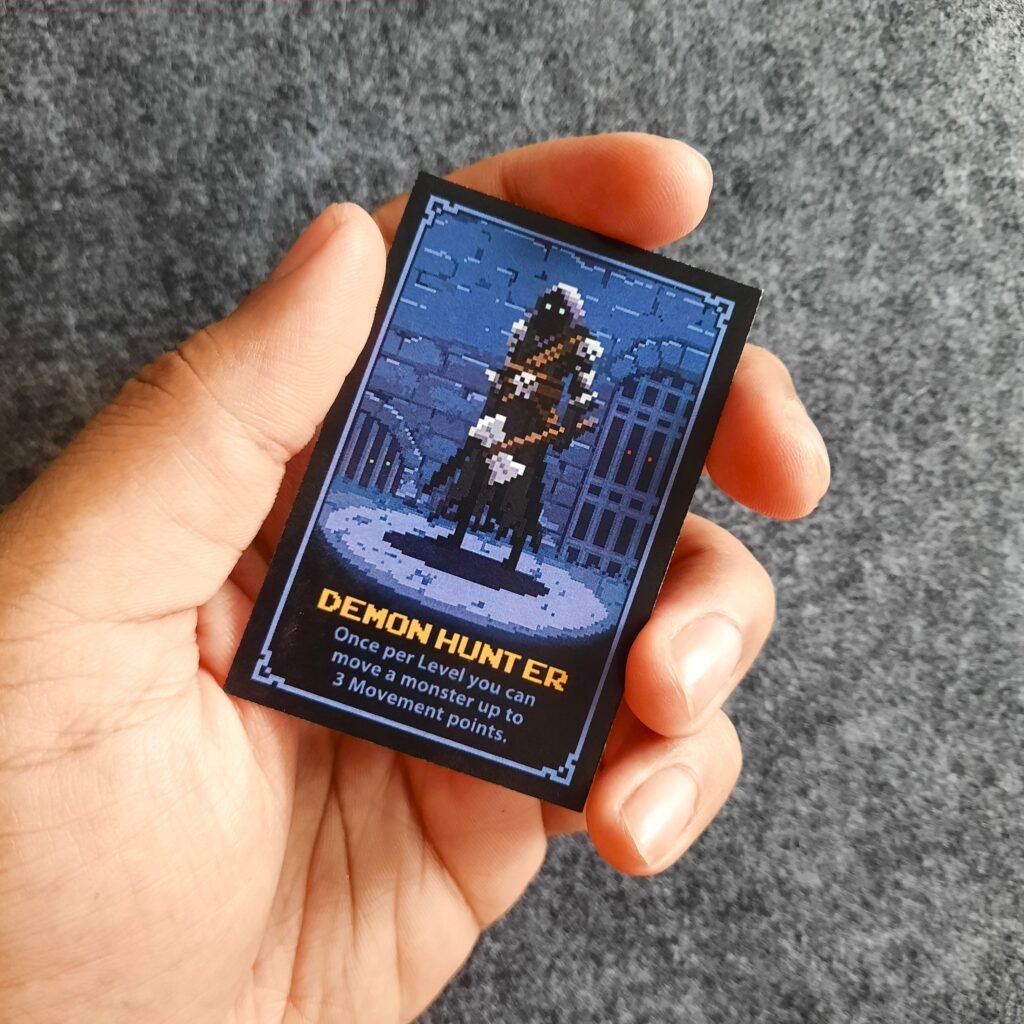
Take the new Demon Hunter class, for example. Once per dungeon level, you can move a monster up to three movement points at any time. That ability can be a lifesaver when a monster is bearing down on you and you need a moment to regroup before things get out of hand.
The Stone of Perdition adds another interesting layer to that balance. Breaking it can feel tempting, especially when monsters are piling up, but it always comes with a cost. Damaging everything on the map, including yourself, turns it into a calculated gamble rather than an obvious move. Use it wisely.
The Treasure Chest found on each level plays a similar role. When its value is high, the extra energy it provides can be a real boost, especially when heading into Hellish Boss fights. Having that extra pool of points to draw from often felt like the difference between barely hanging on and actually standing a chance.
Whether it is cheating death, ignoring the effects of Damned Tiles for a level, or bolstering your defense at the right moment, the Item Cards are just as handy. But timing is everything. Knowing when to use your class ability, when to tap into Treasure Chest energy, or when to burn an item ends up dictating outcomes more than anything.
16 levels now!
If you are thinking these new perks guarantee an easier ride, think again.
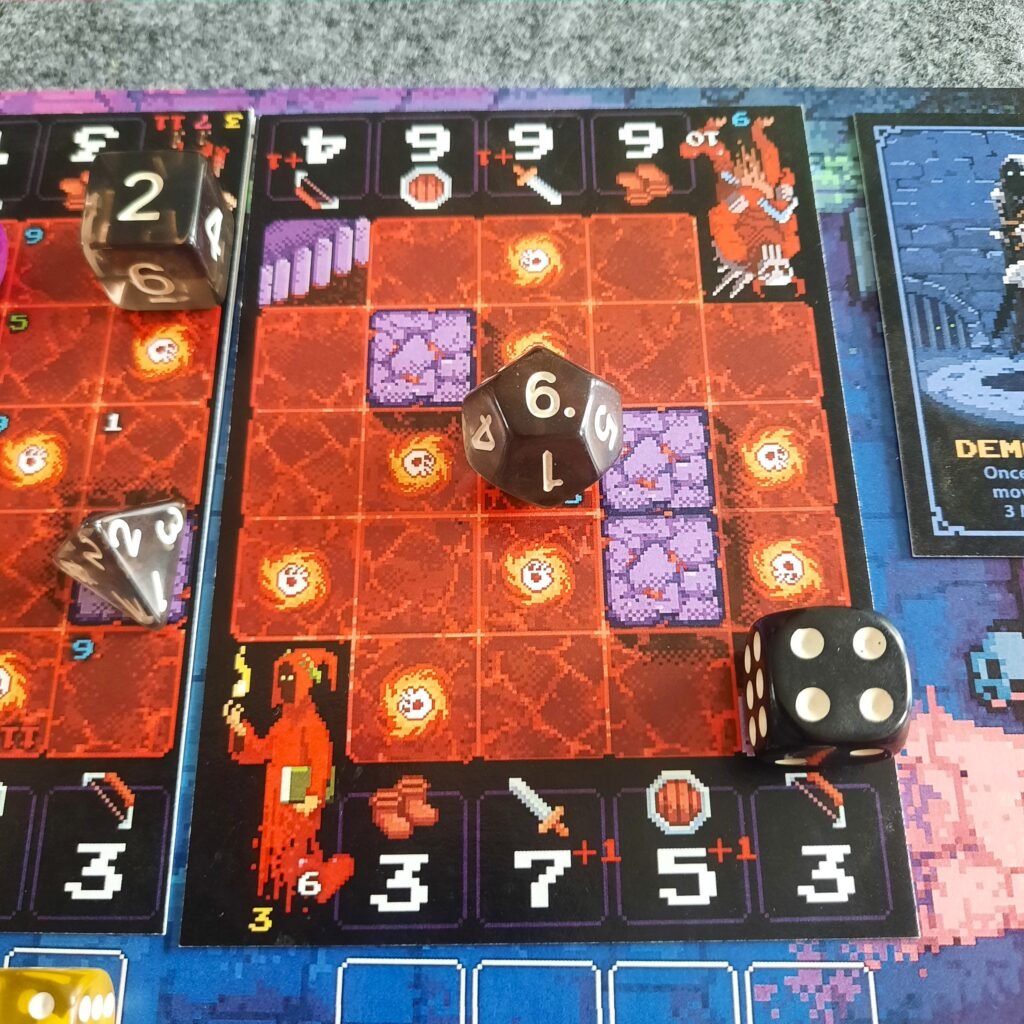
Hell’s Door stretches the journey from twelve levels in the base game to sixteen, and that extra length comes with teeth. At the end of the third, sixth, ninth, and twelfth levels, you are forced into Hellish Boss fights, each one more intense than the last.
Before facing a Hellish Boss, you do not get the usual chance to restore health or improve skills. You go in exactly as you are, which makes preparation during the preceding level crucial. This is where things like the Treasure Chest really start to matter, often providing the extra bit you need to survive those faceoffs.
The Boss Dungeon Card also shifts the tempo of the game. Every three levels, the flow is interrupted by a high-stakes confrontation, effectively giving Hell’s Door four climactic moments instead of one long descent.
Still tough to beat?
With all these new tools on the table, it is fair to ask whether Hell’s Door actually makes One Card Dungeon easier. You get more ways to deal with monsters, more levers to pull, and more moments where a smart choice can save a run.
But you are also staring down more levels and four Hellish Bosses along the way!
That is where the game finds its balance. It gives you a fighting chance without guaranteeing a victory. Reaching the final confrontation is still not a given by any means. So facing the Lord of the Inferno will take some solid planning.
What changes is not the difficulty, but how you approach it. Decisions start to matter more. Which skill do you push next? When is it worth breaking the Stone of Perdition? Do you open the Treasure Chest only when its value is higher? Hell’s Door does not soften the challenge, but it does give you more room to play smarter.
Playing with a friend?
Even though One Card Dungeon is designed as a solo experience, I found myself enjoying it more by letting a friend take control of the monsters. Having someone else make those calls, especially the small ones like whether a monster moves left or right, removes any temptation to play nice with the automa. Those tiny decisions can easily swing outcomes, and I prefer not having that influence on myself.
There is also a great alternative approach I came across during a playthrough by Shamus from Out of the Box Board Games. He used an additional die to determine monster movement, completely removing player choice from the equation. It is a simple tweak, but one that fully commits the game to being impartial.
Both approaches worked well for me. Whether it is a friend handling the monsters or a die calling the shots, taking control away from yourself adds an extra layer of tension that fits the game extremely well.
See you in... hell?
I’ve been excited about this release since the end of 2025, and with just a few days left, I cannot wait to see one of my favorite games return to Kickstarter.
Big thanks to Little Rocket Games for giving me the chance to try Hell’s Door, and for adding more depth to a game I already love.
Recommended items
Game Overview
Publisher: Little Rocket Games
Designer: Barny Skinner
Artist: Marco Salogni
Number of players: 1 ( 2 if you want to try 1v1. You won’t regret it!)
Difficulty level: Medium to hard
Rounds of gameplay needed to learn: 1 to 2 rounds
Game duration: 20-40 minutes
Available on: Kickstarter
Theme: Dice-Placement | Dungeon Crawl
Number of pages and color: 3 (color print)
Assembling difficulty level: Easy
Lamination: Not recommended, unless you build it on 3mm PVC board. Opt for card sleeves!
Additional elements required: 13 D6, 1 D4 and 1 D12 dice.
Time to learn: Within 20 minutes
Travel-friendly: 9/10
Shelving friendly: 10/10
Rating from PnP Time: 9.5/10

Tas is a game designer and blogger based in Bangladesh, with the dream of exploring the world of games and introducing it to anyone new to it.