7 To Midnight
Deep in Shady Valley, a maze surrounds the Midnight Gate.
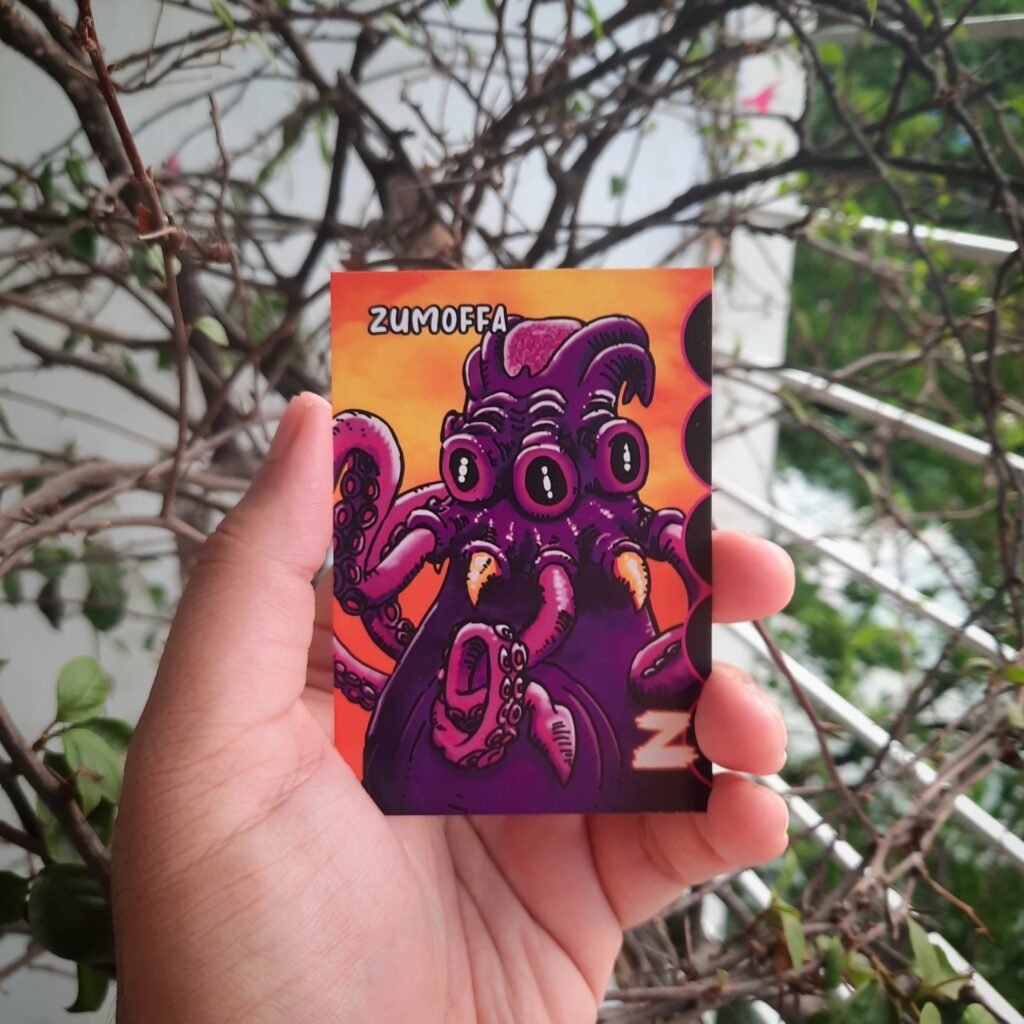
And standing near it is the kind of villain whose title arrives before he does: the Lord of Night, the Master of Masks, the Duke of Deception. ZUMOFFA!
Zumoffa is lurking near the Midnight Gate, and before he vanishes back into the darkness, he has decided to unleash one more cruel act. He has lured innocent critters into the maze, trapping them close enough to the gate so he can feast on them when midnight arrives.
Midnight is not far away, and Zumoffa is hungry. BUT there’s a catch!
Zumoffa is cursed, so he cannot feast on the critters while they are asleep. But the critters can only sleep once their needs are met.
And with midnight creeping closer, someone has to help them and tuck them away from Zumoffa’s reach.
Cue the heroes!
The Midnight Guardians have arrived. Big city superheroes, far from home, stepping into the maze with one job: save the critters before the Lord of Night feasts on them.
But with the twisting ways of the maze and only seven minutes left before midnight… can the Guardians save the critters before they are Zumoffa’s dinner?
Entry: before playing the game
First impression
I haven’t played a ton of horror PnPs.
In fact, horror is not exactly a genre I keep bumping into in the print-and-play space. And cute horror? Even rarer.
Add the thrill of midnight into the mix, and my little list gets even smaller. Funny enough, two games I’ve been working on lately, a PnP and a digital game currently in beta testing, are both set around midnight. So when 7 To Midnight showed up with its late-night showdown, it naturally pulled me in. Also, I’m a night owl, so it fits nicely in my habitat!
Midnight magic aside, what pulled me in even harder was the world built around the game.
I had the chance to talk to Bob Whitely, the creator of the game, about where 7 To Midnight came from, and it turns out this is not just a random little rescue mission. It comes from a much bigger universe he has been building for years!
A few snippets from the interview:
“When I want to design a game, I first review the stories and personalities I’ve created over the years for my Toonaria universe and pick one to make a game about. The story I chose for Midnight Guardians was so big that I didn’t take long to realize I had way more than one game’s worth in my hands. I slipped back 16 years in the storyline and set about designing a small game…”
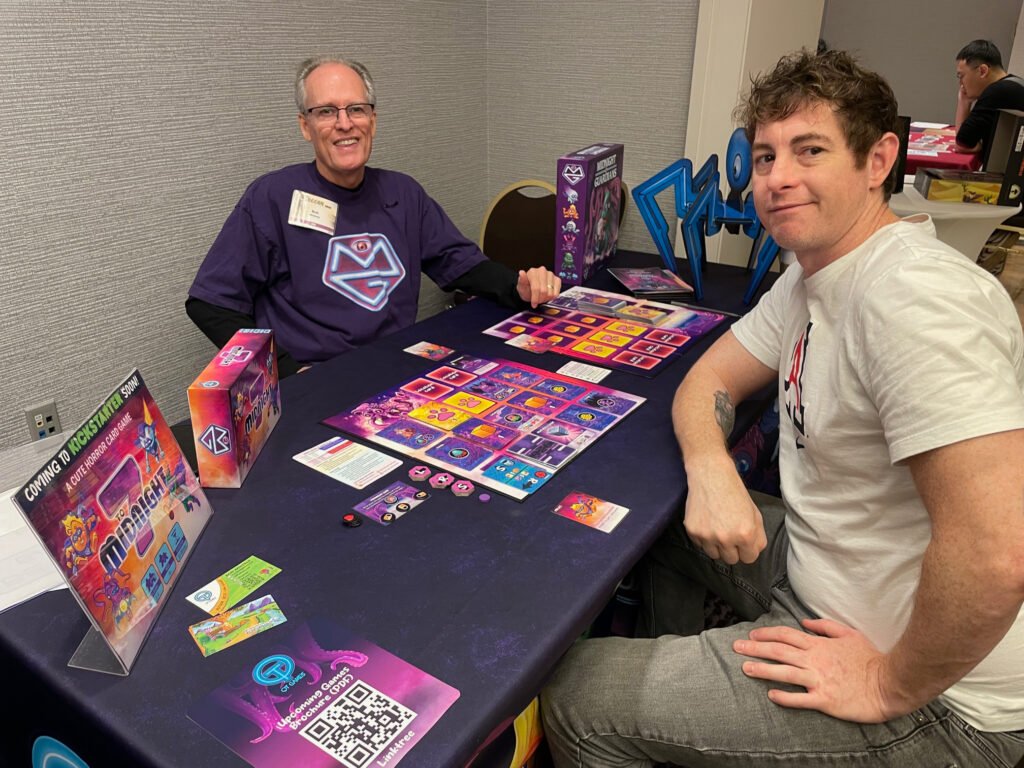
“Originally titled ‘No Time To Breathe’, due to literally having only 7 minutes to rescue all of the critters trapped in a maze, I changed the name to 7 To Midnight.”
“7 To Midnight is where the heroes prove they’re heroes by saving little critters out in the middle of nowhere. They could have walked away, let Zumoffa eat them, and then escape through the Midnight Gate, but they made a choice.”
Alongside the world behind the game, 7 To Midnight also scored a few early wins for me.
A comic book that sets up the world? Yes, please.
A printable playing mat? Lovely.
A badass villain with too many titles? Absolutely. I’m a fan of Sauron, so the more titles, the better. Haha.
And then there is one more little surprise included in the game, but I’ll get to that later. For a start, consider me super-enticed.
A bit on the game
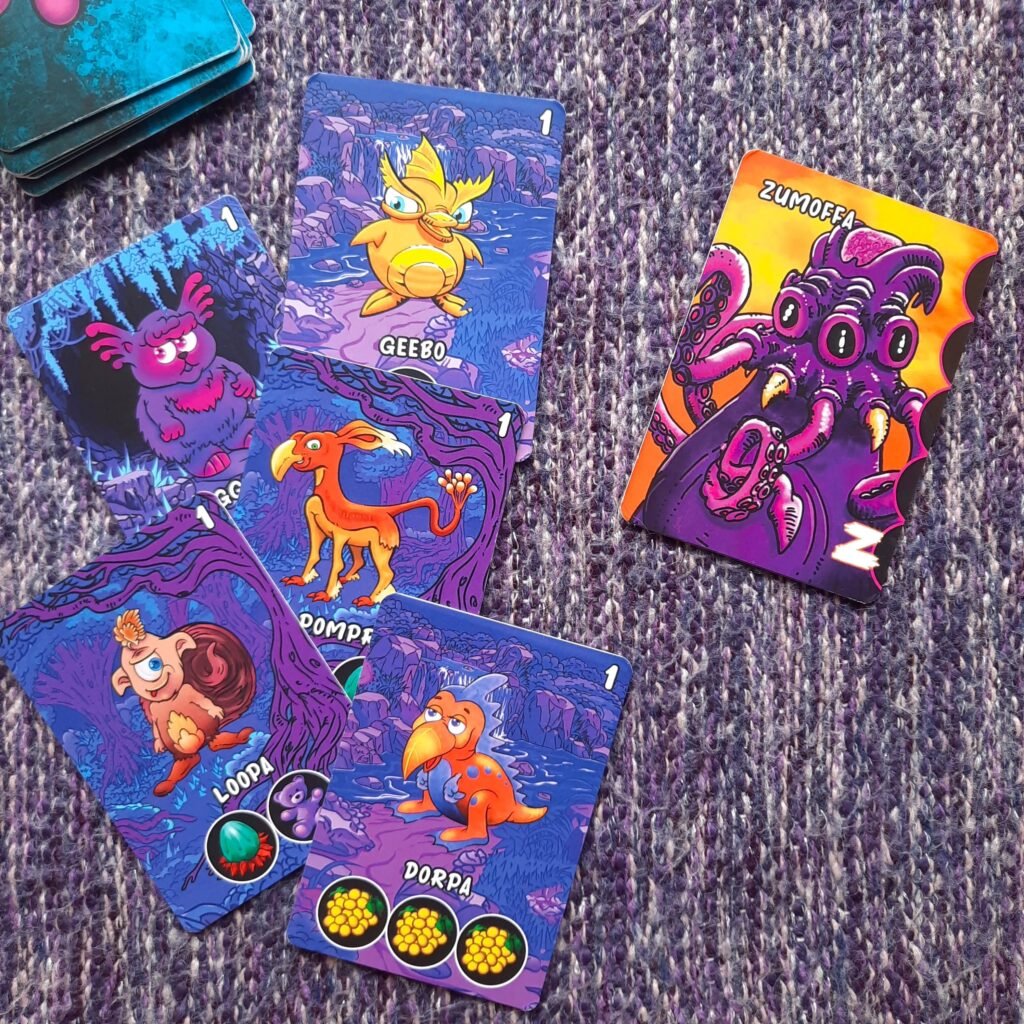
In 7 To Midnight, you take on the role of the Midnight Guardians, a team of superheroes who have found themselves far from home, deep inside Shady Valley.
The mission? Rescue the critters trapped inside the maze before Zumoffa, the Lord of Night, gets to them first.
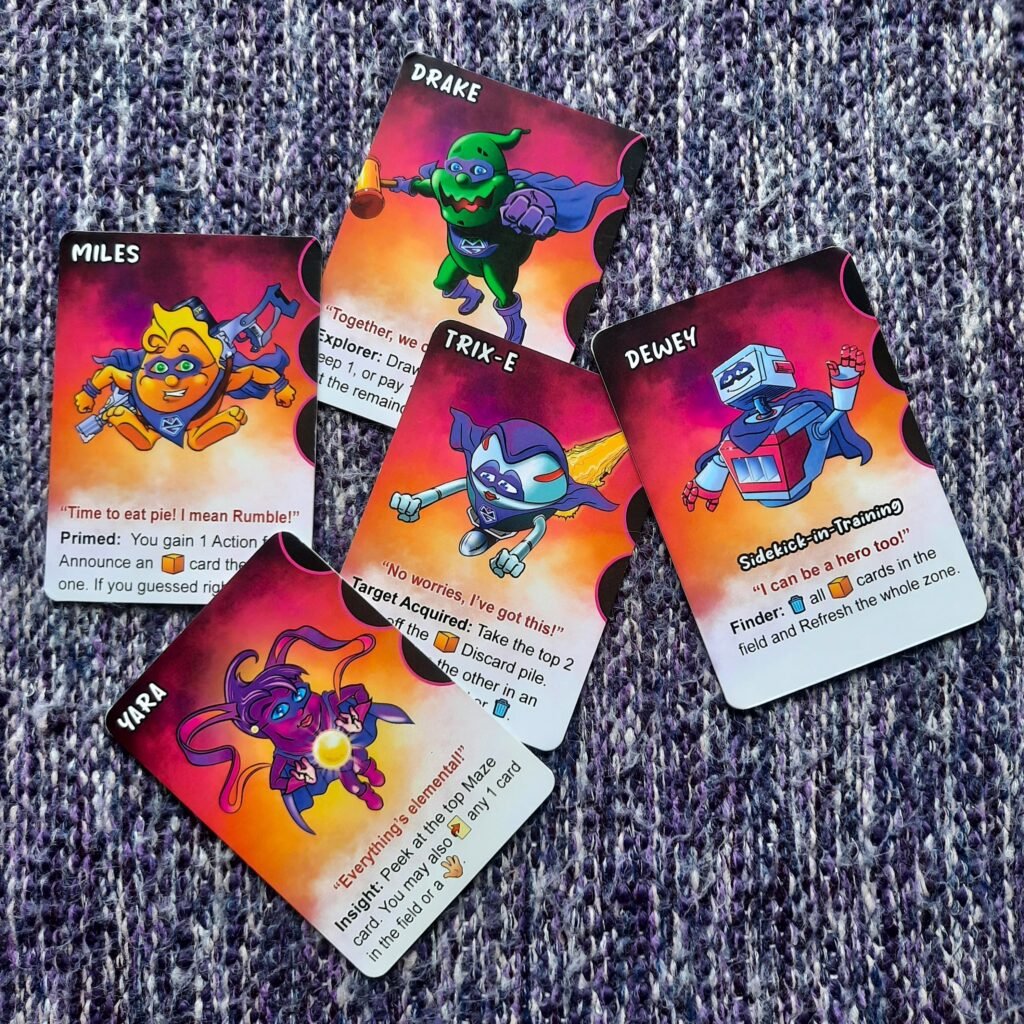
You begin by choosing your Guardians, each coming with their own special talent. Then you enter the maze, where your main job is to reach the critters, find the items they need, and help them fall asleep. Because remember, Zumoffa cannot eat them while they are asleep. So yes, bedtime is basically the difference between survival and becoming dinner. Lovely little horror logic, this one.
The items you find in the maze include the things the critters specifically need, along with special or technomagical items that can help you on your quest. Some of them can even compromise the mission!
The game mainly moves between two phases: the Rescue Phase and the Maze Phase.
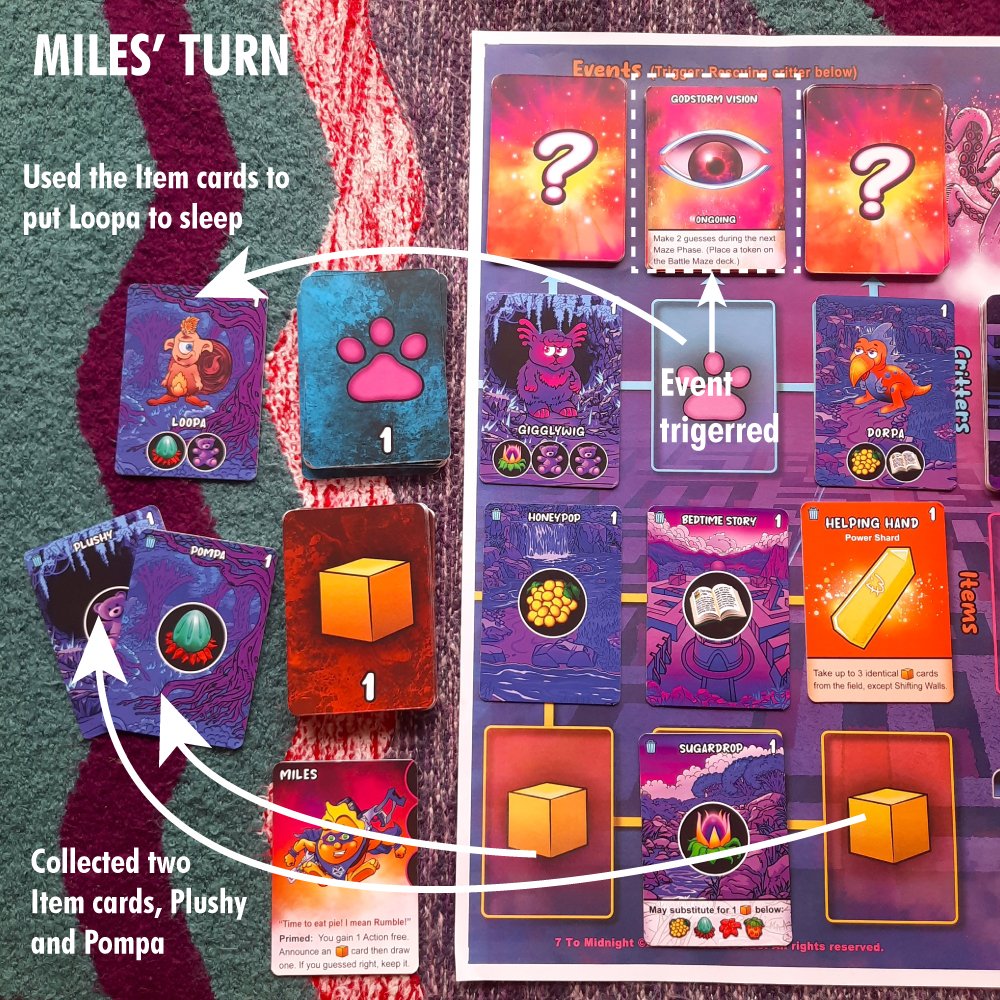
In the Rescue Phase, you collect items and rescue critters. Whenever you rescue a critter, you trigger the Event card right above it, which may either help you or add another little wrinkle to the mission.
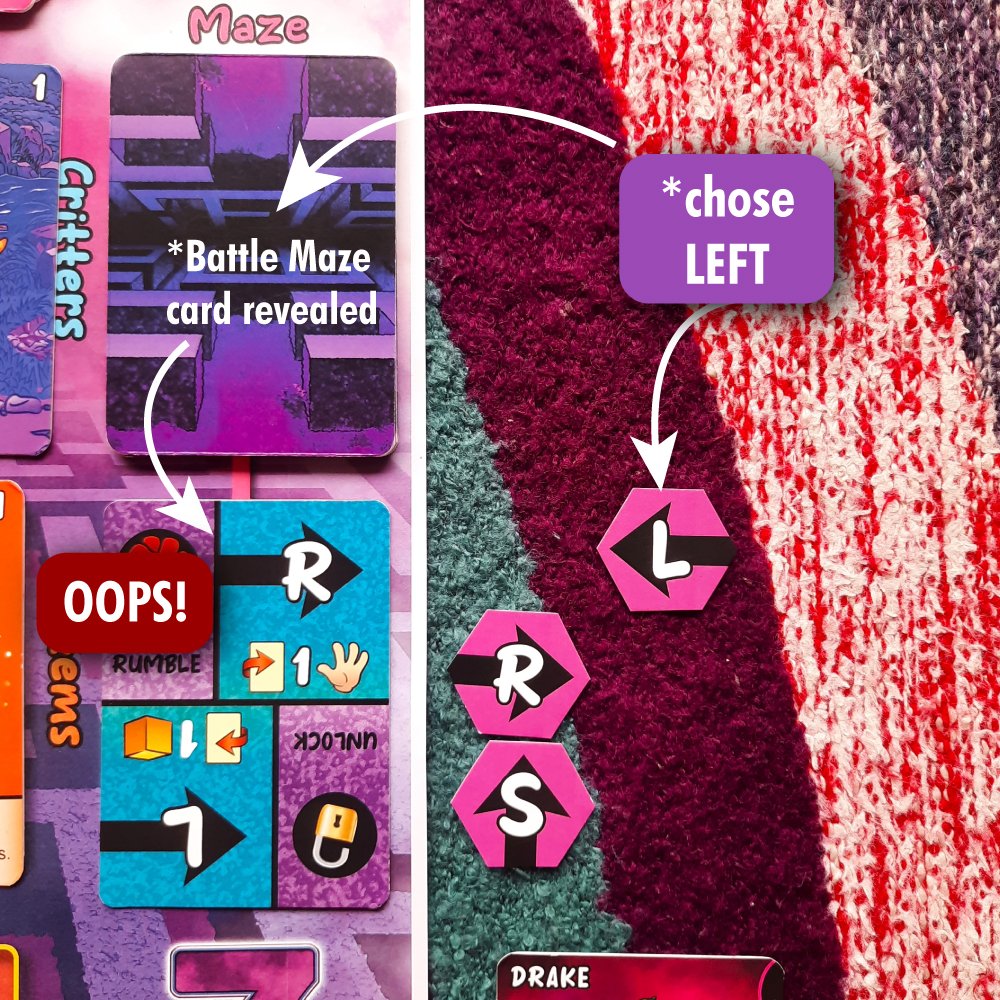
Then comes the Maze Phase, where you have to choose your direction inside the maze: left, right, or straight. Pick the correct direction, and you may get to control whether an Event card stays or goes. Pick wrong, and things can get rougher, with cards flipping facedown or an Event card being discarded from the field.
All of this plays out against a ticking clock. You only have 7 rounds, or 7 minutes in the game’s story, before midnight arrives and Zumoffa is ready for dinner.
And if the rescue mission successfully reaches its end, let’s just say the night may still have one final confrontation waiting near the Midnight Gate…!
All you need
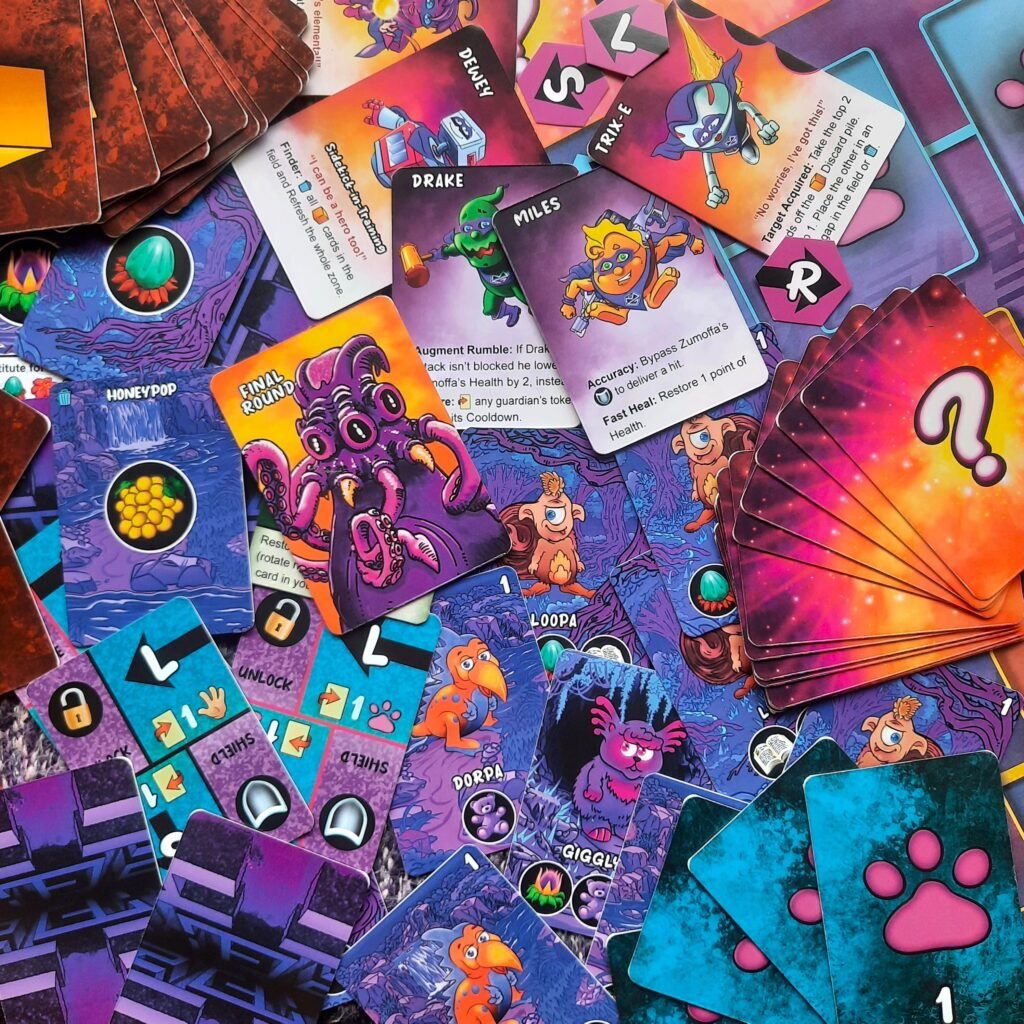
7 To Midnight is a card game, so if you print everything included for the full package, you’re looking at 108 cards in total.
That includes the Guardian cards, Critter decks, Item decks, Event cards, Battle Maze cards, Player Aid cards, the Story card, Zumoffa card, and a few others. How many cards you actually need will depend on the player count and the mode you’re planning to play. The game offers quite a few ways to jump in, from solo and co-op to competitive play, so the number of pages you print can vary. Since I wanted to try it solo and in 2-player co-op, I printed about 25 pages of cards.
Alongside the cards, you’ll also need to print a handful of tokens: Battle Maze tokens, Health tokens, Lock tokens, Tracking tokens, and an Active Player token. Keep 3 extra tokens nearby, just to help track things a bit more smoothly as the game moves along.
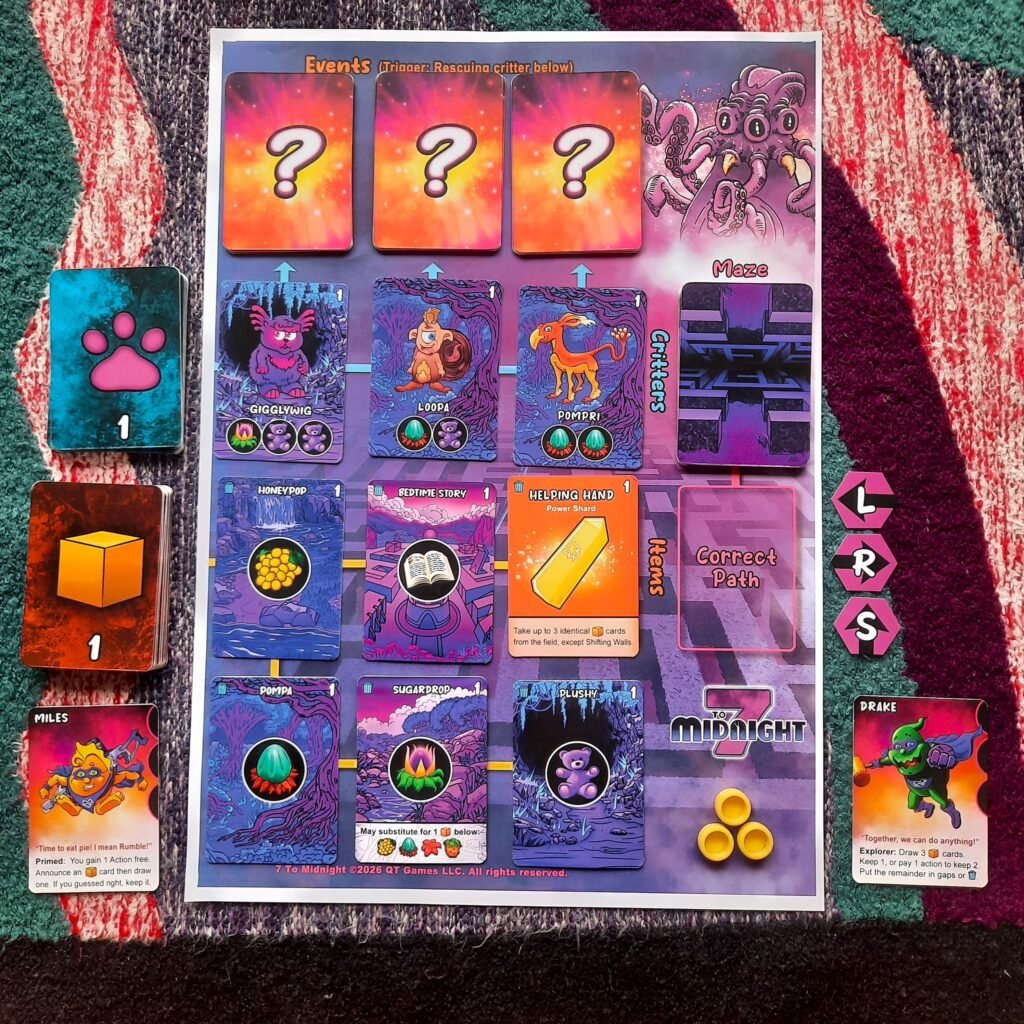
The game also comes with an A3 printable playing mat, and while you can technically play without it, I would definitely recommend printing it. The table layout has different zones for Events, Critters, Items, and the Battle Maze cards, so having the mat in front of you makes the whole thing feel much easier to manage.
So yes, there are quite a few cards to print, but the overall build is still very straightforward. Print the cards, cut and prep them, cut the tokens, place everything into their zones on the mat, and you’re ready to send the Guardians into the maze!
Entry: after playing the game
Findings
More than a rescue run
On paper, the objective of 7 To Midnight is very clear: rescue the critters before Zumoffa gets to them.
And the way you do that is also easy to understand. Find what a critter needs, collect those items, rescue the critter, and send the little one off to sleep. Clean, simple, lovely.
But the game has much more going on underneath that headline…
There are quite a few moving pieces orbiting around that rescue mission, and they all keep giving you small decisions to chew on. Which critter do you go for first? Which items do you grab? How do you make the most of the actions you have in a round? Above all, when do you use your Guardian’s special talent?
The Guardians are not just different faces on cards. Each one comes with a talent that can help you bend the situation in your favor, but since you can only use them once, timing is everything. Unless, of course, you stumble upon an Item card that lets you use that talent again. Wink, wink.
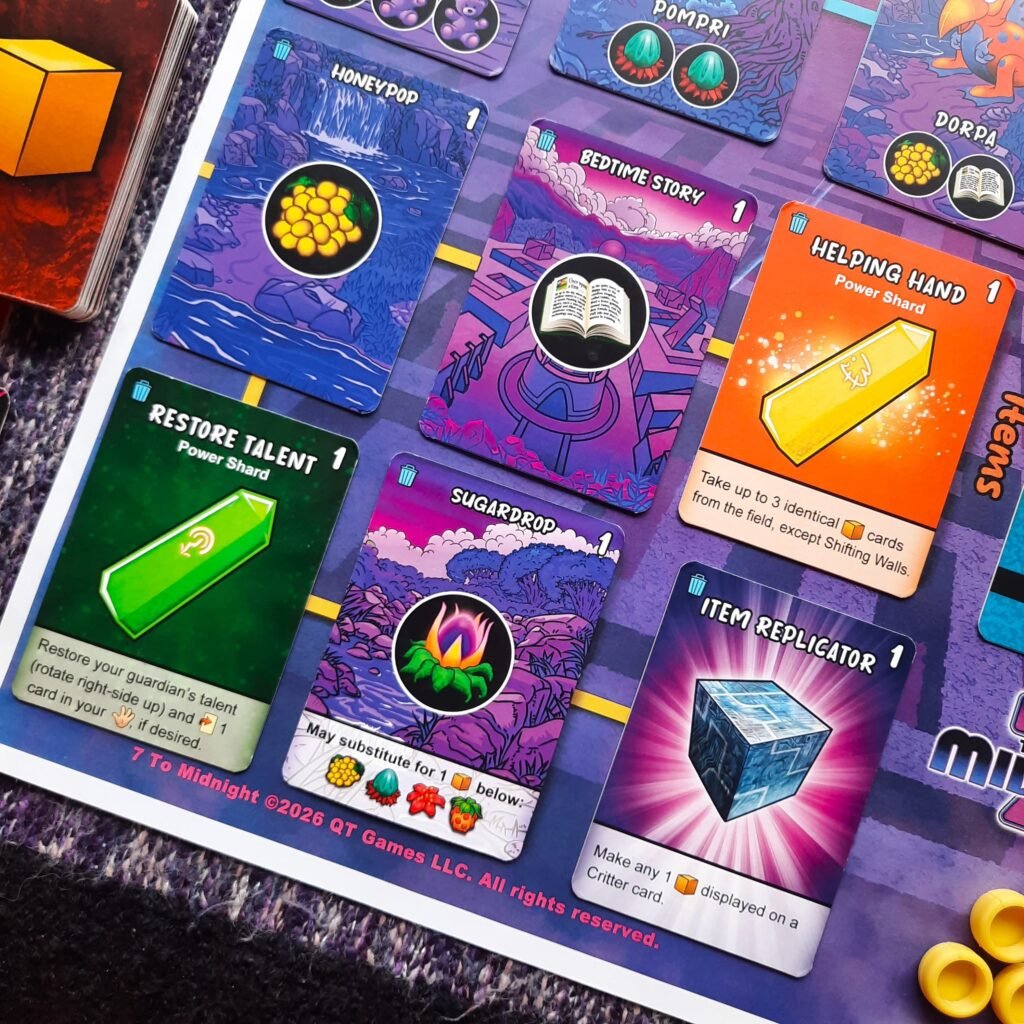
That is where the Item deck starts getting fun. It does not only consist of the things critters need to fall asleep. You also get cards like:
– Item Replicator, which can act as any one item shown on a Critter card
– Helping Hand, which lets you take up to 3 identical Item cards from the field, and
– Restore Talent, which does exactly what the name suggests. But then you also have stuff like Shifting Walls, which can sit there and make the mission messier until you deal with it.
Then the Maze Phase adds another layer on top. Make the right call and you are through. Make the wrong call and you might lose momentum exactly when you need it most.
The Events you trigger while rescuing critters can be game-changers too.
– Magic Pool can help you draw more cards.
– Friendly Topiary gives you a free Item card.
– Godstorm Vision lets you make 2 guesses in the next Maze Phase.
But then you also have little troublemakers like Hugger, who stops you from performing Rescue Actions until you get rid of it.
So while the core idea is simple, the path toward winning never feels flat. The critters, the Items, the Events, the Guardians, and the Battle Maze cards all keep tugging at the rescue mission from different sides.
The oscillation of phases
One thing I really enjoyed in 7 To Midnight was how nicely the game moved back and forth between its two phases.
The Rescue Phase felt like the part where I had some control. In 2-player Lightning mode, I got my 3 actions, looked at the field, and tried to make the most of what was in front of me. I was grabbing the right items, rescuing critters, putting them to sleep, and sometimes picking up cards that did not help immediately, but could become useful a little later. That part almost felt like scavenging inside the maze. Every action mattered, because spending one action here meant not spending it somewhere else. So there’s some Opportunity Cost at play!
But then came the Maze Phase, and the mood shifted.
Here, the game pulled me away from planning and threw me into uncertainty. Left, right, or straight. A 1-in-3 call. And while that sounded simple, it carried weight because the wrong call was not just a tiny “oops” moment. If this phase did not go right, then the next Rescue Phase became harder to work with.
So it never felt like two separate chunks of gameplay sitting beside each other. Even some cards connected the two phases, like the Event card Godstorm Vision giving you an extra shot at guessing the right direction in the next Maze Phase. So your odds of getting the right direction become a 2-in-3 call.
So many ways through the maze
For a card game about rescuing critters from a maze, 7 To Midnight gives you a surprising number of ways to play.
At the base level, you have Lightning Mode and Standard Mode. Lightning keeps things quicker and tighter, while Standard opens the game up with more critters, more Events, and more Items. Standard is ideal for 4 players, but it still works with any player count, so the game gives you a nice bit of control over how big or compact you want the rescue mission to feel.
Then comes the player side of things. You can play solo, where you control 2 Guardians yourself. You can play cooperatively, where everyone works together to get the critters to safety. And if you want the mission to have a little more rivalry in it, the game also comes with competitive ways to play.
I enjoyed the solo mode because it let me sit with the puzzle properly, controlling both Guardians and trying to make their talents, actions, and item cards work together. But the 2-player co-op mode had its own charm. My wife and I were constantly trying to make the best use of what we had, not just collecting item cards, but also sharing the right cards with each other at the right time, all while trying to rescue as many critters as possible before the Maze Phase came along and tried to mess things up.
I haven’t played many print-and-plays that offer this many ways to approach the same core game, and as a game designer, I really respect that.
The final battle!
And here comes the little surprise I was holding back.
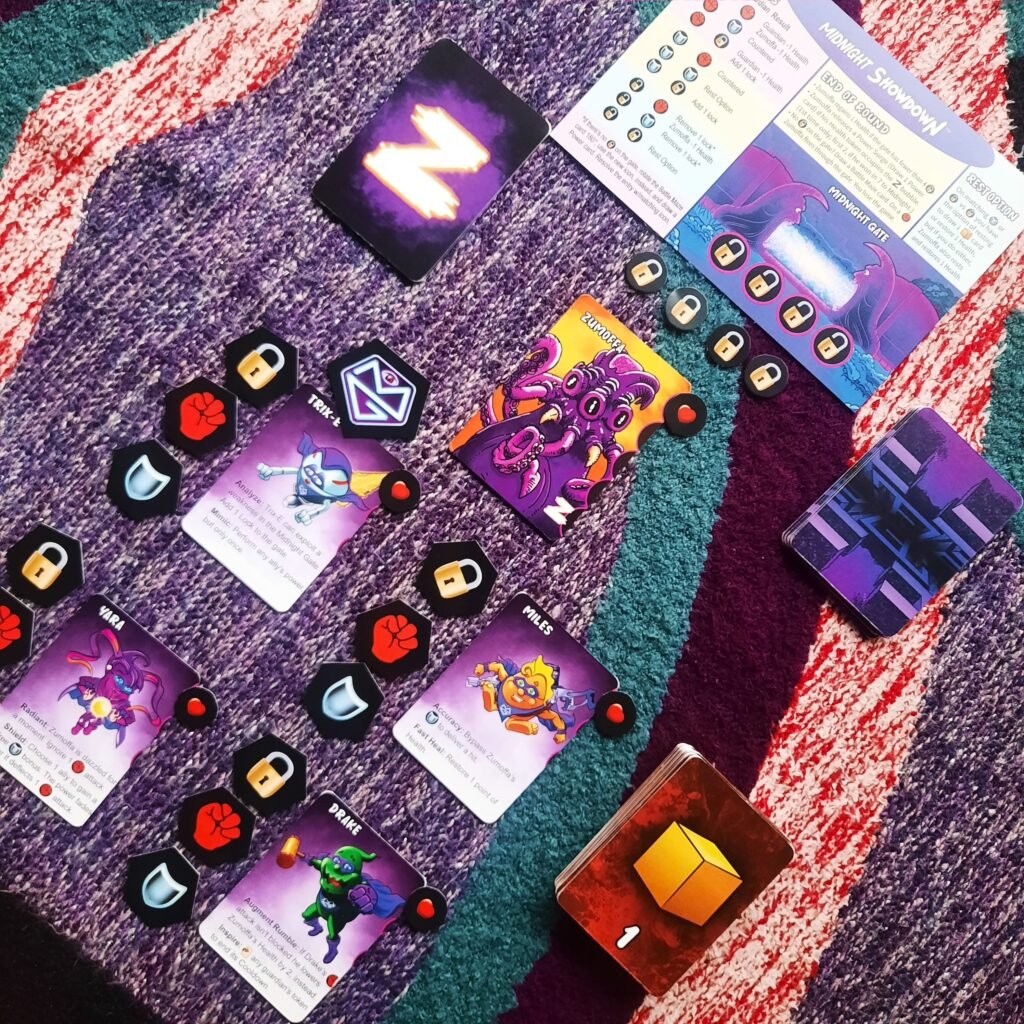
7 To Midnight does not only give you the rescue mission. It also comes with Midnight Showdown, a second game that acts as the final battle against Zumoffa.
I’m a sucker for “game-in-a-game” ideas, especially when they do not feel forced. And here, it makes complete sense. You spend 7 To Midnight trying to save the critters before Zumoffa gets to them, and then Midnight Showdown picks up from there by letting the Guardians actually challenge the Lord of Night.
The goal is simple: defeat Zumoffa and seal the Midnight Gate.
Mechanically, it’s different from 7 To Midnight. Instead of collecting items and putting critters to sleep, the Guardians are now choosing actions like Lock, Rumble, or Shield. Lock helps seal the gate. Rumble lets you attack Zumoffa. Shield helps you block attacks. Zumoffa responds to those actions too, so the battle becomes this quick back-and-forth where you are trying to hurt him, protect yourself, and stop the gate from becoming his easy way out.
The Battle Maze cards also return, but in a different role. This time, they help determine Zumoffa’s actions during the fight, which is such a neat way to make the second game feel connected to the first without simply repeating it.
The cool part is that Midnight Showdown is not mandatory. You can play it as a standalone game, or you can play it right after 7 To Midnight as the epilogue. If you do that, leftover Item cards from the rescue mission can even carry over and help you in the fight.
So yes, you are basically getting two games in the package. What a cool touch!
In the coming days, I’ll be sharing my gameplay experience with the Midnight Showdown Battle Game in one of my newsletter issues through a Visual Playthrough.
It’s a special format where I show how a game unfolds round by round. So to see how the final battle against Zumoffa plays out, and whether I can seal the Midnight Gate for good, make sure to subscribe!
A project with heart all over it
One of the best parts of playing new games is getting to know more game designers and the stories behind why they make what they make.
And 7 To Midnight gave me plenty of reasons to look beyond the game itself.
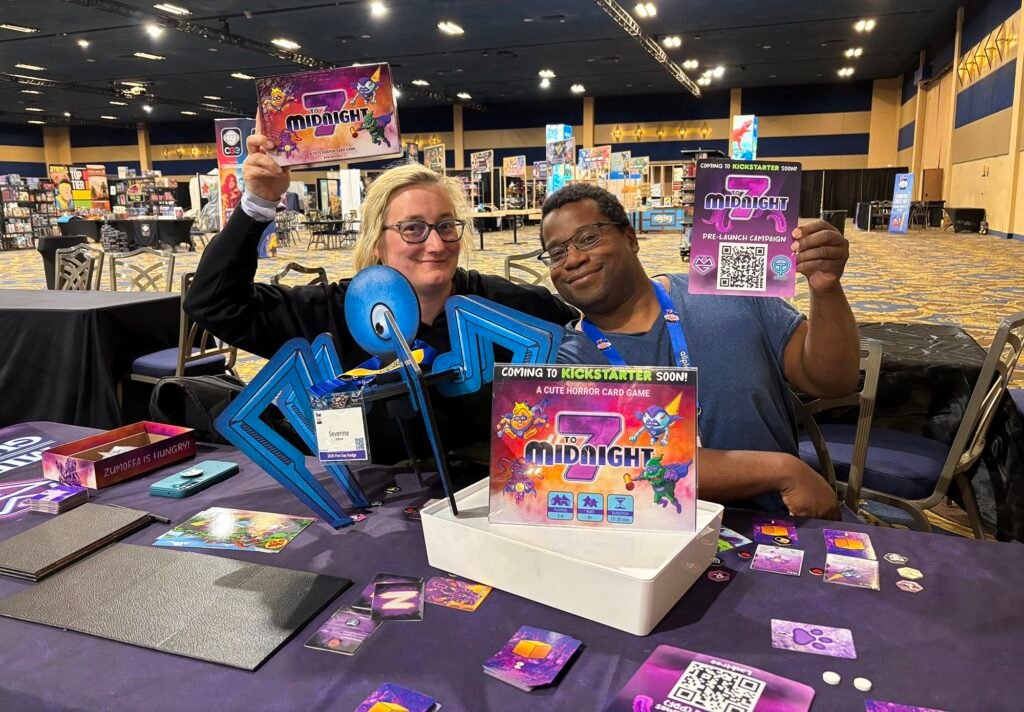
The more I played the game, read through the lore, and talked to Bob Whitely, the clearer it became that this is not just a quick little project he put together. He has poured so much of himself into it.
The unique artwork, the Toonaria universe, the backstory behind Zumoffa and the Midnight Guardians, the different game modes, the included Midnight Showdown game, and even the larger series this is building toward, all of it feels deeply considered.
You can feel the experience behind it too. Bob has been designing games for over four decades, and that shows in the way 7 To Midnight feels playful, flexible, and full of small, thoughtful touches.
But more than anything, it shows heart.
Even a couple of days back, he was telling me how he was working on making the gameplay experience better by changing the number of actions in the Rescue Phase. Even with the campaign already live and running, he is still looking for ways to make the game better.
The more I talk to Bob, the more my respect for him grows. Not just as a designer, but as someone who is clearly thorough and considerate about what he creates.
As a game designer myself, seeing someone pour this much care into a world, a game, and the people who will eventually play it is genuinely inspiring.
Before Zumoffa escapes…!
The critters are in danger, midnight is closing in, and Zumoffa is getting ready for dinner.
So, are you ready to put on your big hero shoes, step into the maze, and save the day? Better yet, are you ready to take on the bad guy himself and seal the Midnight Gate for good?
You’ve still got time to join the mission!
Recommended items
Game Overview
Designer: Bob Whitely
Artist: Bob Whitely
Number of players: 1-4
Difficulty level: Medium
Rounds of gameplay needed to learn: At least 2 rounds
Game duration: approx. 20 minutes
Available on: Kickstarter
Theme: Cute horror card game
Number of pages and color: 25 A4 pages for solo/2-player mode (color print), and an A3 printable playing mat (optional)
Assembling difficulty level: Relatively easy. Print and cut out cards.
Lamination: Not needed
Additional elements required: 3 tokens
Time to learn: Within 30 minutes
Travel-friendly: 9.5/10
Shelving friendly: 9/10
Rating from PnP Time: 9/10
Tas is a game designer and blogger based in Bangladesh, with the dream of exploring the world of games and introducing it to anyone new to it.